

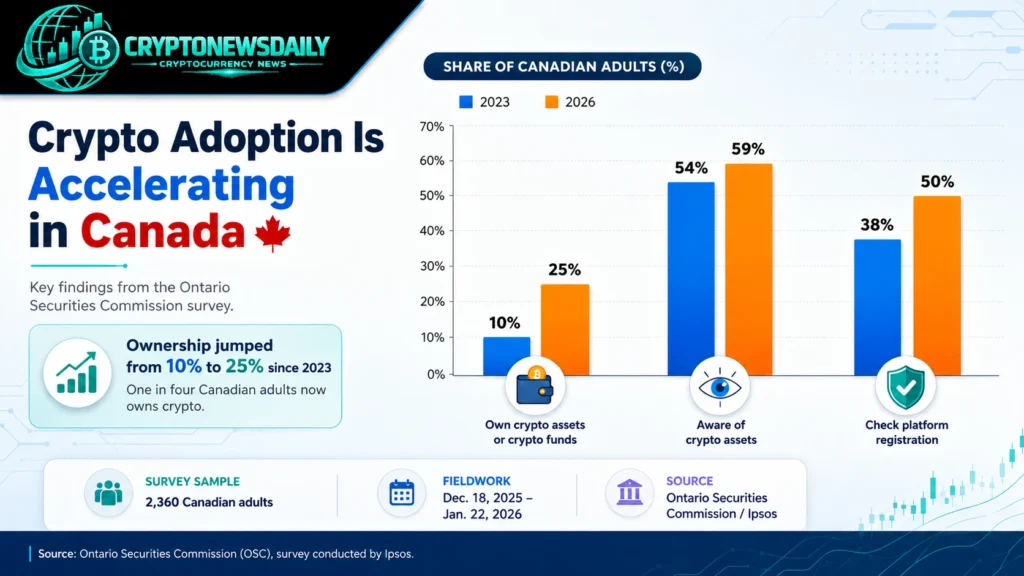
Three years ago, 10% of Canadians owned cryptocurrency. Today that number is 25%. That’s not a gradual climb — it’s a doubling and then some, in roughly the same time it takes most people to finish a car loan.
New data from the Ontario Securities Commission (OSC), released Tuesday and based on a survey of 2,360 Canadian adults conducted between December 2025 and January 2026, puts some hard numbers on what’s been a fairly obvious cultural shift. Crypto is no longer a niche hobby for tech enthusiasts and finance bros. It’s mainstream. And the OSC, to its credit, isn’t just celebrating the growth. It’s flagging the gaps that come with it.
What the Survey Actually Found
Start with the headline: 25% of Canadian adults said they own crypto assets or crypto funds. That’s up from 10% in 2023 and 13% in 2022. Awareness has moved too, with 59% of respondents saying they know what crypto assets are, up from 54% in 2023 and 51% in 2022. Both curves are pointing up, and they’ve been doing that for three consecutive survey cycles now.
Worth noting: Ipsos ran this survey for the OSC, polling adults online between December 18, 2025 and January 22, 2026. Crypto owners were oversampled to give the regulator a large enough group to study in detail, then results were weighted to reflect the broader Canadian population. That’s a methodologically sound approach, and the credibility interval for the full sample sits at roughly 2.5 percentage points.
So when the OSC says one in four Canadians owns crypto, that’s not a back-of-the-envelope estimate. It’s a statistically grounded finding from Canada’s primary securities regulator. The OSC’s full release is publicly available if you want to read the methodology in detail.
Key Numbers from the OSC Survey
25% of Canadian adults own crypto assets or crypto funds (up from 10% in 2023)
59% of Canadian adults are aware of crypto assets (up from 54% in 2023)
50% of crypto owners check whether a platform is registered before using it (up from 38% in 2023)
Survey: 2,360 Canadian adults, Dec 18, 2025 to Jan 22, 2026, conducted by Ipsos
The Part That Concerns Regulators
Ownership tripling in three years sounds like a success story. And it is, partly. But the OSC is careful to note that knowing someone owns crypto tells you very little about whether they understand what they own, how it’s protected, or what happens if something goes wrong.
Half of Owners Don’t Verify Registration
About 50% of crypto owners said they check whether a platform is registered before opening an account or making a transaction. That’s actually an improvement from 38% in 2023. Still, it means roughly half of Canadian crypto holders are depositing money onto platforms without confirming they’re dealing with a FINTRAC-registered Money Services Business. That’s not a trivial gap. Unregistered platforms have no legal accountability to Canadian authorities, no requirement to maintain records, and no obligation to cooperate with regulators or law enforcement if something goes wrong.
FINTRAC’s public MSB registry exists specifically so Canadians can verify this in under two minutes. The fact that half of owners still aren’t doing it suggests the awareness campaign around registration hasn’t landed as well as regulators might hope. For a refresher on why this matters, our guide on Best Crypto Exchanges in Canada 2026 walks through how to verify registration and what to look for before depositing.
Misunderstandings About Insurance and Recovery
Crypto holdings on Canadian platforms are not insured the way bank deposits are. Full stop. Canada Deposit Insurance Corporation (CDIC) protection covers eligible deposits at member institutions, and no crypto exchange is a CDIC member. If a platform fails, freezes withdrawals, or gets hacked, your crypto is not insured. You have a claim against the insolvent estate, same as any other creditor, and that claim might recover cents on the dollar or nothing at all.
The OSC’s survey found that many Canadian crypto owners don’t understand this. A meaningful portion of respondents held misconceptions about whether their assets are insured and whether transactions can be reversed or recovered. They can’t be, in almost every scenario. Once crypto leaves your wallet, it’s gone unless the recipient sends it back voluntarily. Blockchain transactions don’t have a “dispute” button.
These aren’t obscure technicalities. They’re the most basic risk facts about owning crypto, and a significant share of the people who own it apparently don’t know them. If you’re new to the space, our Complete Beginner’s Guide to Crypto in Canada covers these fundamentals in plain language.
Stablecoins and Tokenised Assets: High Interest, Low Knowledge
Two emerging asset classes stood out in this year’s survey. Stablecoins are still unfamiliar to most people, and ownership remains low, yet those who do understand them show surprisingly strong interest. Meanwhile, tokenised real‑world assets—everything from government bonds to money market funds issued on blockchain rails—are even less known, with only 24% awareness among respondents. But here’s the striking part: 74% of those who knew about them said they’d consider investing if their bank or investment firm offered the option.
That last number is worth sitting with. It suggests the tokenised asset market has a potential adoption path that looks a lot like how mutual funds went mainstream — not through crypto-native channels, but through familiar institutional relationships. People don’t necessarily need to understand the blockchain plumbing if they trust the bank offering the product.
Ottawa’s Response: Cautious and Selective
Growing adoption hasn’t prompted Ottawa to throw open the doors. If anything, the federal government has been moving to restrict specific crypto use cases at the same time ownership is expanding.
In April, the federal government introduced a bill to ban political donations made via cryptocurrency to boost transparency and prevent fraud. Officials argue that digital assets make tracking money far harder than traditional bank transfers, raising serious concerns about election integrity. Additionally, Ottawa is considering a ban on crypto ATMs (BTMs), pointing to their frequent use in scams—particularly those targeting seniors who are tricked into depositing cash by fraudsters impersonating government officials.
Both proposals reflect the same underlying tension that the OSC’s data makes visible. Crypto is becoming a normal part of Canadian financial life. But some of the rails that exist around it remain genuinely vulnerable to misuse, and the government is trying to close specific channels that have proved most problematic without restricting the broader market.
Whether that targeted approach works is an open question. Bitcoin ATMs are regulated federally as MSBs, meaning operators are supposed to be registered with FINTRAC. A full ban would remove a legitimate access point for Canadians who prefer cash-to-crypto transactions, not just the fraud vectors. The policy tradeoff isn’t entirely clean. For context on the broader Canadian regulatory picture, the Government of Canada’s official crypto guidance page outlines the current legal framework for Canadian residents.
Proposed Federal Crypto Restrictions (April 2026)
Ban on cryptocurrency political donations: cited transparency and fraud prevention concerns.
Proposed ban on digital asset ATMs (Bitcoin ATMs): cited use in fraud schemes targeting vulnerable Canadians.
Both measures are proposals, not yet law. Neither affects regulated exchange use or general crypto ownership.
Coinbase Is Watching This Closely
It’s not just regulators paying attention to Canada’s rising adoption numbers. Coinbase, which already operates in Canada as a FINTRAC-registered MSB, has been preparing to expand what it’s calling its “Everything Exchange” strategy into the Canadian market. The plan involves moving beyond straightforward crypto trading to combine tokenised stocks, traditional financial products, and blockchain-based services in a single app for Canadian users.
That’s a significant ambition, and the OSC’s data gives it a clearer commercial rationale. One in four Canadian adults already owns crypto. Six in ten know what it is. If Coinbase can successfully bridge crypto-native assets with products Canadians already use through familiar interfaces, the potential market is genuinely large.
How Canadian regulators respond to that expansion will be interesting to watch. Coinbase offering tokenised equities alongside Bitcoin in the same app starts to look like a securities dealer function, which brings CSA and CIRO oversight into the picture alongside FINTRAC. The regulatory boundaries here aren’t fully settled, and a product that spans crypto, tokenised securities, and traditional finance is going to test them.
What This Means If You Own Crypto in Canada
A few practical things worth taking from this survey if you’re one of the 25%.
Check registration before you deposit anywhere. Go to fintrac-canafe.gc.ca and search the MSB registry. It takes two minutes and it’s the single most useful thing you can do before trusting a platform with your money. Half of current owners skip this step. Don’t be in that half.
Your crypto is not insured. Not by CDIC, not by any government scheme. If the exchange fails, you’re an unsecured creditor. If you’re holding meaningful amounts long-term, a personal hardware wallet removes the exchange failure risk entirely, at the cost of making you solely responsible for your own security. Our guide on Hot Wallets vs Cold Wallets explains the options clearly.
Transactions are not reversible. Once you send crypto somewhere, it’s gone unless the recipient returns it voluntarily. There is no dispute process. If you’re scammed, there’s no mechanism for recovery in most cases. Our full breakdown of crypto scams targeting Canadians covers every major fraud type and exactly what to watch for.
And if you’ve been holding for a while without thinking about your tax position, it’s probably time to review that. Every disposal you’ve made — selling for CAD, trading one coin for another, or spending crypto on something — was a taxable event under CRA rules. The OSC’s data on rising ownership will feed directly into the CRA’s enforcement priorities. They notice these trends too. For a full breakdown of what you owe and how to file, read our Crypto Taxes Canada 2026 guide.
The Short Version
- 25% of Canadian adults own crypto in 2026, up from 10% in 2023. That’s the OSC’s official figure based on a survey of 2,360 adults conducted by Ipsos.
- 59% are aware of crypto assets, up from 54% in 2023. Awareness and ownership are both on a three-year upward trend.
- Half of crypto owners don’t verify platform registration before depositing. Only 50% check the FINTRAC registry, up from 38% in 2023 but still a significant gap.
- Many owners misunderstand insurance and transaction recovery. Crypto is not CDIC-insured, and blockchain transactions are not reversible.
- Ottawa is moving selectively, proposing bans on crypto political donations and Bitcoin ATMs while leaving regulated exchange use and general ownership untouched.
- Coinbase is planning a broader Canadian rollout combining crypto trading with tokenised stocks and traditional financial products. The 25% ownership figure is part of why.