

Crypto Markets in Canada: What Moves Prices and How to Read Them
Crypto trades around the clock, in U.S. dollars, on hundreds of venues at once, and it reacts to everything from a Fed press conference to a single wallet moving coins. For a Canadian investor there are two more layers on top: the loonie, and a set of TSX-listed ETFs that only trade during market hours. This hub explains how the market fits together and links to our latest market coverage.
Latest market coverage
Markets
View all
Canada US Tariff Mining 2026: Why Canadian Miners Are Winning
Canada US tariff mining 2026 became a real story on August 25. Finance Minister François-Philippe Champagne announced that Canada would match the…
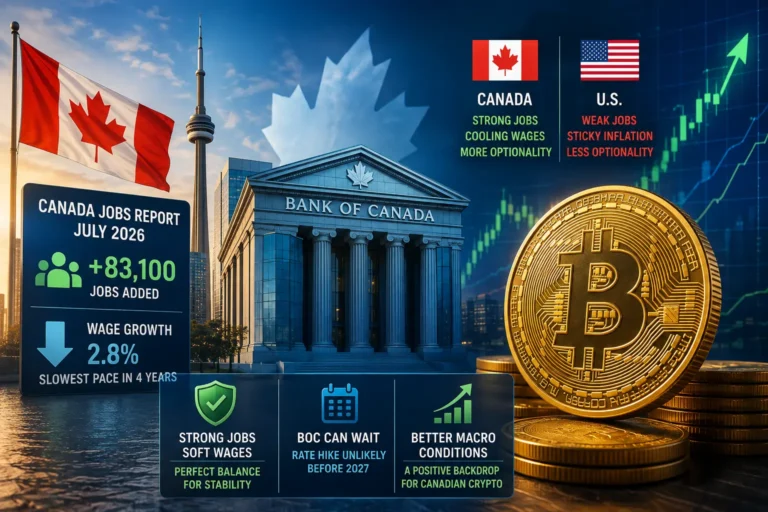
Canada Added 75,000 Jobs While the U.S. Lost 23,000. Here’s What That Means for Crypto.
Why the Numbers Matter Beyond the Headlines The raw jobs figures are striking, but the detail that matters most for monetary policy…
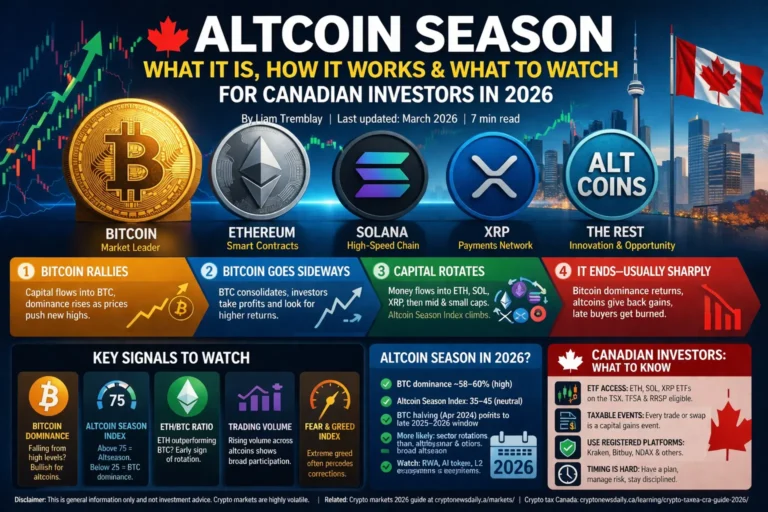
What Is Altcoin Season? A Canadian Investor’s Guide
Every so often in the crypto market, something shifts. Bitcoin has already run hard, and investors start moving capital into Ethereum, Solana,…
Live prices
| Name | Price | 24H (%) |
|---|---|---|
 Bitcoin(BTC) | C$117,676.42 | 0.21% |
 Ethereum(ETH) | C$3,549.49 | -0.08% |
 Tether(USDT) | C$1.43 | 0.00% |
 BNB(BNB) | C$1,061.32 | 0.54% |
 XRP(XRP) | C$2.00 | 0.54% |
 USDC(USDC) | C$1.43 | 0.01% |
 Solana(SOL) | C$156.35 | -0.46% |
 TRON(TRX) | C$0.471720 | -0.40% |
 Figure Heloc(FIGR_HELOC) | C$1.43 | -2.80% |
 Zcash(ZEC) | C$1,729.47 | -0.36% |
What actually moves crypto prices
ETF flows
Since U.S. spot Bitcoin ETFs launched in January 2024, daily fund flows have become one of the clearest signals of institutional demand. Big outflow days tend to line up with weak price action, as in our report on BlackRock’s IBIT outflows.
Interest rates and the U.S. dollar
Crypto now trades much like other risk assets. Expectations of rate cuts from the Federal Reserve or the Bank of Canada usually help it, and a rising U.S. dollar usually hurts. The relationship isn’t fixed, though. Our analysis of the Bitcoin and U.S. dollar correlation shows how loose it can get.
Regulation and politics
U.S. legislation moves global prices because most trading volume is tied to U.S. markets. The long fight over the CLARITY Act, the market-structure bill in the Senate, has produced several rallies and sell-offs on its own, which we followed in the CLARITY Act setback.
Leverage
Perpetual futures let traders borrow heavily. When prices drop, leveraged long positions get liquidated automatically, which pushes prices down further. Many of the sharpest single-day moves are liquidation cascades, not news events, as in the Oct. 7 sell-off.
How the market is structured
Bitcoin is the anchor. It usually makes up more than half of total crypto market value, a share known as Bitcoin dominance. Ethereum is the second-largest asset and the base layer for most DeFi. Stablecoins such as USDT and USDC are the cash of the crypto market: traders park money in them between positions, and they carry most of the trading volume. Altcoins make up the rest, from large networks like Solana and XRP down to tokens that may not survive the year.
When Bitcoin dominance falls for a sustained period, money is usually moving into altcoins, a phase traders call altcoin season. It doesn’t follow every Bitcoin rally, and it rarely lasts. Our guide to altcoin season explains the signals.
Metrics worth watching
| Metric | What it measures | How to read it |
|---|---|---|
| Market capitalization | Price × circulating supply | The real size of a coin. A $1 token can be worth more in total than a $100 one. |
| 24-hour volume | How much changed hands in a day | Thin volume means wide spreads and sharper moves. |
| Bitcoin dominance | BTC’s share of total crypto value | Rising: money concentrating in Bitcoin. Falling: rotation into altcoins. |
| Funding rate | Payments between long and short futures traders | High positive funding means crowded longs and a higher risk of liquidations. |
| Open interest | Value of outstanding futures contracts | A rapid drop during a sell-off means leverage is being flushed out. |
| Fear & Greed Index | Sentiment score from 0 to 100 | Extremes have often come near turning points, but it isn’t a timing tool. |
| ETF net flows | Money into and out of spot ETFs | Sustained inflows signal institutional demand. |
The Canadian angle
Prices in CAD
Crypto is priced in U.S. dollars, so a Canadian’s return depends on both the coin and USD/CAD. When the loonie strengthens, as it did during the oil rally in September, CAD returns lag even if Bitcoin is flat. Canadian platforms quote in CAD; global sites default to USD.
TSX crypto ETFs
Canada has spot ETFs for Bitcoin, Ether, Solana and XRP, all eligible for TFSAs and RRSPs. They trade only during TSX hours, so a weekend sell-off shows up all at once at Monday’s open. See the Bitcoin ETF guide and the XRP ETF comparison.
Domestic data
Bank of Canada decisions, jobs reports and trade policy all feed into the loonie and into risk appetite. We cover the crossover, as in our piece on the July jobs report and crypto.
Tax on trading
Every sale or swap is a taxable disposition. Investors include 50% of capital gains in income, while frequent traders can be taxed on 100% as business income. From Jan. 1, 2027, platforms report customer transactions to the CRA under the Crypto-Asset Reporting Framework. Our crypto tax guide covers the details.
Crypto markets: FAQ
Why do crypto prices differ between Canadian and global sites?
Canadian platforms quote in CAD, global sites in USD. Small gaps between platforms also come from their own order books and spreads.
What is Bitcoin dominance?
Bitcoin’s share of the total crypto market value. A falling share usually means money is rotating into altcoins.
Why does crypto drop on weekends?
It doesn’t drop more often on weekends, but liquidity is thinner, so moves can be sharper. TSX-listed ETFs catch up at Monday’s open.
Is day trading crypto taxed differently in Canada?
It can be. If the CRA considers the activity a business, all of the profit is taxable as business income instead of half as a capital gain.
General information only, not investment or tax advice. Crypto markets are volatile and losses can be large.