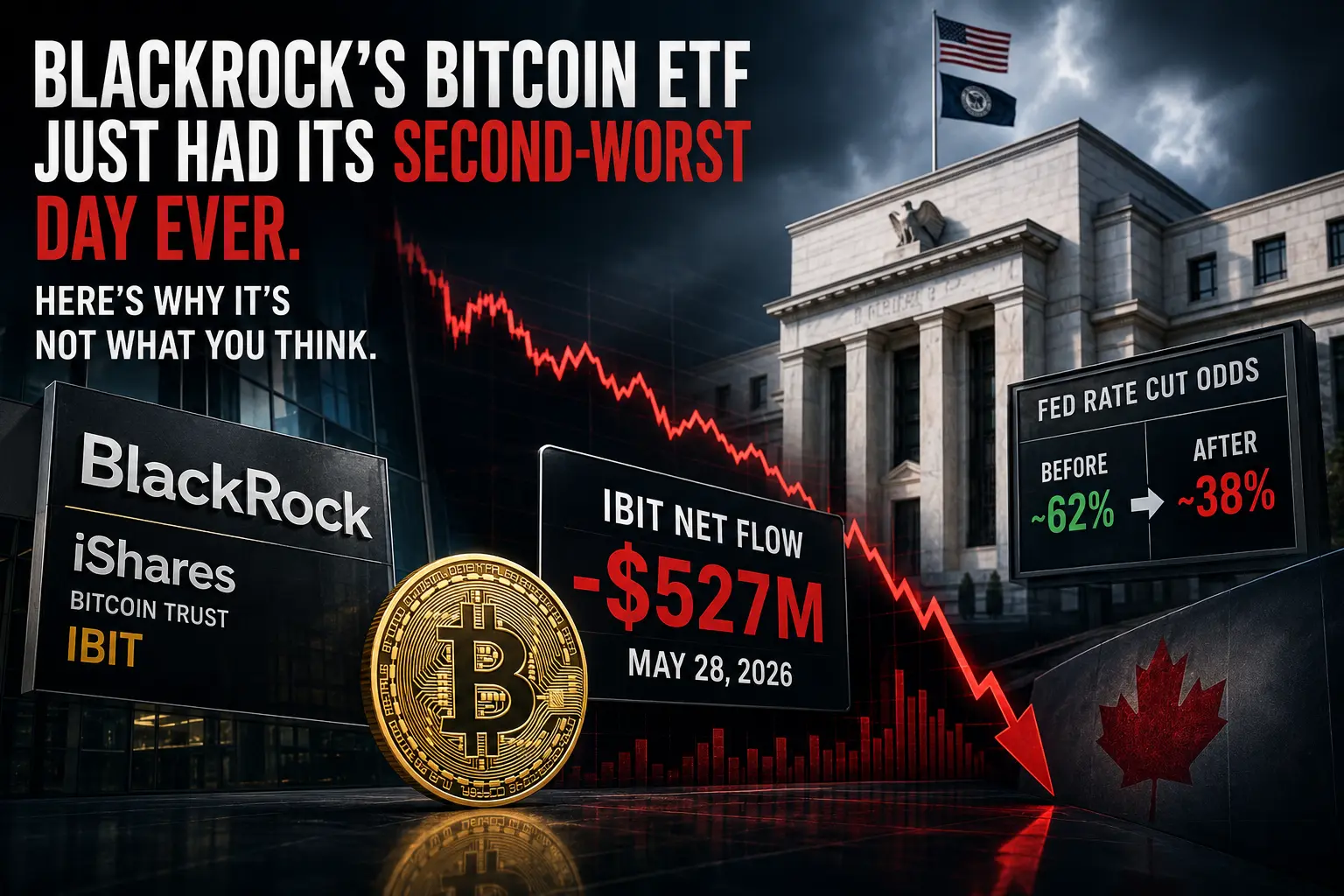
On Wednesday, BlackRock’s iShares Bitcoin Trust shed $527.84 million in a single trading session. That’s the fund’s second-largest outflow on record, just a hair below the $528.30 million it lost on January 30. For a product that spent most of its two-year existence as a relentless inflow machine, two near-record redemption days in one calendar year is a pattern worth paying attention to.
But here’s the thing. This isn’t really a Bitcoin story. It’s a rates story. And once you understand that, the whole picture looks different.
What Actually Happened
Bitcoin ETFs in the U.S. had been on a genuine run. Over March and April, spot Bitcoin funds pulled in a combined $3.29 billion, their first sustained inflow streak of 2026. IBIT specifically had gone more than 20 consecutive days with net inflows, one of the cleanest institutional demand signals of the year. Macro conditions felt supportive. Rate cut expectations were still alive. Risk assets were catching a bid.
Then Tuesday, May 12, happened. April’s CPI came in at 3.8% year-over-year, the hottest reading since May 2023. Bad, but not catastrophic. Wednesday made it worse. April PPI printed at 6% annually, the highest since December 2022, blowing past estimates that had been around 3.8%. Wholesale prices surging at that rate tells you the inflation pressure isn’t a blip, it’s structural. Energy is a big part of it, with gasoline up 15.6% in April alone, a direct consequence of the Strait of Hormuz situation.
Markets repriced fast. On the CME FedWatch tool, odds of a June rate cut had been sitting around 62% heading into Wednesday morning. By the time trading closed, they’d dropped to 38%. Rate hike odds for later in 2026 climbed to roughly 39%. Polymarket put the probability of zero rate cuts all year at 62%. Bank of America pushed its first cut call all the way to mid-to-late 2027. JPMorgan started openly discussing a possible Q3 2027 hike.
The rate-cut trade that had been supporting Bitcoin since March didn’t slowly fade. It reversed in two days.
| The Numbers at a Glance IBIT single-day outflow: -$527.84 million (May 28, 2026) IBIT’s worst day ever: -$528.30 million (January 30, 2026) Total U.S. spot Bitcoin ETF outflows, month of May: -$2.07 billion Bitcoin price range during sell-off: $67,000 to $78,000 April CPI: 3.8% YoY (highest since May 2023) April PPI: 6.0% YoY (highest since December 2022) CME rate cut odds before PPI: ~62% for June. After: ~38% |
Why IBIT Is the Exit of Choice
Something worth understanding about how institutional money moves in and out of crypto: IBIT isn’t just the biggest Bitcoin ETF, it’s the most liquid one. When a macro fund decides to exit the rate trade fast, they don’t sell Bitcoin directly. Custodying Bitcoin, dealing with wallets, settlement quirks, none of that is built for speed when you’re managing billions. IBIT shares, though, trade like any other equity. You sell, you’re done.
That convenience is a double-edged thing. It’s exactly what made IBIT the easiest institutional on-ramp when the rate-cut narrative was building. Now it’s the easiest off-ramp. A near-record redemption day reads less as panic about Bitcoin’s fundamentals and more as a clean, fast exit from a macro trade that stopped working.
Fidelity’s FBTC shed $57.74 million in the same session. Grayscale’s GBTC lost $41.21 million. The selling isn’t concentrated in one fund. It’s spread across the ETF space, which is consistent with institutional portfolio-level decisions rather than any Bitcoin-specific concern.
This Isn’t a Verdict on Bitcoin
There’s a version of this story that reads as institutions abandoning crypto. That’s not what the data shows.
BlackRock is still building deeper into blockchain-based finance. The asset manager recently filed paperwork for another tokenised investment fund using Securitize’s infrastructure, following the growth of BUIDL, its tokenised Treasury fund that’s now sitting at around $2.3 billion in assets. Fidelity, Franklin Templeton, and State Street are all increasing their tokenised product activity at the same time their Bitcoin ETFs are seeing outflows. The institutional interest in digital asset infrastructure hasn’t gone anywhere. What’s changed is the short-term rate environment, and Bitcoin happened to be sitting in the rate-sensitive bucket when that changed.
There’s a framing issue here that comes up every time Bitcoin sells off alongside rate expectations. For years, Bitcoin’s proponents have argued it’s an inflation hedge, digital gold, a store of value that performs when fiat purchasing power erodes. If that were true, surging inflation should be bullish for Bitcoin, not bearish. Instead, what you consistently see is Bitcoin behaving as a liquidity-sensitive risk asset. When cheap money is expected, it goes up. When that expectation flips, it comes back down. That’s not a damning conclusion, it just means the inflation hedge thesis hasn’t been proven in live market conditions yet.
| The Rate-Cut Trade, Explained Simply For most of early 2026, institutional investors were pricing in Fed rate cuts. Cheaper money means looser liquidity, which flows into risk assets including Bitcoin. That expectation drove the March-April inflow streak. When April PPI came in at 6%, the cuts-are-coming thesis fell apart. Institutions sitting in IBIT as part of that rate trade had no reason to stay. They sold. Fast. The plumbing that made IBIT easy to buy made it equally easy to sell. |
Where Bitcoin Goes From Here
Kevin Warsh’s first FOMC meeting as Fed Chair runs June 16-17. That’s the next real decision point. If he opens with a hawkish stance, which markets are increasingly pricing in, Bitcoin’s $75,000 support level gets tested seriously. A more measured tone could let prices stabilise and start rebuilding toward the $78,500 resistance zone.
Nationwide senior economist Ben Ayers has forecast May CPI above 4%. If that’s right, and the Strait of Hormuz situation keeps energy prices elevated, the Fed has no room to cut. Rate hike odds will probably keep climbing. That’s not a supportive backdrop for risk assets in the short term.
Longer term, the picture is more interesting. Bitcoin’s YTD return on IBIT as of late May is -11.37%, which sounds bad but is worth contextualising. Equities and bonds have both struggled in the same environment. The CLARITY Act cleared the Senate Banking Committee markup last week, with XRP up 5.2% on the news. If market structure legislation eventually passes and brings more institutional infrastructure into the space, the medium-term demand story for Bitcoin ETFs doesn’t disappear, it just needs the macro environment to cooperate again.
What This Means for Canadians
Canadian investors can’t buy IBIT directly on U.S. exchanges through standard brokerage accounts, but the flows still matter. IBIT is the price-setting vehicle for Bitcoin in institutional markets. When it bleeds at this scale, it drags the spot price, which affects every Canadian who holds Bitcoin outright, through a Canadian ETF, or on a registered exchange.
Canada has its own spot Bitcoin ETFs trading on the TSX, including the Purpose Bitcoin ETF (BTCC) and the Evolve Bitcoin ETF (EBIT), both of which are RRSP and TFSA eligible. They’ve tracked the same pattern, outflows during the May sell-off, recovery attempts tied to macro news. If you’re holding through a registered account, the tax treatment insulates you from the capital gains implications of selling and rebuying during volatility, which is worth keeping in mind when you’re watching daily flow numbers and feeling the urge to react.
From a CRA perspective, nothing has changed. If you sold Canadian Bitcoin ETF units at a loss during the sell-off, that’s a capital loss you can use. If you held and are currently underwater, you haven’t triggered anything yet. The tax clock only starts when you actually dispose of the position.
The Short Version
- IBIT posted a $527.84 million outflow on May 28 its second-worst day ever, just below the January 30 record.
- April PPI at 6% and CPI at 3.8% blew up the rate-cut trade that had been driving Bitcoin’s spring rally.
- Fed rate cut odds collapsed from 62% to 38% in a single day. Rate hike odds for 2026 climbed to roughly 39%.
- Total U.S. spot Bitcoin ETF outflows for May hit $2.07 billion. IBIT accounts for the majority.
- It’s not a conviction call against Bitcoin. Institutions are exiting a macro trade, using IBIT as the cleanest exit vehicle.
- For Canadians: BTCC and EBIT have tracked the same pattern. Tax considerations apply on any disposals. Holding through registered accounts has its own implications worth reviewing with an advisor.
- Watch June 16-17. Kevin Warsh’s first FOMC meeting sets the tone for the rest of 2026.
This article is for informational purposes only and does not constitute financial or investment advice. Bitcoin and other digital assets are high-risk investments. Always consult a qualified financial advisor before making investment decisions.