Canada US tariff mining 2026 became a real story on August 25. Finance Minister François-Philippe Champagne announced that Canada would match the United States dollar for dollar on tariffs, effective September 8. The trigger was a U.S. decision to impose 50% tariffs on $27.6 billion of Canadian goods. Canada’s retaliation covers more than 800 product lines across steel, aluminum, dairy, agricultural equipment, electronics, and plastics.
Steel duties doubled specifically, jumping from 25% to 50% to mirror the U.S. rate. Prime Minister Carney, speaking in both English and French, put it plainly: “We learned during the negotiations that the Americans want to destroy our major industries, including autos, steel and aluminum. That was one of the main reasons we said no.”
Most people reading this story see a manufacturing and auto sector fight. Anyone running Bitcoin mining infrastructure sees something else too. It’s a supply chain shock, and it hits each side of the border in a very different way.
Why Canada US Tariff Mining 2026 Begins With Steel
This connection isn’t obvious at first, so here’s the mechanism behind it. Industrial Bitcoin mining doesn’t run out of racks of laptops. It runs inside purpose-built steel containers: large, ventilated, water-cooled enclosures that house rows of ASIC miners.
Each enclosure manages heat and handles power distribution at scale. A standard mining container is essentially a steel box wired with copper and fitted with aluminum ventilation and cooling systems. These units typically weigh several tonnes and cost anywhere from $50,000 to $150,000 CAD for an industrial-grade build.
Before this latest escalation, mining containers in the U.S. had already climbed $10,000 to $25,000 per unit. That increase came from earlier rounds of Section 232 steel and aluminum duties, well before Canada doubled its own steel tariffs in late August. The ASIC miners that go inside those containers carry a separate cost layer entirely.
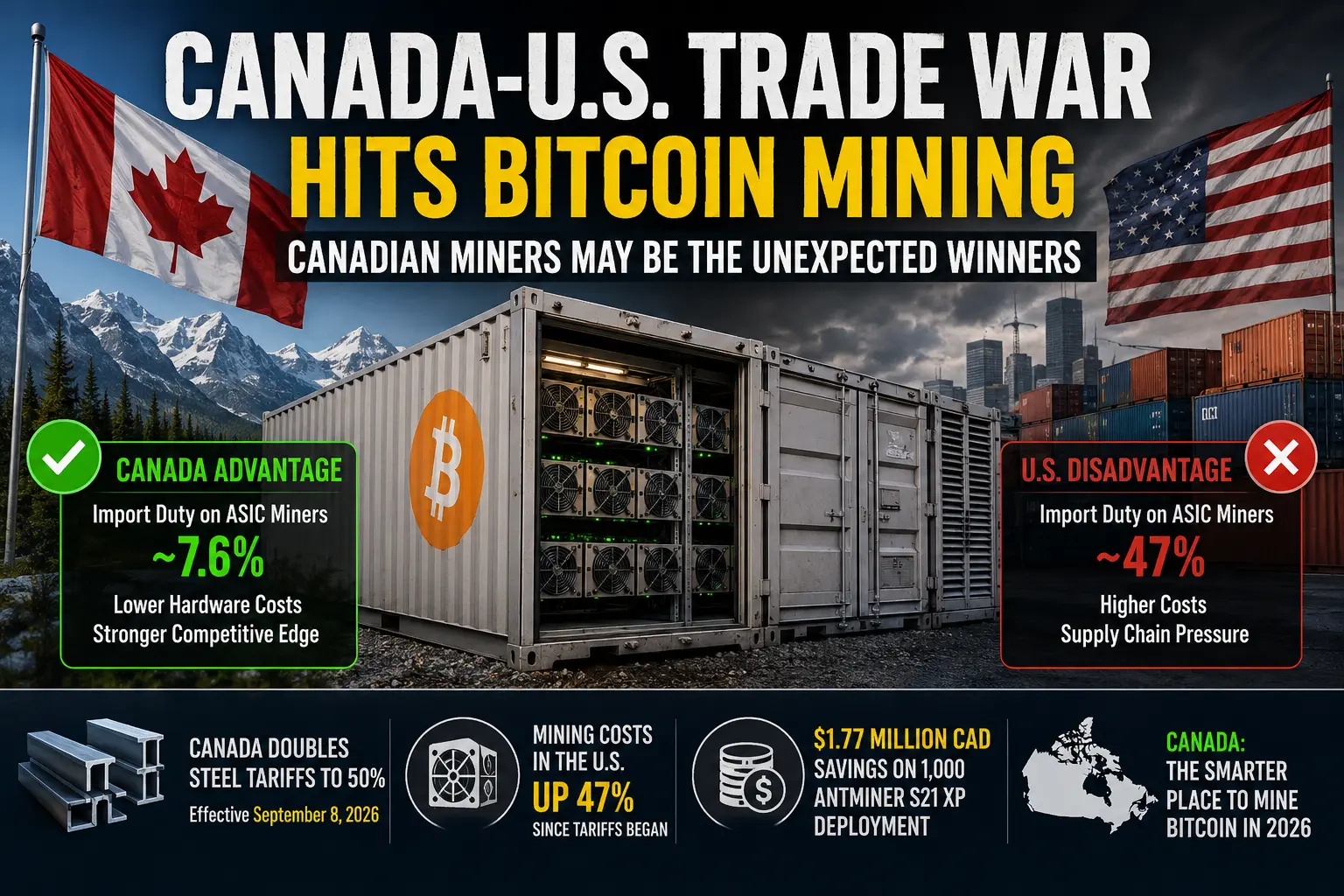
A flagship Antminer S21 XP already carries roughly $1,600 in Section 232 metals duties. On top of that sits a 21.6% reciprocal tariff on ASIC imports from Southeast Asia. Together, those two charges push the combined U.S. tariff burden to about 47% before other import fees even apply.
Deployment costs for U.S. miners have risen by roughly that same 47% since this tariff cycle began in earnest. Canada’s tariff picture on the identical hardware looks nothing like it.
The Hardware Cost Gap Behind Canada US Tariff Mining 2026
That divide sits at the center of Canada US tariff mining 2026. Canadian operators importing ASIC miners from China currently pay roughly 5% GST plus a standard 2.6% duty. That’s a combined rate near 7.6%, and it doesn’t touch the U.S. Section 232 metals duties or the reciprocal ASIC tariffs American buyers face.
Nothing about the September 8 retaliatory measures shifts that gap either. Those measures target U.S.-origin goods, not Chinese-manufactured mining hardware. Canada has also avoided the reciprocal tariff structure the U.S. built specifically around ASIC miners from Southeast Asian assembly hubs. Bitmain’s regional production faces duties at American borders that simply don’t apply at Canadian ones.
In practical terms, a Canadian mining company buying Antminer S21 XP units from Bitmain pays roughly 7.6% in import costs. An American company buying the identical hardware pays somewhere near 47% combined. That’s not a rounding error.
On a 1,000-machine deployment costing about $4,500 per unit, the Canadian operator pays roughly $342,000 in import costs. The U.S. operator pays close to $2,115,000 on that same order.
US import duty applies to more than just the machines, too. According to Cointelegraph’s reporting on the tariff standoff, customs fees on some Bitmain shipments into the U.S. have reached $500,000 per shipment. Miners quoted in that reporting warn that further increases could make imports close to cost-prohibitive. Nothing comparable applies at the Canadian border.
Alberta and the Provinces Leading Canada US Tariff Mining 2026
Alberta is the province worth watching closest. British Columbia permanently banned new grid connections for crypto mining in October 2025, pushing operators toward friendlier jurisdictions. Alberta’s deregulated electricity market and relatively mining-friendly rules have absorbed a good share of that displaced activity.
American Bitcoin, the majority Hut 8 subsidiary, expanded its Drumheller, Alberta site in May. Hashrate there jumped 1,112% using Bitmain units. That expansion predates the latest tariff round, but the underlying economics look even stronger now.
Hut 8 itself operates mining facilities across Alberta alongside its U.S. sites. The company ended 2025 by signing a 15-year, $7 billion USD deal with Fluidstack to lease 245 megawatts of IT capacity. It’s been accelerating a pivot toward AI infrastructure since. Its Alberta mining operations still represent a cost structure that looks increasingly favourable next to its U.S. peers as the tariff gap widens.
IREN, formerly Iris Energy, operates 3 gigawatts of secured power capacity across the U.S. and Canada. Its British Columbia site is being converted from ASICs to GPUs for AI compute. The plan calls for growth from 23,000 to 140,000 GPU units by the end of 2026. IREN’s Canadian infrastructure benefits from the same import cost structure that makes ASIC deployment cheaper in Canada than south of the border.
Picture a U.S. mining company and a Canadian mining company each planning to deploy 10 megawatts of new capacity. Both need to buy hardware and containers to do it. The Canadian company’s upfront capital spending comes out meaningfully lower, and across multiple hardware upgrade cycles, that gap compounds into a real structural advantage.
Canada’s Electricity Advantage
Hardware cost is one side of the Canada US tariff mining 2026 equation. Electricity is the other, and it’s where Canada’s advantage has historically run deepest.
Quebec offers some of the cheapest industrial electricity rates in North America. Rates there have historically sat around 4 to 5 cents CAD per kilowatt hour for large industrial consumers. Manitoba runs in a similar range.
Hydroelectric infrastructure in both provinces provides stable, renewable baseload power without the volatility that gas-peaking markets bring. Ontario rates run higher but stay competitive. New Brunswick, with 80% non-emitting generation from nuclear and hydro, has attracted miners including HIVE Blockchain Technologies.
Pricing works differently in Alberta’s deregulated market. Rates in 2026 have ranged from $0.14 to over $0.22 CAD per kilowatt hour depending on the season, so monthly costs can swing hard. Most miners there lock in fixed-rate contracts with competitive retailers to stabilise costs, trading some upside for predictability.
British Columbia’s cheap hydro power remains off-limits for new mining connections following the October 2025 ban. That’s a real loss for the sector. It doesn’t, though, change the picture for operators already established in Quebec, Manitoba, Alberta, or New Brunswick.
Combined with the hardware import gap, this electricity advantage pulls Canada’s total cost to mine one Bitcoin well below the U.S. equivalent. That gap is widest in states where energy markets are less competitive. Industry estimates put the cost to mine one Bitcoin in the U.S. at around $49,912 for listed miners in the second quarter of 2026. Canadian operators with access to cheap provincial hydro power run well below that figure.
The Steel Tariff Complication in Canada US Tariff Mining 2026
None of this runs entirely one way for Canadian operators. Canada’s retaliatory 50% steel tariffs apply to U.S.-origin steel starting September 8. Mining containers built in the United States and imported into Canada now carry meaningfully higher costs for Canadian buyers. Some industrial mining container suppliers are U.S.-based, and their prices rise under the new measures.
Fortunately, the mitigation paths are fairly clear. Operators can source containers from non-U.S. manufacturers, build custom enclosures domestically, or work with Canadian steel fabricators. None of these moves happen overnight, but all of them are realistic over a six to twelve month planning horizon. Canadian steel fabrication capacity already exists, and the tariff structure creates a price signal that makes domestic container manufacturing more competitive than before.
Operators with existing container fleets feel very little of this. The impact lands mostly on new deployments that would otherwise have sourced U.S.-manufactured containers. Given the size of the hardware cost gap working in Canada’s favour, this sourcing constraint reads as a manageable problem rather than a structural disadvantage.
Hash Rate and the Global Canada US Tariff Mining 2026 Picture
Step back from individual operator economics, and this starts to look like something bigger: a geographic rebalancing of global hash rate. The U.S. currently controls roughly 38% of global Bitcoin hash rate, around 400 exahashes per second. Yet 97% of the ASIC hardware powering that hash rate comes from just three Chinese manufacturers: Bitmain, MicroBT, and Canaan.
Every tariff cycle that raises the cost of that hardware in the U.S. adds pressure on America’s share of global mining activity. No comparable cost rise happens anywhere else. Canada is one of the most natural beneficiaries.
It has cheap power across multiple provinces, an established regulatory and banking framework for mining companies, and existing infrastructure. On top of that sits a much lower hardware import cost than its southern neighbour.
Still, nothing here is a guaranteed outcome. U.S. states like Texas and Wyoming remain aggressively pro-mining. American miners also have a political tool Canadian operators don’t.
Senators Cassidy and Lummis introduced the pending Mined in America Act in March 2026. It would create federal subsidies and tax incentives for domestic mining operations. Should that bill pass, it could offset some of the hardware cost disadvantage U.S. operators currently face. Right now, though, the broader tariff environment keeps pointing in Canada’s direction.
What This Means for Canadian Crypto Investors
Anyone holding shares of Canadian-listed mining companies should treat Canada US tariff mining 2026 as relevant context. It shapes how their cost structures stack up against U.S. peers.
Shares in Hut 8 (TSX: HUT, NASDAQ: HUT) have been among the best-performing Canadian crypto mining stocks of 2026. The stock was up 262% year on year as of late March, with a market cap near $7.77 billion CAD. IREN trades on NASDAQ but carries significant Canadian operational exposure, and HIVE Blockchain Technologies still runs Canadian mining operations out of New Brunswick.
Holding Bitcoin directly, or through a Canadian ETF like the Purpose Bitcoin ETF or the Evolve Bitcoin ETF, changes the calculus only indirectly. Anything that raises U.S. mining costs and shifts capacity toward cheaper jurisdictions affects the global cost curve for the asset. That doesn’t move Bitcoin’s price on its own, but it does change the economics for the operators who secure the network.
They sometimes turn into forced sellers of Bitcoin to cover operating costs. Cheaper mining in Canada means less of that pressure, which is a mild structural positive for price stability over time.
From a CRA perspective, none of this changes anything for individual Canadian crypto holders. If you own Bitcoin and the price rises because miners elsewhere face higher costs, any gain you realise on selling is still a taxable capital gain. That’s the same rule that’s applied all along, and our guide to crypto regulations in Canada walks through how the CRA treats crypto more broadly.
The Short Version
- Canada announced 50% steel tariffs on U.S. goods effective September 8, 2026, matching the U.S. rate dollar for dollar. The move covers $27.6 billion in U.S. products across 800-plus product lines.
- Bitcoin mining and steel tariffs connect directly. Industrial mining containers are steel structures, and their U.S. cost has already climbed $10,000 to $25,000 per unit from earlier tariff rounds.
- Canadian operators face far lower ASIC hardware import costs than U.S. peers: roughly 7.6% versus close to 47%. On a 1,000-machine deployment, that’s nearly $1.77 million CAD in extra capital spending.
- Alberta is absorbing mining activity displaced by BC’s grid ban. American Bitcoin expanded its Drumheller site 1,112% in May, and both Hut 8 and IREN carry significant Canadian operational exposure.
- Canada’s electricity advantage stays intact in Quebec, Manitoba, and New Brunswick, where rates sit well below most U.S. markets.
- The complication: Canada’s 50% tariffs on U.S. steel raise the cost of U.S.-manufactured mining containers for Canadian buyers, though workable sourcing alternatives exist.
- Sustained U.S. hardware cost pressure across several upgrade cycles could shift real hash rate growth toward Canada and other tariff-exempt jurisdictions.
Treat all of this as background, not investment advice. Tariff rules are moving fast enough that checking the government’s own release before making a big call is worth the effort. Weighing a position in a Canadian mining stock, or just curious how this touches your own holdings? A conversation with a qualified financial advisor beats guessing from a headline.