
Making a purchase with bitcoin in Canada is just five minutes. Understanding the rules can take a long time as most buyers do not ever take the time to research. The regulations for crypto in Canada aren’t a neat law, and not a single agency enforces the laws. They’re distributed between the securities regulators, a financial crime watchdog central bank as well as the Tax Authority.
How Crypto Regulations in Canada Are Structured
Canada has never passed any crypto-related law as some other countries have. The financial regulators in place today have stretched their authority as digital assets gained traction. More than a quarter of Canadians have a form of cryptocurrency nowadays. This is precisely the reason regulators stopped looking at the vantage point and began shaping the market.
Five major organizations share the burden but they do not always communicate with each the other. There is the Canadian Securities Administrators (CIRO), which is made up of provincial regulators, like BCSC and OSC, OSC and BCSC considers the majority of platforms as dealers in securities. CIRO oversees the day-to-day operations of these registered platforms. Below them are FINTRAC regarding money laundering and The Bank of Canada on stablecoins as well as the CRA on taxes.
It wasn’t a quick process neither did it happen overnight. The CSA published its very first notices to staff on crypto assets in the year 2017. It was many years before Canadians were aware of the term ICO. Since then, what’s been changed doesn’t concern necessarily the fundamental legal concept. It’s the drive to enforce it. This is reflected in higher fines and a bigger CIRO team in support of the initiative in the present.
Quebec along with British Columbia complicate the picture further. Businesses that operate in crypto generally require an additional provincial registration in addition to of being approved by FINTRAC. Québec’s Autorite des marches financiers has been particularly tough, having to obtain its own licence prior to providing services to residents of the province. Many exchanges are in the way of this extra step, typically after having assumed that the federal registration would be sufficient to be sufficient to cover them.
They operate in a way that is independent from one another. A platform may be in compliance with the securities regulations, even if its FINTRAC paperwork is in a review process, or even the reverse. This isn’t an excuse. It’s the way Canadian regulatory system has functioned sector-by-sector instead of asset class by asset class.
Europe has taken a different route in this case. MiCA established a common rulebook for crypto assets throughout Europe. European Union. Canada modified its existing laws on financial crime and securities to accommodate the new asset class. The two approaches are not necessarily superior however Canada’s approach means that compliance rules can vary slightly between provinces.
Registering a Crypto Trading Platform Under Canadian Rules
Any exchange that provides Canadian customers must be registered as either an investment broker as well as a dealer with restricted access. Both are based upon the current securities law and not anything specific to crypto. The full investment dealer registration offers the greatest flexibility with the highest standards of compliance to meet. The restricted dealer registration is a more narrow path designed for platforms that adhere to a small selection of products.
A new account created on a registered platform can end looking a lot like opening a bank account. It is a matter of verifying your identity and answer several questions about your experience with investments and verify where your funds come from. It’s a hassle, but platforms make use of these checks to detect risks before trading but not until later on.
Platforms that were not registered could be able to get away with what was known as an undertaking prior to registration. It was basically an agreement to adhere to the rules for protecting investors as an application swam throughout the process. Regulators snuffed out that option August 2024. The new platforms must submit an application directly to CIRO for membership. the bar has increased in the process.
Registration isn’t just a one-time requirement neither. Platforms have ongoing obligations regarding advertising claims and product suitability and know-your-client verification prior to allowing traders to trade high-risk tokens. Regulators have a proven history of enforcing these as well. Some platforms have closed their Canadian operations, rather than clearing of the bar. This speaks something about the seriousness with which it’s being treated.
Being a foreign-based business does not let a platform free of the burden by any means. If the platform actively seeks Canadian customers via local advertisements or CAD deposit options Canadian securities law is still in force. It is not a matter of where the company’s head office is. Some foreign exchanges already been notified of warnings from the public on precisely this basis.
What’s more, the way it is seen is in what you’re allowed to do. Restricted dealers usually adhere to a smaller list of coins that are already in circulation. Full investment dealers are able to offer more when they have met the additional conditions. Be sure to check before assuming your token of choice is in a waiting room.
FINTRAC, AML Rules, and Crypto Regulations in Canada
Every exchange that operates within Canada must sign up as a financial service business in FINTRAC. This is separate from registration for securities in the whole, and has its own reporting requirements. Transactions that exceed $10,000, any suspicious activities and international transfers are all required to be reported, and the records pertaining to each. FINTRAC deals with crypto exchanges in exactly the same way as it does banks. They are a full stop.
The consequences for doing this wrong have risen rapidly. In the last quarter of 2018, FINTRAC hit a Canadian crypto exchange with a penalty close to $177 million, and cited around 2600 violations. Another exchange was fined around $20 million a few months prior for similar violations. Both cases were not terribly quiet about it.
FINTRAC also canceled around 50 registrations for businesses in the field of money services this year. Of these 47, they were linked directly to crypto-related companies who failed to pass inspections or had not fulfilled their reporting obligations. For the average investor that’s where crypto laws in Canada cease to be abstract. A crypto-related platform that’s in the hands of FINTRAC has escaped a standard of scrutiny, whereas a platform that is not registered isn’t.
The transfer of funds from a wallet is also under scrutiny as per Canada’s version of the international travel rules. Platforms are required to collect and transmit information about the recipient and sender in larger transactions, much similar to banks’ wire transfers. Self-custody wallets that don’t connect to the registered exchanges remain in the shadows of this. That’s precisely why regulators are looking to platforms to strengthen their own chain.
Take a step back and you’ll find that none of this can be said to only apply to cryptocurrency. banks and traditional financial services companies have been following similar guidelines for years. FINTRAC has basically expanded the same rules once digital assets became a legitimate payment option. What’s different is the size of fines and the speed with which regulators are prepared to utilize these. Some exchanges are learning this lesson in a costly way.
The Stablecoin Act: A New Layer of Crypto Regulations in Canada
Bill C-15, better known as the Stablecoin Act, received royal assent in March 2026. It was the first part to the crypto regulations in Canada by giving authorities to the Bank of Canada authority over stablecoin issuers. The reasoning behind this is that these coins behave much more as payments instruments rather than investment products.
Under the new rules the issuers have to sign up with a public Bank of Canada registry before offering coins to Canadians. They must also have complete reserves, which are held by a certified custodian and a separate account they cannot use for anything else. Holders finally have a right to repurchase them at par which the previous exemptions didn’t quite promise. We discussed how this change affects issuers as well as holders in our review on the Stablecoin Act.
One aspect that catches people in the dark quite often: issuers aren’t able to pay interest or earn a yield directly on the stablecoins they hold. Regulators are trying to stop stablecoins from morphing into non-registered investment products. The complete regulations are being drafted, with the final framework due in 2027.
Payment processors and merchants also have their particular reasons to be attentive to. A stablecoin that is properly regulated may eventually allow transactions to be settled faster and at a lower cost than card networks can manage today, at a minimum on paper. If that guarantee is able to be kept is contingent on issuers complying with the requirements for reserve and redemption the Act stipulates. Businesses that are accepting stablecoins right now must take backing claims seriously and in a dose doubt until the time comes.
Other major economies have tightened control of stablecoins within the same time, considering coins that are not regulated as a risk to the system. Canada does not stand by itself, which is to say. If international rules are in line such as this and stick, they are more likely to be followed instead of being merely reduced within a year.
Crypto Taxes and Custody Protections for Investors
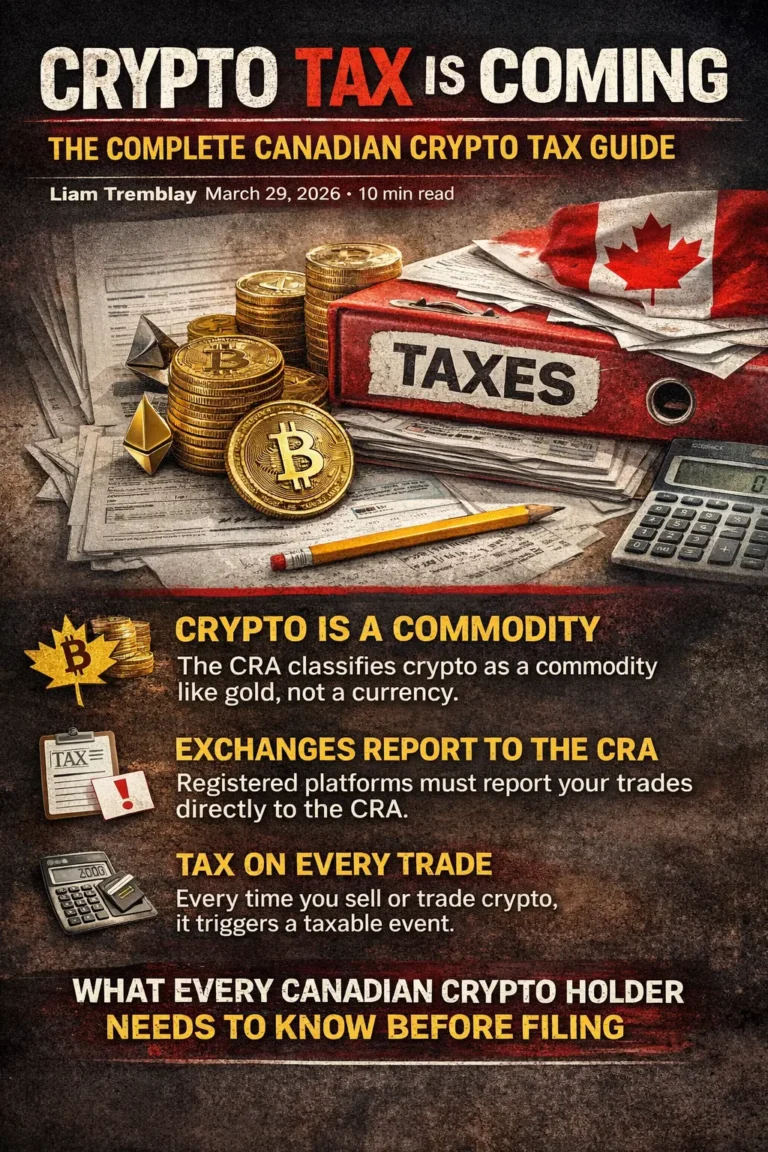
The Ottawa tax authority, known as Canada Revenue Agency, which is the tax authority of Ottawa. Canada Revenue Agency, doesn’t consider cryptocurrency to be legal tender. It views cryptocurrency as more of a commodity, and therefore every transaction, sale or purchase is an event that is tax deductible. If it results in the tax benefits of a capital gain or a business income is determined by the specifics of your situation. It’s all about how often you trade, whether or not you’re trading for a livelihood and how much preparation is required for each transaction.
The majority of casual investors end up within the capital gain section which means that only 50% of the profits is tax-deductible. People who trade regularly, or who runs a cryptocurrency-related business, are taxed for the whole sum as normal income. This is a big pain when you file. Staking and mining rewards are taxed as income if they are received and then as a loss or gain when they are they are sold.
Custody laws received an important update also, and this one has a name to go with it. CIRO released the new Digital Asset Custody Framework on February 20, 2026. It was specifically designed to prevent another crash like QuadrigaCX. It was wiped out with $123 million of customer funds in the year prior to the year 2019. The new framework lays out high-risk standards that are tied and based on risk. the way platforms are expected to keep client assets in the future.
It’s not that difficult until you get the CRA audit letters sat in your mailbox. Canada has also signed a commitment to implementing the The OECD’s Crypto-Asset Reporting Framework. In this framework, exchanges will eventually be required to report activity directly to the CRA instead of making it up to you to. It is better to get ahead of this now, by keeping accurate reports for each trade, beats the rush once the automatic reporting system is in place.
Regulations only cover a small portion However, it only covers a small portion of. Transferring significant assets to a bank account you control eliminates all risk of exchange, however, it puts the responsibility for security to you. For balances with smaller amounts an established platform that has good custody practices is typically an option that is more sensible.
What Crypto Regulations in Canada Mean for You
All of this is just unimportant if you own cryptocurrency. Before you open an account at any place make sure the account appears in the list of dealers who are registered. It takes only a few minutes, and can tell you more than a marketing website ever will. The registered platforms have been checked for the handling of complaints, custody, and the person you can report to if something isn’t working.
The process of checking the status requires much less time than reading an online review, provided you think about it. Provincial and national regulators create free, searchable databases designed to serve this reason. Make sure to bookmark one before you use it, but not when a platform has been unable to function properly and you’ve lost your money.
Representations against registered platforms do not have to be settled with a shrug. Canadians can take unresolved complaints towards the Ombudsman for Banking Services and Investments. This is a service that all registered dealers must take part in. Platforms that aren’t registered offshore provide no option to register Another reason why registration status is more important than a simple app.
Tax season demands the same care. Make a record of each transaction in the moment and not try to reassemble an entire year of trades during April. The CRA would like dates, amounts for each transaction in Canadian dollars, as well as an explanation of the reason behind every transaction. If you’re still a novice to digital assets may want an uncomplicated introduction, such as the one we have in our guide for newcomers to the world of digital financial.
Verify registration by checking the regulator’s list rather than having a badge displayed on the website of the exchange. Badges are copied or they just become old news and no one updates them. Any promise of guaranteeing return or interest on stablecoins as a warning signal, not a perk. It is clear on who is allowed to provide this type of offer.
A good tax software for crypto can help you save time when filing time comes around, however it’s not as good as reviewing your own financial statements. Check the numbers against the information provided by each platform because automated software can fail to recognize transfers between wallets that you own. A little manual review can catch mistakes prior to what the CRA makes them later.
The regulations for crypto in Canada are likely to shift as more people adopt the technology and regulators finalize the rules for custody and stablecoins. This isn’t a reason to stay in the dark however it’s an opportunity to consider taxes and registration in the final decision. Regulators cannot stop people from purchasing in the wrong place or putting their faith in the wrong venture. A little caution in the beginning can save you a lot of anxiety later on, whether a large portfolio or no.