
Most people who’ve spent time around crypto already know the tradeoff: chains that feel fast usually cut corners somewhere else, and chains built for security often feel sluggish for anything resembling real trading. Sei was built to attack that tradeoff directly. It’s a Layer-1 blockchain designed specifically for exchanging digital assets, and its entire architecture is built around one goal: making a blockchain feel as fast as a normal app.
Think of Sei as trying to merge the two biggest strengths in crypto into one chain. It borrows Ethereum’s massive developer ecosystem through EVM compatibility, and it borrows Solana’s need for speed. The result is a chain that lets Ethereum developers deploy apps they already know how to build, without giving up the throughput that high-frequency trading platforms actually need.
The problem Sei is trying to solve
Time to finality is the technical term for how long it takes a transaction to become permanently locked into a blockchain, unable to be reversed. On many established chains, that process takes seconds, sometimes longer during congestion. For a trader watching prices move in real time, that lag is the difference between a good fill and a missed one.
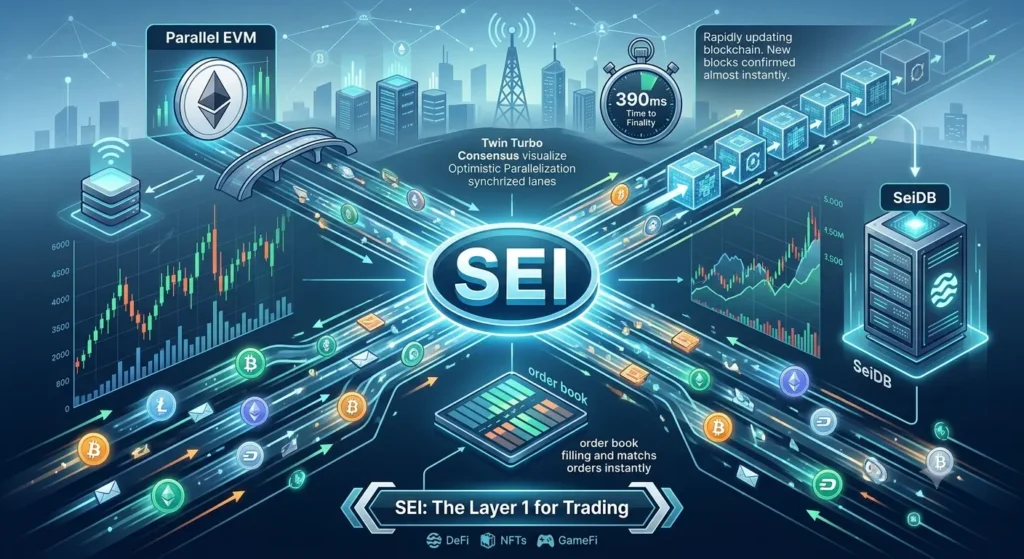
Sei’s time to finality sits at roughly 390 milliseconds, and the network can process over 12,500 transactions per second. Those two numbers together mean Sei can support large-scale, high-frequency trading environments without the delays that plague older chains. For anyone comparing this to more familiar names, it’s worth reading up on how Ethereum works first, since Sei is designed to be compatible with the same tooling while solving problems Ethereum wasn’t originally built to handle.
How Sei actually gets this fast: Twin Turbo Consensus and SeiDB
Two pieces of technology do most of the heavy lifting here.
Twin Turbo Consensus is Sei’s method for validating transactions and building new blocks. It’s the reason transactions finalize in that 390-millisecond window. SeiDB, meanwhile, is an advanced database system built specifically to handle rapid data reads and writes, which matters enormously once transaction volume climbs. A blockchain that’s fast in a lab test but chokes under real demand isn’t actually solving the problem, and SeiDB exists to keep performance consistent as usage scales up.
Single-slot finality: why this matters more than it sounds
Sei achieves what’s called single-slot finality, meaning a transaction is confirmed and becomes irreversible within a single slot, or cycle, of the network’s operation. This is faster than what most blockchains offer, and it provides secure, instant finalization that’s genuinely important for anything resembling a trading platform. If a transaction can be reversed or contested for several seconds after it’s submitted, that’s a window where bad actors can exploit timing. Single-slot finality closes that window almost entirely.
Optimistic Parallelization and the Parallel Stack
Here’s where Sei diverges from most other chains architecturally. Sei uses something called Optimistic Parallelization, a method for processing multiple transactions at the same time rather than one after another. Most blockchains process transactions sequentially, which is inherently slow. Sei instead assumes transactions won’t interfere with each other and processes them simultaneously. When a genuine conflict shows up, the network identifies and resolves it quickly without stalling the whole system.
This approach led to the Parallel Stack, an open-source framework built on top of the EVM that optimizes transaction processing for speed, cost, and security. Nearly nine in ten blockchain developers already contribute to at least one EVM chain, so building scalable infrastructure around that existing base was a deliberate choice, not an accident. Because the framework is open-source, any developer can build on it, which pushes the boundaries of what a Layer-2-style solution can realistically achieve.
Sei rolled out the world’s first Parallelized Ethereum Virtual Machine (PEVM) — a major leap forward for blockchain performance. Instead of processing tasks one after another, the PEVM splits them into multiple parallel workloads, dramatically increasing throughput and making the network fast enough for high‑frequency trading, advanced DeFi platforms, and other computation‑heavy apps.
What makes this even more compelling is its full compatibility with existing Ethereum applications. Developers can plug into Sei’s speed without rewriting their smart contracts, giving them instant performance gains with zero migration headaches.
The SEI token: what it actually does
SEI sits at the center of the network’s economics and governance. It handles transaction fee payments, secures the network through staking, and gives holders a vote in governance decisions. This “tokenomics” structure is meant to align the interests of everyday users, developers, and the long-term health of the network itself, rather than treating the token as separate from how the chain functions day to day. If you’re new to how tokens like this generally work across different ecosystems, our crypto learning hub is a good starting point before diving deeper into Sei specifically.
Sei’s growing ecosystem
Sei isn’t just a speed benchmark. It supports a genuinely broad ecosystem: decentralized finance (DeFi) platforms, non-fungible tokens (NFTs), GameFi projects, and more. High performance tends to attract builders who need it, and Sei’s combination of speed, security, and developer-friendly tooling has pulled in a community actively shaping where the network goes next. The chain remains focused on staying scalable as demand grows, with the Parallel Stack playing a central role in making sure increasing transaction volumes don’t degrade the experience for either developers or everyday users.
What this means for Canadian investors
For Canadians curious about exposure to newer Layer-1 tokens like SEI, the same registered-account rules apply as with other cryptocurrencies. You can’t hold SEI directly inside a TFSA or RRSP, since it isn’t a qualified investment under the Income Tax Act, though the Bitcoin ETF landscape in Canada shows how registered-account access tends to expand as an asset matures. If you’re trading SEI directly, keep in mind that gains are generally treated as capital gains or business income by the CRA depending on your trading frequency, and it’s worth reviewing our Canadian crypto tax guide before filing.
As with any newer Layer-1 token, SEI carries real volatility risk, and speed or throughput numbers don’t guarantee adoption or price stability. Do your own research, check which Canadian exchanges actually list SEI before assuming it’s accessible, and never invest more than you’re prepared to lose.
Sei is a clear example of a chain built around one specific bet: that blockchains competing for trading and exchange activity need to feel instant, not merely fast by crypto standards. Whether that bet pays off long-term depends on adoption, but the underlying architecture is genuinely one of the more focused approaches in the current Layer-1 landscape.
📌 Disclaimer: This is general information only and not financial advice. Always do your own research and consult a qualified professional before making investment decisions.