

How to Learn Crypto in Canada:
The Complete Beginner’s Guide
Cryptocurrency is legal, regulated, and increasingly mainstream in Canada — but getting started can feel overwhelming. This guide covers everything you need to know, in plain language, with no hype.
Latest posts
Learning
View all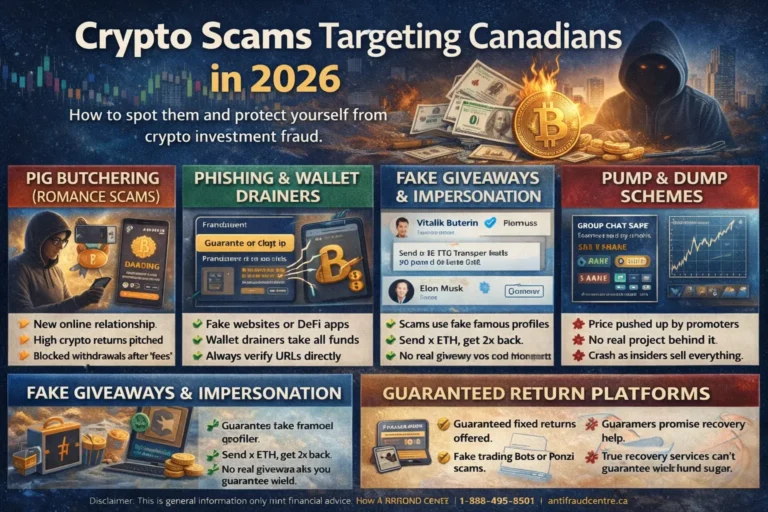
How to Avoid Crypto Scams in Canada: A Beginner’s Safety Guide (2026)
Canada consistently ranks among the countries hardest hit by crypto-related investment fraud. The Canadian Anti-Fraud Centre reported over $309 million in crypto…
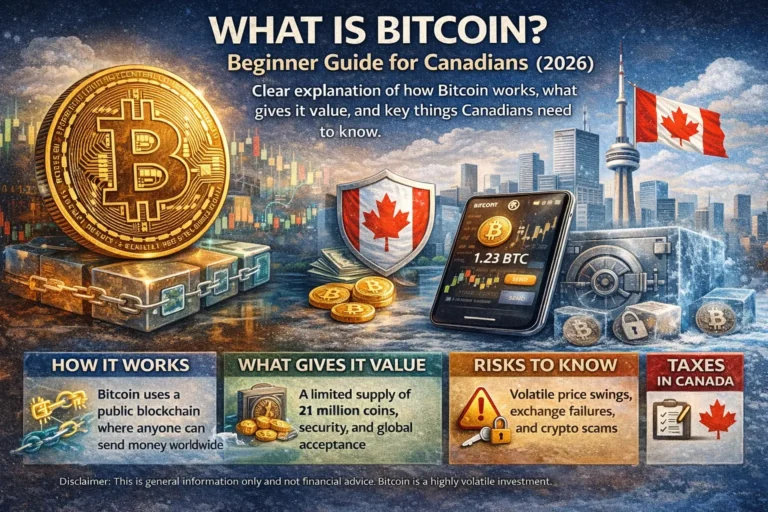
What Is Bitcoin? A Plain-Language Guide for Canadians (2026)
Bitcoin gets talked about constantly, on the news, at the dinner table, in your inbox from that one friend who won’t stop…
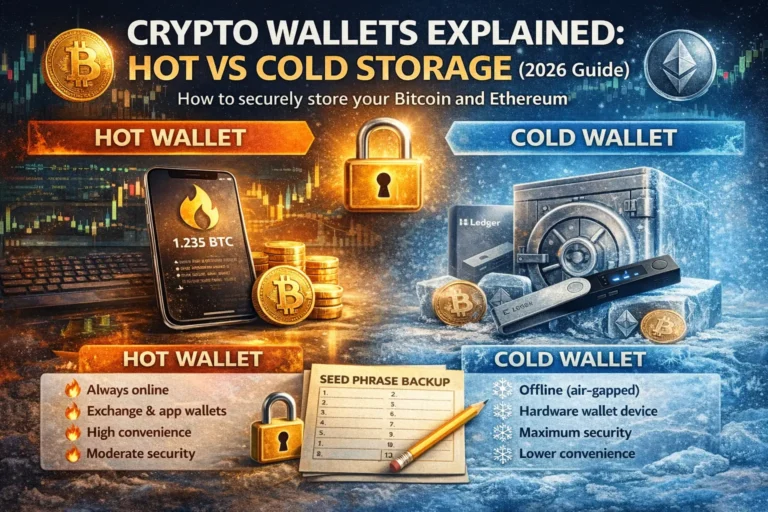
Hot Wallet vs Cold Wallet: Which One Do You Actually Need?
,Most people who buy crypto for the first time don’t think much about where it goes. It sits on the exchange they…
Canada is one of the most crypto-forward countries in the world. We were home to the world’s first Bitcoin ATM (in Vancouver, 2013) and among the first nations to approve a spot Bitcoin ETF. And yet for millions of Canadians, the question is still the same: Where do I even start?
This guide is built to answer exactly that. Whether you have never bought a dollar of cryptocurrency or you have been curious for years but kept putting it off, you will leave this page knowing what crypto is, how to buy it safely in Canada, how the CRA will tax it, and how to protect yourself from scams. No hype, no jargon without explanation, and no pressure to invest more than you are comfortable with.
Cryptocurrency is a high-risk, volatile asset class. Prices can drop 30–50% in a matter of weeks. Never invest money you cannot afford to lose entirely. This guide is educational, not financial advice.
What Is Cryptocurrency?
Cryptocurrency is digital money that exists only online – there are no physical coins or bills. Unlike the Canadian dollar, which is issued and controlled by the Bank of Canada, cryptocurrencies are typically decentralized. No single government, bank, or company controls them.
Instead, they run on a technology called a blockchain – a shared digital ledger that records every transaction ever made. Think of it like a Google spreadsheet that thousands of computers around the world keep a copy of simultaneously. When someone sends Bitcoin from one wallet to another, that transaction is verified by the network and permanently added to the spreadsheet. No single person can alter it without the rest of the network catching on.
Bitcoin (BTC) was the first cryptocurrency, created in 2009 by an anonymous person or group using the name Satoshi Nakamoto. It was designed to be a peer-to-peer digital currency – money you can send directly to anyone, anywhere, without needing a bank. There will only ever be 21 million Bitcoin in existence, a feature built into its code to prevent inflation.
Ethereum (ETH) followed in 2015 and went further: it is not just a currency, but a programmable blockchain that developers can build applications on. These applications – called decentralized apps or dApps – run financial services, games, marketplaces, and more without a central company running them.
Beyond Bitcoin and Ethereum, there are thousands of other cryptocurrencies – collectively called altcoins. Some have genuine use cases; many do not. For beginners, sticking to Bitcoin and Ethereum is the most prudent approach.
Is Crypto Legal in Canada?
Yes — cryptocurrency is fully legal in Canada. Buying, selling, trading, and holding digital assets is permitted for Canadian residents and businesses. However, it is regulated, and that regulation has been getting stricter and more comprehensive in recent years.
Who Regulates Crypto in Canada?
Crypto regulation in Canada operates at both the federal and provincial levels:
As of 2026, Canada has adopted the OECD’s Crypto-Asset Reporting Framework (CARF). This means registered Canadian exchanges are now required to report your transaction data directly to the CRA. If you trade crypto in Canada, the CRA knows about it.
When using any crypto exchange in Canada, you should confirm it is on FINTRAC’s public registry of registered MSBs. Using an unregistered exchange carries legal and financial risk — and offers you no recourse if the platform disappears with your funds.
How Crypto Taxes Work in Canada
One of the most important things for Canadian crypto users to understand is how the CRA taxes digital assets. The rules are clear, but they trip up many beginners because they are different from how most people think about money.
Crypto Is a Commodity, Not Currency
The CRA does not treat Bitcoin or any other cryptocurrency as legal tender. Instead, crypto is classified as a commodity – similar to gold. This means that every time you sell, trade, or spend crypto, you have a taxable event. Yes, even buying a coffee with Bitcoin is technically a taxable transaction.
Capital Gains vs. Business Income
For most Canadians who buy and hold crypto as an investment, profits are treated as capital gains. The key rule: only 50% of your capital gain is included in your taxable income. If you made $10,000 in profit from selling Bitcoin, only $5,000 is added to your income and taxed at your marginal rate.
However, if the CRA determines you are trading crypto as a business – meaning frequently, with profit as your primary intent – 100% of your gains may be treated as business income. This is a grey area and depends on factors like trading frequency and your overall conduct.
Record-Keeping Is Mandatory
The CRA requires you to keep detailed records of every crypto transaction. For each trade, you must record: the date, the type of transaction (buy, sell, trade, spend), the amount in CAD at the time of the transaction, and the fees paid. Your Adjusted Cost Base (ACB) – the average cost of your holdings – determines your gain or loss on each sale.
You report crypto gains and losses on Schedule 3 of your T1 personal tax return. There are several reputable Canadian crypto tax tools (such as Koinly and CoinLedger) that can automatically calculate your ACB and generate a tax report.
How to Buy Your First Crypto in Canada
Buying cryptocurrency in Canada is straightforward when you use a registered exchange. Here is the complete step-by-step process for a first-time buyer.
Only use exchanges that are registered with FINTRAC as a Money Services Business. Well-known Canadian-compliant platforms include Newton, NDAX, Kraken Canada, and Coinbase Canada. Each has slightly different fees, coin selection, and user interfaces – compare a few before committing.
All registered Canadian exchanges are legally required to verify your identity – a process called Know Your Customer, or KYC. You will need a government-issued photo ID (driver’s licence or passport) and proof of address (a utility bill or bank statement). This process typically takes 10–30 minutes and must be completed before you can fund your account.
Interac e-Transfer is the most cost-effective funding method for Canadians – it is fast (usually same-day), free or low-cost on most exchanges, and does not require a wire transfer. Simply send an e-Transfer from your online banking to the exchange’s account details and funds typically appear within hours.
Navigate to the trading or buy section of the exchange. Select the asset you want to purchase – for beginners, Bitcoin (BTC) or Ethereum (ETH) are the logical starting points given their liquidity, track record, and widespread recognition. Enter the amount in CAD you wish to spend and confirm. You do not need to buy a whole coin – you can buy $50 worth of Bitcoin if that is where you want to start.
Once purchased, your crypto sits in a wallet on the exchange. For small amounts you plan to sell soon, this is fine. For larger holdings you plan to keep long-term, consider moving your crypto to a personal wallet for better security.
There is no minimum investment threshold that makes crypto worthwhile. Starting with $50–$200 CAD is a perfectly legitimate way to learn the process without significant financial exposure. The experience of completing your first trade is valuable in itself.
Types of Crypto Wallets
A crypto wallet does not actually store your cryptocurrency – the crypto lives on the blockchain. What a wallet stores is your private key: a secret password that proves ownership and allows you to authorize transactions. Lose your private key and you lose access to your crypto, permanently.
There are two broad categories of wallets: hot wallets (connected to the internet) and cold wallets (offline). Think of it like a checking account versus a safe deposit box. Both hold your money; they have very different risk and access profiles.
| Feature | 🌐 Hot Wallet | 🔒 Cold Wallet |
|---|---|---|
| Internet connection | Always connected | Offline (air-gapped) |
| Examples | Exchange wallet, MetaMask, Trust Wallet | Ledger Nano, Trezor Model T |
| Convenience | High — easy access anytime | Lower — requires physical device |
| Security | Lower — vulnerable to hacks | High — protected from online attacks |
| Best for | Active trading, small amounts | Long-term storage, large amounts |
| Cost | Free (usually) | $80–$250 CAD for hardware device |
If your crypto is on an exchange and that exchange collapses or freezes withdrawals – as happened with Canadian exchange QuadrigaCX in 2019 – you may lose everything. For any amount you are not actively trading, a personal wallet gives you full control.
Key Crypto Concepts Every Beginner Should Know
You do not need to understand every corner of the crypto ecosystem to get started. But familiarity with these core concepts will help you navigate conversations, evaluate projects, and make better decisions.
Crypto Scams to Avoid in Canada
The Canadian Securities Administrators (CSA) and the RCMP regularly issue warnings about crypto fraud. Canada has unfortunately seen high-profile cases — including the QuadrigaCX exchange collapse that cost Canadian investors over $169 million. Knowing the most common scam types is one of the most practical things you can do before putting money into crypto.
- Phishing Sites & Fake ExchangesFraudulent websites that mimic legitimate exchanges or wallets, designed to steal your login credentials or private key. Always type URLs manually and verify the exact domain name before logging in. Use bookmarks for exchanges you use regularly.
- Social Media ImpersonatorsFake accounts impersonating Elon Musk, Vitalik Buterin, or popular Canadian figures running “send 1 ETH, get 2 back” giveaways. These are always scams — no legitimate giveaway requires you to send money first.
- Pump-and-Dump SchemesCoordinated groups artificially inflate the price of a low-cap altcoin by promoting it heavily, then sell their holdings at the peak — crashing the price and leaving late buyers with losses. Telegram and Discord groups are common channels.
- Romance Scams (Pig Butchering)A growing threat in Canada. Scammers build romantic relationships online over weeks or months, then introduce a “great crypto investment opportunity.” The RCMP and CAFC have flagged this as one of the fastest-growing fraud types in Canada by dollar value.
- Guaranteed Return PlatformsAny platform promising fixed, guaranteed returns (e.g., “earn 15% monthly”) is a red flag. Legitimate investments do not come with guaranteed profits. These platforms are typically Ponzi schemes.
- Recovery ScamsIf you have already lost money to a crypto scam, be aware of “recovery services” that claim they can get your funds back — for an upfront fee. These are scams targeting victims a second time.
Report suspected crypto fraud to the Canadian Anti-Fraud Centre (CAFC) at antifraudcentre.ca, or to your provincial securities regulator. If you believe you are a victim of fraud, contact your local RCMP detachment.
Your First 30-Day Action Plan
You do not need to do everything at once. Here is a simple, low-pressure roadmap for your first month in crypto.
- Week 1 — Research: Read through this guide fully. Look up FINTRAC’s registry of registered crypto exchanges at fintrac-canafe.gc.ca and identify two or three platforms you want to compare.
- Week 1 — Account creation: Sign up for your chosen exchange and complete KYC verification. This step takes a few days to be approved — get it done before you are ready to buy.
- Week 2 — Small first purchase: Fund your account with a modest amount (e.g., $50–$200 CAD via Interac e-Transfer). Buy a small amount of Bitcoin or Ethereum. Observe how the interface works.
- Week 2 – Start a transaction log: Create a simple spreadsheet tracking every purchase: date, asset, CAD amount, and amount of crypto received. You will need this for tax purposes.
- Week 3 – Learn about wallets: If you plan to hold crypto long-term, research hardware wallets (Ledger, Trezor) and understand how to safely store and back up a seed phrase.
- Week 3 – Read the CRA guidance: Spend 20 minutes reading the CRA’s official guidance on cryptocurrency taxation at canada.ca. Understanding this now saves significant headaches at tax time.
- Week 4 – Consider a DCA strategy: Decide if you want to invest a fixed amount regularly (e.g., $100 every two weeks) rather than trying to time the market. Set up a recurring buy if your exchange supports it.
- Ongoing – Stay informed: Bookmark cryptonewsdaily.ca for daily Canadian crypto news, market updates, and regulatory changes that affect you as a Canadian investor.
Frequently Asked Questions About Crypto in Canada
These are the questions Canadian beginners ask most often – with complete, plain-language answers. If you are using RankMath or Yoast SEO, replace this section with their native FAQ block to automatically generate FAQPage schema markup, which makes these questions eligible to appear directly in Google’s search results.
Can I put crypto in my RRSP or TFSA?
Not directly. You cannot hold Bitcoin, Ethereum, or any other cryptocurrency directly inside a standard RRSP, TFSA, or FHSA account. The Canada Revenue Agency does not permit direct crypto holdings in registered accounts. However, some Canadians gain indirect exposure through crypto-related ETFs listed on the Toronto Stock Exchange (TSX) — such as the Purpose Bitcoin ETF (BTCC) or the Evolve Bitcoin ETF (EBIT) — which are eligible for registered accounts. This allows you to track Bitcoin’s price performance within a tax-sheltered structure without holding the cryptocurrency directly. Always consult a registered financial advisor before making changes to your registered accounts.
Do I have to pay tax on crypto in Canada?
Yes. The CRA treats cryptocurrency as a commodity, and every time you dispose of crypto — by selling for CAD, trading for another coin, or spending it — you trigger a taxable event. For most individual investors, profits are treated as capital gains, with only 50% of the gain included in your taxable income. Simply holding crypto does not trigger tax. The CRA now receives transaction data directly from registered Canadian exchanges under the CARF framework, so non-reporting of gains is increasingly detectable. Keep accurate records of every transaction from day one.
What is the minimum amount I can invest in crypto in Canada?
Most registered Canadian exchanges allow you to start with as little as $20–$50 CAD. Fractional ownership means you do not need to buy a whole coin — $50 buys you approximately 0.00055 BTC at current prices, and that fraction has exactly the same percentage return as a full Bitcoin. There is no financial reason to wait until you have a larger sum. Starting small while learning is the recommended approach.
What is the safest crypto exchange in Canada?
The safest exchanges in Canada are those registered with FINTRAC as Money Services Businesses, compliant with CIRO regulations, with a clear Canadian legal presence, mandatory KYC, two-factor authentication, and cold storage for the majority of customer funds. No specific exchange can be universally declared “safest” because conditions, management, and financial health change. Always verify FINTRAC registration at fintrac-canafe.gc.ca, check for recent news about the platform, and look for evidence of proof-of-reserves publication. Never leave more on an exchange than you are actively trading in the short term.
Is Bitcoin the same thing as cryptocurrency?
Bitcoin is a type of cryptocurrency – the first and the largest by market cap. The word “cryptocurrency” refers to the broader category of digital assets secured by cryptography and running on blockchains. Bitcoin (BTC) is one example; Ethereum (ETH), Solana (SOL), XRP, and thousands of others are different cryptocurrencies with different properties, use cases, and risk profiles. Using “Bitcoin” as a synonym for “cryptocurrency” is a common shorthand in general conversation, but the two terms are not interchangeable when you are making investment decisions.
How do I report crypto on my Canadian tax return?
You report capital gains and losses from cryptocurrency on Schedule 3 of your T1 personal income tax return. You must calculate the adjusted cost base (ACB) of each asset — the average cost of all purchases in your pool — and subtract it from your proceeds of disposition to determine your capital gain or loss for each transaction. The net capital gain for the year is then carried to line 12700 of your T1. Crypto tax software (Koinly, CoinLedger, TaxBit) can generate a Schedule 3-compatible report automatically if you connect your exchange accounts. If your situation involves frequent trading, DeFi activity, mining, or staking, the calculations are more complex and a Canadian accountant familiar with digital assets is worth consulting.
What happens if I lost money on crypto? Do I still need to report it?
Yes — you must report capital losses, and you should want to. Capital losses can be used to offset capital gains in the same tax year, directly reducing the amount of tax you owe. Excess losses can be carried back up to three previous tax years (to recover taxes already paid on gains) or carried forward indefinitely to offset future capital gains. A year in which you realize significant crypto losses should result in a filed Schedule 3 showing those losses – it has real, lasting tax value. Do not neglect to report losses simply because no gain was made.
Is it safe to talk about my crypto holdings publicly?
Exercise caution. Publicly discussing significant cryptocurrency holdings – on social media, in forums, or in casual conversation – can make you a target for scammers, phishing attempts, and in extreme cases, physical theft. You do not need to be anonymous, but be thoughtful about sharing how much you hold, which platforms you use, or expressing frustration about an exchange publicly (fake support accounts monitor these posts to initiate scam contact). Participation in educational crypto discussions is valuable and fine – just keep specific holdings and platform details private.