Canada consistently ranks among the countries hardest hit by crypto-related investment fraud. The Canadian Anti-Fraud Centre reported over $309 million in crypto fraud losses in 2024 alone, and they estimate fewer than 5% of victims actually report what happened. The true number is likely staggering.
What makes crypto fraud so damaging is that it’s permanent. Once you’ve sent cryptocurrency to a scammer’s address, there’s no reversal, no dispute process, and no insurance. Your only protection is knowing what you’re dealing with before it happens. This guide covers every major scam type targeting Canadians right now, what they look like in practice, and exactly what you can do to protect yourself.
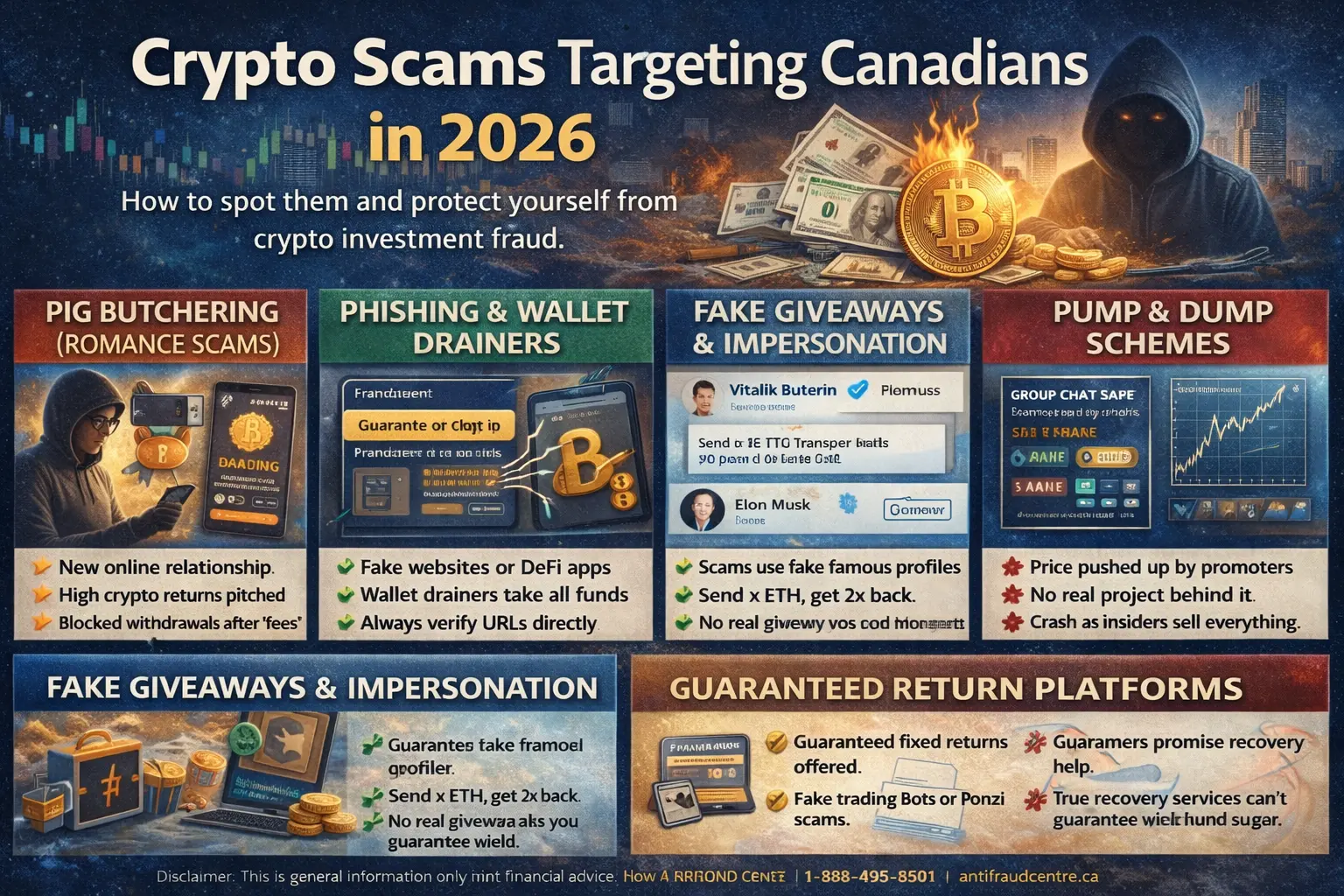
Pig Butchering (Romance Investment Scams)
This is currently the highest-value crypto fraud category in Canada, and it’s one of the most psychologically sophisticated scams ever run at scale. The name is brutal but accurate: the idea is to fatten the victim with trust and small wins before taking everything.
It starts with a connection. A message on a dating app, a LinkedIn request, a ‘wrong number’ text from someone friendly and personable. The scammer, often operating from an organised criminal network in Southeast Asia, builds a genuine-feeling relationship over weeks or months. They’re patient, thoughtful, interested in your life. Eventually, they mention crypto almost casually, describing returns they’ve been getting on a ‘private platform’ a family member introduced them to.
You’re invited to try it. You put in a small amount and it grows. Withdraw a little to prove it works. You invest more. Your account shows extraordinary gains. Then, when you try to withdraw a larger amount, there’s a problem: a tax hold, a compliance fee, a verification requirement. Each fix requires more money. When you can’t or won’t pay, everything goes dark. The platform disappears. The person disappears. Your money is gone.
Individual Canadian losses in these cases regularly exceed $100,000. Cases above $500,000 are not unusual. Both the RCMP and the CAFC have issued national warnings specifically about this fraud type.
| Warning Signs of Pig Butchering Someone you’ve never met in person mentions crypto and claims exceptional personal returns. You’re invited to a ‘private’ platform not available through any app store. Small withdrawals work early on to build your confidence. When you try to withdraw a larger amount, fees or holds appear requiring additional payment. The person discourages you from telling family or friends about the investment. |
Phishing and Wallet Drainers
Phishing in crypto works the same way it does in regular banking, except the consequences are more permanent. Fraudulent websites are built to look identical to legitimate exchanges, wallet apps, or DeFi platforms. One character off in the URL is all it takes. You log in, hand over your credentials, and that’s it.
A more sophisticated version is the wallet drainer. You encounter what looks like a DeFi protocol, NFT mint, or airdrop claim. You connect your wallet and sign a transaction. What you’ve actually signed is a malicious smart contract giving the attacker permission to drain everything in your wallet. These spread through hacked social media accounts, fake influencer posts, and Google ads targeting crypto search terms.
Two rules that prevent most phishing: always type exchange URLs directly into your browser rather than clicking links, and never sign a transaction without understanding exactly what permissions it’s requesting.
Fake Giveaways and Social Media Impersonation
You’ve seen them. An account that looks exactly like Elon Musk or Vitalik Buterin posts that they’re giving away crypto: send 0.5 ETH, get 1 ETH back. Or a YouTube stream shows a CEO interview with a link in the chat to a doubling promotion. These scams have run continuously for years because they keep working.
Fake verified checkmarks, copied profile photos, usernames nearly identical to the real accounts, all designed to look legitimate at a glance. Some operations compromise actual verified accounts and run the scam before the account gets locked.
There are no exceptions to this rule: no legitimate giveaway ever asks you to send money first. Not from Elon Musk, Not from Vitalik, Not from a Canadian bank. Not from anyone. If you’re asked to send crypto to receive more back, it’s a scam every single time.
Pump-and-Dump Schemes
A coordinated group buys up a low-value altcoin, then promotes it aggressively through Telegram groups, Discord servers, and paid newsletters. The price spikes as new buyers pile in. Then the promoters sell everything at once, the price collapses, and anyone who bought during the hype is holding worthless tokens.
These schemes target people looking for the next Bitcoin: a cheap coin they can get into early. It’s a rational impulse that scammers exploit very effectively. You’ll often be invited into an exclusive group with an urgency-driven pitch about a coin that’s about to break out.
If the promotional material for a coin is almost entirely about the price going up, with little or nothing about what the project actually does, that’s a serious sign. Genuine projects lead with their technology and use case. Pump-and-dump schemes lead with the chart.
Guaranteed Return Platforms
Any platform promising fixed, predictable returns from crypto is fraudulent. There’s no qualifier on that. No legitimate crypto investment can guarantee returns because the market is too volatile. What looks like a yield-generating platform is almost always a Ponzi scheme: early investors get paid from new investors’ money, creating the illusion of a working system until it collapses.
In 2026, these platforms have gotten more convincing. Some present as AI trading bots with detailed performance histories. Others dress themselves up as DeFi protocols with fabricated audit reports. They’ll show you dashboards with impressive growth curves and claim proprietary algorithms. None of it is real.
The tell is always the guarantee. Whether it’s 2% a day, 20% a month, or steady risk-free yield, nobody operating legitimately can promise that. If the returns sound better than anything a bank or regulated investment would offer, that’s because they’re made up.
Recovery Scams: Getting Hit Twice
After losing money in a crypto scam, many victims search frantically for a way to get it back. Recovery scammers are waiting for them. They monitor fraud forums, CAFC reports, Reddit posts, and social media for recent victims, then make contact claiming to be blockchain forensic specialists or lawyers with connections to retrieve stolen funds, for an upfront fee.
They produce convincing-looking reports. Everybody say recovery is imminent but requires one more payment for a compliance hold. Then they disappear with that money too.
The CAFC is explicit: no legitimate service can guarantee crypto recovery. If someone reaches out to you after a crypto loss offering to get your funds back, they’re almost certainly going to take more from you. Report them and don’t pay.
How to Protect Yourself: What Actually Works
Most crypto fraud is preventable. The patterns are consistent enough that knowing them puts you well ahead of most targets.
Verify before you deposit.
Treat unsolicited crypto contact as a red flag.
Never share your seed phrase.
Research every platform independently.
Talk to someone before a large investment.
No guaranteed returns exist. If the yield sounds better than anything available from any regulated institution in Canada, it’s because it’s fictional.
| How to Report Crypto Fraud in Canada Canadian Anti-Fraud Centre: antifraudcentre.ca or 1-888-495-8501 Your bank or financial institution if you transferred CAD (act quickly, some transfers can be recalled) Your provincial securities regulator at securities-administrators.ca Local RCMP or police detachment to file a report |
If You’ve Already Been Scammed
Report to the CAFC first. This matters even if recovery seems unlikely. It builds the intelligence picture that helps protect others and sometimes leads to enforcement action against the fraud networks behind these operations.
Contact your bank immediately if you sent fiat currency to fund the platform. Wire transfers can occasionally be recalled if you act quickly enough. Credit card companies sometimes offer more recourse.
Be very cautious about ‘recovery services’ that reach out to you after a loss. The vast majority are secondary scams. If you want legal help pursuing recovery, contact a Canadian lawyer independently and don’t respond to anyone who initiates contact with you.
Don’t let embarrassment stop you from reporting. Crypto fraud happens to smart, educated people. The operators behind these schemes are professionals who do this full time. Reporting protects others and contributes to eventual enforcement.
Frequently Asked Questions
Where do I report a crypto scam in Canada?
Start with the Canadian Anti-Fraud Centre: antifraudcentre.ca or 1-888-495-8501. Also report to your provincial securities regulator and local RCMP. If you transferred CAD, call your bank right away. Reporting doesn’t guarantee recovery, but it matters.
Can I get my money back after a crypto scam?
Rarely, but not never. Blockchain transactions are irreversible by design. In some situations where funds passed through regulated exchanges with KYC records, law enforcement has traced and seized stolen crypto. That’s a small fraction of cases. Any service promising to recover your funds for an upfront fee is almost certainly another scam.
How do scammers find their victims?
Dating apps, social media, LinkedIn, WhatsApp groups, and even wrong-number texts are common entry points. Some target people who’ve publicly discussed losing money in crypto. Others buy contact data. You don’t have to do anything wrong to be targeted. They cast a very wide net.