,Most people who buy crypto for the first time don’t think much about where it goes. It sits on the exchange they used, and that feels fine. For small amounts and short time horizons, it usually is. But as your holdings grow, or as you start reading about exchanges that have frozen withdrawals or gone under, the question of where your crypto lives starts to matter a lot more.
This guide explains how crypto wallets work, what the difference between hot and cold storage actually means in practice, and how to figure out which approach makes sense for where you are right now.
What a Wallet Actually Is
Here’s something that surprises a lot of people: a crypto wallet doesn’t hold your cryptocurrency. Your Bitcoin or Ethereum exists on the blockchain, a public ledger spread across thousands of computers worldwide. What a wallet holds is your private key: a unique cryptographic string that proves you’re the rightful owner of a specific address on that blockchain and lets you authorize transactions.
Your crypto address is like a bank account number. It’s public, and you share it to receive funds. Your private key is more like the PIN, the password, and the physical card all in one. If someone else gets it, they have complete and immediate control over everything in that wallet. No verification process, no reversal, no customer support. It doesn’t matter who you are.
“Not your keys, not your coins”
The QuadrigaCX Warning Canada’s most prominent exchange failure, QuadrigaCX in 2019, left roughly 76,000 customers unable to access more than $169 million in funds. Their crypto was on the exchange. When it failed, they had no way to get it back. A hardware wallet would have prevented every one of those losses.
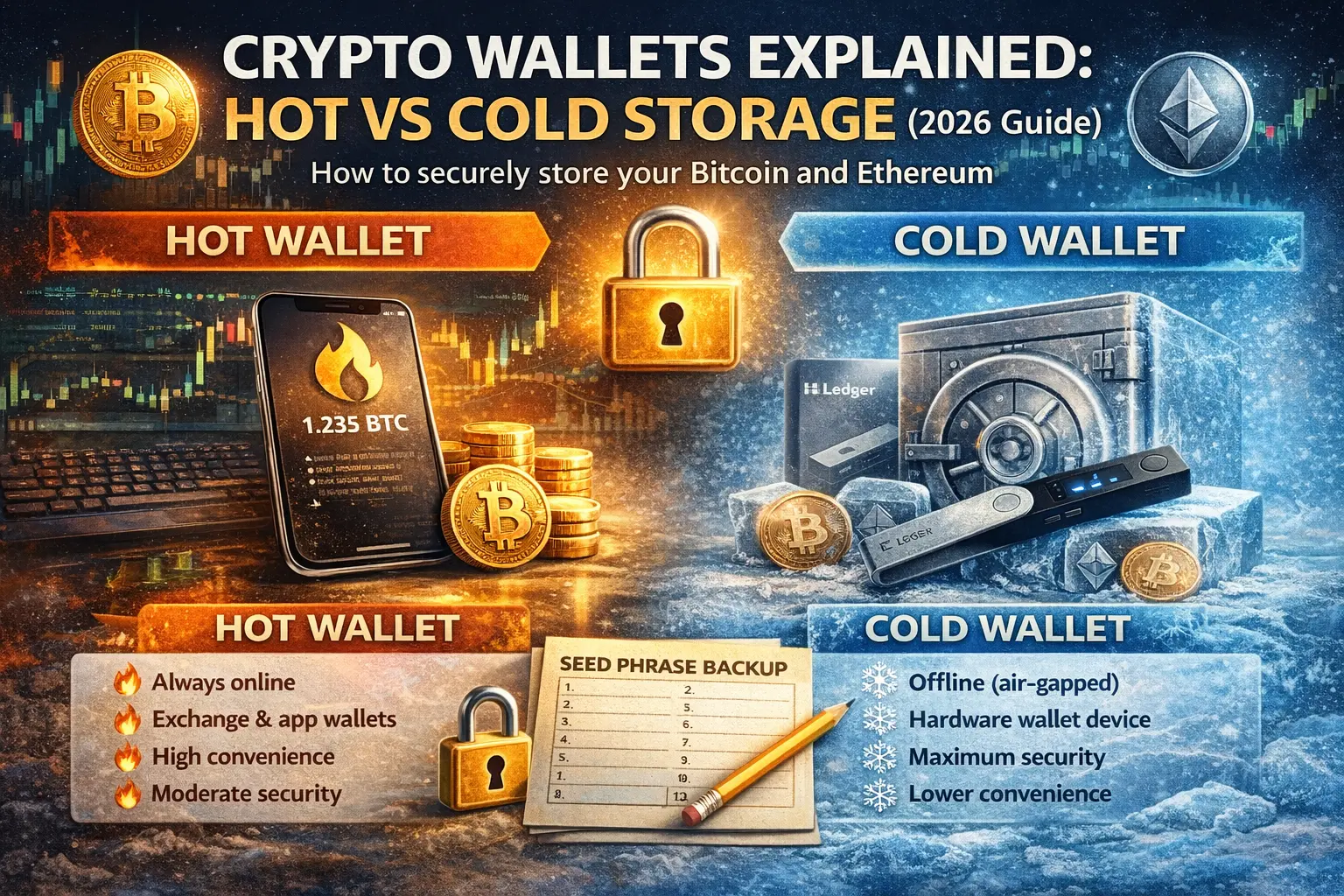
Hot Wallets: Convenience First
A hot wallet is any wallet that’s connected to the internet. That includes the built-in wallet on your exchange account, software wallets installed on your phone like Trust Wallet or MetaMask, and browser extension wallets used to interact with web-based apps.
Hot wallets are convenient. You can access them from anywhere, send and receive instantly, and interact with decentralized applications without any additional hardware. They’re free to set up. For everyday use and smaller amounts, they’re a sensible tool.
The trade-off is security. Because a hot wallet is online, it’s exposed to anything that can reach you online: malware on your device, phishing sites that mimic your exchange, compromised browser extensions, and platform-level breaches on the exchange itself. These risks are manageable with good habits, but they’re real.
Cold Wallets: Security First
Cold storage means keeping your private keys on a device that’s never connected to the internet. Hardware wallets, small physical devices made by companies like Ledger and Trezor, are the most common form. They generate and store your private keys entirely offline. When you want to sign a transaction, you connect the device briefly, confirm the details on the device’s own screen (which can’t be manipulated by anything on your computer), and then disconnect.
Even if your computer is completely compromised by malware, a properly used hardware wallet keeps your keys safe. That’s the protection cold storage provides.
Hardware wallets cost somewhere between $80 and $250 CAD depending on the model. For anyone holding meaningful amounts they don’t plan to touch often, that cost is trivial compared to what it protects.
Feature Hot Wallet Cold Wallet Internet connection Always online Offline (air-gapped) Examples Exchange wallet, MetaMask, Trust Wallet Ledger Nano, Trezor Model T Convenience High, access from anywhere Lower, requires physical device Security level Moderate, exposed to online threats High, protected from remote attacks Best for Active trading, small amounts Long-term holdings, larger amounts Cost Free $80 to $250 CAD
Your Seed Phrase: The Most Important Thing You’ll Write Down
When you set up any personal wallet, hot or cold, you’ll be given a seed phrase. It’s a sequence of 12 or 24 ordinary words, generated randomly, that can reconstruct your entire wallet on any compatible device.
That seed phrase is the master key to everything in your wallet. Anyone who has those words, in that order, has your crypto instantly, completely, and irreversibly. It doesn’t matter whether they’re sitting next to you or on the other side of the world.
Write it on paper right away. Store it somewhere physically secure: a home safe, a fireproof box, a safety deposit box. Some people engrave it on stainless steel as a backup against fire or water. Don’t photograph it, don’t type it into your computer. Don’t email it to yourself or save it in a notes app. And don’t share it with anyone, ever, not tech support, not a company rep, not a helpful person in a forum. No legitimate service will ever ask for it.
If you lose your hardware wallet device but you still have your seed phrase, you’re fine. Buy any compatible device, enter the phrase, and your wallet restores. If you lose the seed phrase and can’t access your wallet, your funds are gone permanently. No recovery process exists. This is why the phrase matters more than the device.
Which One Do You Actually Need?
It depends on how you’re using crypto and how much you’re holding.
If you’ve just made your first purchase, you’re still learning, and you’re not planning to hold for years, leaving your crypto on a registered exchange is acceptable. It’s convenient, it’s where most beginners start, and the risk is manageable at small amounts.
Once you’re holding an amount you’d genuinely be upset to lose, it’s time to think seriously about a hardware wallet. $1,000 is a number many people cite as a rough threshold, but the real question is whether the cost of a hardware wallet feels trivial compared to what you’re protecting. At current prices, that point comes well below $1,000 for most people.
For anyone using DeFi apps or connecting to web-based protocols, a software hot wallet like MetaMask is necessary regardless of total holdings. Use it for the amounts you’re actively working with, not your full portfolio.
The most common setup among experienced holders: a hot wallet or exchange account for active trading and small amounts, and a hardware cold wallet for the majority of their holdings. Two layers, two different risk profiles.
Quick Decision Guide Just starting out, small amounts: Exchange wallet is fine for now.
Holding over $1,000 long-term: Hardware wallet strongly recommended.
Using DeFi or Web3 apps: Software hot wallet like MetaMask for active use.
Maximum security for long-term savings: Hardware cold wallet only.
Frequently Asked Questions
What if I lose my hardware wallet?
You’re not stuck. If you have your seed phrase, you can buy any compatible hardware wallet, enter the phrase, and your full wallet restores. The device is just a container. Losing the device without the phrase, though, means losing everything.
Is MetaMask safe to use in Canada?
It’s a reputable and widely used software wallet, particularly for Ethereum and DeFi. It’s considered safe when downloaded from the official metamask.io site, your seed phrase is secured properly, you’re on a clean device, and you’re careful about which sites you connect it to. Like all hot wallets, it’s more exposed to online threats than cold storage. Use it for active funds, not everything you own.
Do I need a wallet if I’m just starting out?
Not right away. Your first purchase will sit in your exchange account by default, and that’s fine for the learning phase. As your holdings grow and your time horizon extends, a personal wallet becomes more important. Start learning about them now so you’re not making that decision under pressure later.