Bitcoin gets talked about constantly, on the news, at the dinner table, in your inbox from that one friend who won’t stop sending links. But for most Canadians who haven’t bought any yet, the basic question still hasn’t been answered clearly: what actually is it?
This guide answers that from the ground up. No assumed knowledge. No price predictions. Just a plain-language explanation of what Bitcoin is, how it works, what gives it value, and what you’d need to know before deciding whether it belongs in your financial life.
Bitcoin in One Paragraph
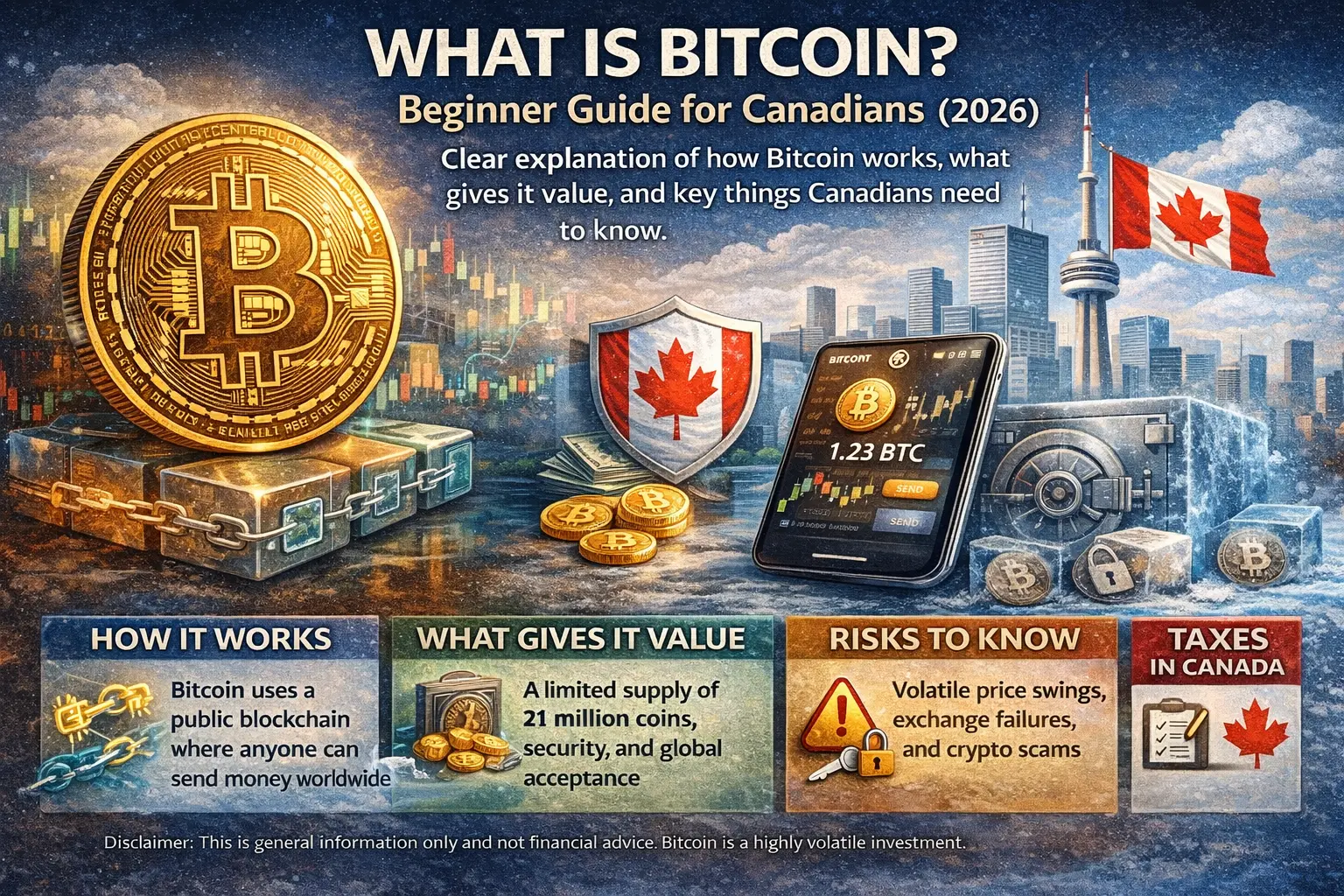
Bitcoin is digital money you can send to anyone, anywhere, without a bank. It was created in 2009 by someone using the name Satoshi Nakamoto, and it runs on a public network called a blockchain. Nobody owns that network. There’s no company running Bitcoin, no CEO, no head office. It’s maintained by thousands of computers around the world running the same software, all checking each other’s work.
Only 21 million Bitcoin will ever exist. That limit is built into the code, and changing it would require the agreement of the entire global network. This combination of decentralization, transparency, and hard supply cap makes Bitcoin different from every other form of money that’s ever existed.
How Bitcoin Actually Works
The Blockchain: A Ledger Everyone Can See
Every Bitcoin transaction ever made is recorded on a public ledger called the blockchain. Transactions get grouped into blocks, and each block links to the one before it, forming a chain going back to the very first transaction in 2009.
Thousands of computers each hold a complete copy of this ledger. When you send Bitcoin to someone, that transaction gets broadcast to the whole network, verified by those computers, and permanently written into the next block. Once it’s there, it can’t be altered. Changing an old transaction would mean rewriting every block that came after it on the majority of those thousands of computers simultaneously. That’s what makes Bitcoin secure.
Mining and the Proof of Work System
New Bitcoin enters circulation through mining. Specialized computers compete to solve a complex mathematical puzzle. Whoever solves it first gets to add the next block of transactions and receives a reward of newly created Bitcoin. This process, called Proof of Work, is deliberately energy-intensive, and that’s by design. It makes attacking the network incredibly expensive.
The mining reward gets cut in half roughly every four years in an event called the halving. It happened most recently in April 2024, dropping the reward from 6.25 BTC to 3.125 BTC. Around the year 2140, the last Bitcoin will be mined and no new coins will ever be created.
Wallets and Private Keys
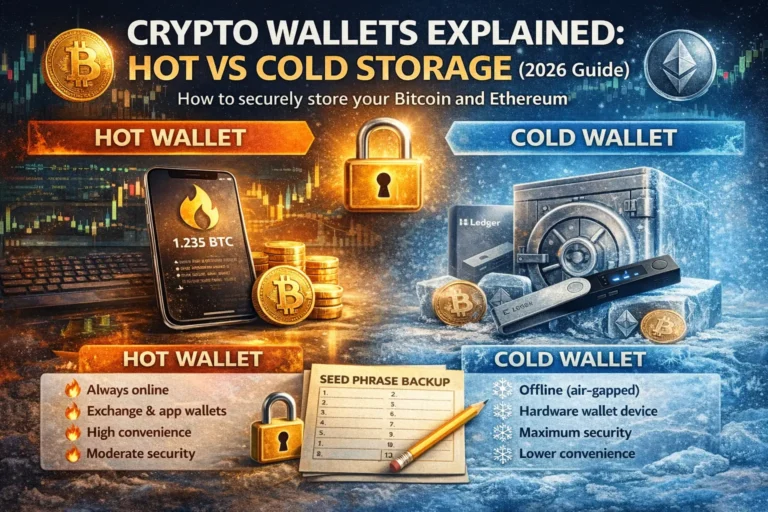
You don’t store Bitcoin in a bank account. You store it in a wallet, which holds your private key, a unique cryptographic password that proves you own a particular amount of Bitcoin on the blockchain. Share that key with someone else and they have complete, instant control. Lose it, and your Bitcoin is gone permanently. No customer support can help. There’s no password reset.
This is one of the most important things to understand about Bitcoin: it puts you in full control of your money. That’s genuinely powerful. It also means the responsibility for keeping it safe is entirely yours.
Private Key Security Your private key, or the seed phrase that generates it, is the only thing standing between you and losing your Bitcoin. Never store it digitally. Write it down on paper and keep it somewhere physically secure. Anyone with your seed phrase has your Bitcoin, full stop.
What Gives Bitcoin Its Value?
This is the question that trips people up. Bitcoin isn’t backed by gold. No government stands behind it. So what makes it worth anything?
Quite a lot, it turns out, though reasonable people disagree about exactly how much.
Scarcity
Only 21 million Bitcoin will ever exist. Compared to fiat currencies, where governments can print more money when needed, Bitcoin’s supply is completely fixed. Many people see this scarcity as a form of inflation protection, similar to owning gold but in digital form.
Network Effect
Bitcoin is valuable partly because millions of people and institutions have decided it’s valuable and are willing to transact in it. It’s the most recognised, most traded, most liquid cryptocurrency in the world. A currency nobody accepts isn’t really a currency. Bitcoin has crossed a threshold of adoption where its usefulness is self-reinforcing.
Institutional Acceptance
It’s no longer just retail investors buying Bitcoin. Major financial institutions, pension funds, and publicly traded companies hold it on their balance sheets. Spot Bitcoin ETFs, including Canadian ones listed on the TSX, have opened the door to Bitcoin exposure through traditional brokerage accounts and even registered accounts. That institutional presence creates a demand floor that simply didn’t exist in Bitcoin’s early years.
Bitcoin vs Ethereum vs Everything Else
People often use Bitcoin and cryptocurrency interchangeably. They’re not the same thing. Bitcoin is one cryptocurrency, the oldest and largest by market cap. Ethereum is a different coin with a different purpose: it’s a programmable blockchain that developers build applications on. Every other coin, Solana, XRP, Cardano, and the rest, is called an altcoin.
Bitcoin’s focus has always been relatively narrow: be a reliable, scarce, decentralized store of value. It’s been doing that one thing for 17 years. For a first-time Canadian buyer, Bitcoin is typically the starting point. It’s the most established, the most liquid, and the one most likely to still be around in 20 years, though no guarantees exist in this space.
Risks Every Canadian Should Know
Bitcoin has made a lot of people a lot of money. It’s also cost a lot of people a lot of money. Both things are true.
Volatility
Bitcoin’s price has dropped more than 80% from peak to trough multiple times. It’s not unusual for the price to fall 20% in a single week. If you might need this money in the short term, Bitcoin is a poor choice. People who’ve done well with it have generally held through multiple market cycles. It’s a long-horizon asset.
Custody Risk
If your Bitcoin is on an exchange and that exchange fails, as Canadian exchange QuadrigaCX did in 2019, taking $169 million in customer funds with it, you could lose everything. Self-custody through a hardware wallet eliminates this risk, but introduces another: you become solely responsible for keeping your private key safe.
Scam Risk
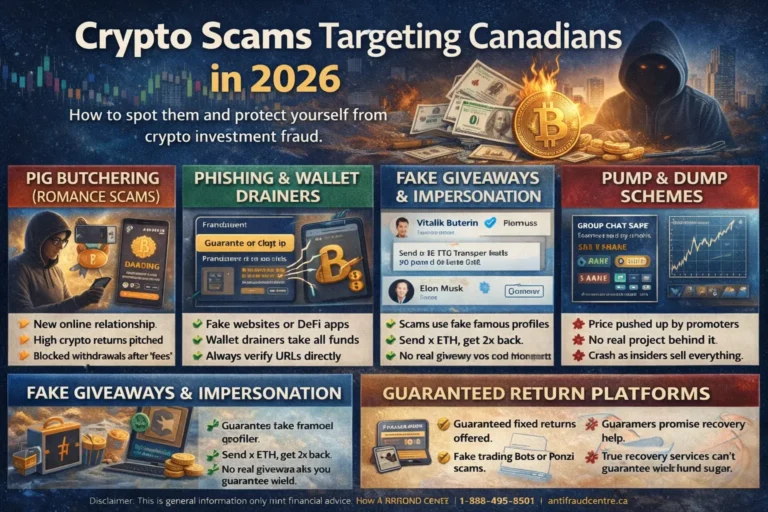
Bitcoin’s success has attracted an enormous amount of fraud. Romance scams, fake investment platforms, phishing sites, and pump-and-dump schemes targeting Canadians are common. The CAFC reports hundreds of millions in crypto-related fraud losses every year. Knowing what to watch for is one of the most valuable things you can learn.
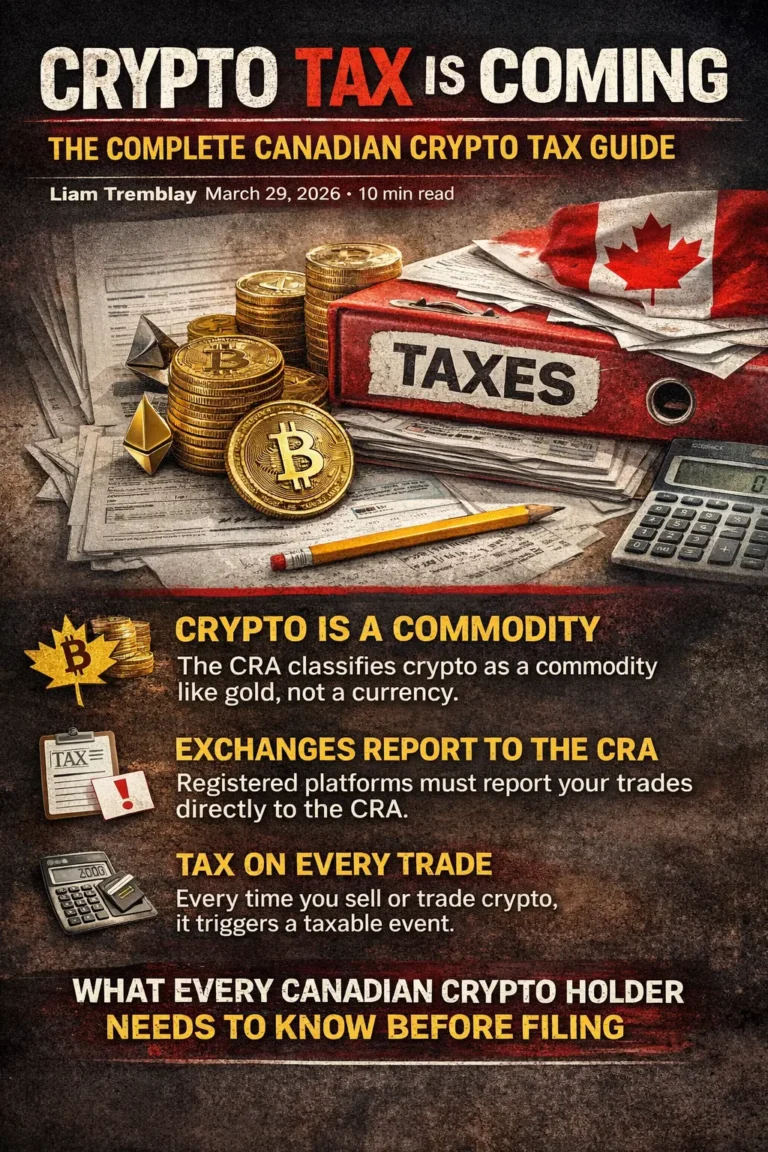
Bitcoin in Canada: Tax Summary The CRA treats Bitcoin as a commodity, not currency. Buying and holding it isn’t taxable. Selling, trading, or spending it triggers capital gains tax. Only 50% of capital gains are included in your taxable income for individual investors. Keep records of every transaction from day one.
Should You Buy Bitcoin?
That’s a personal question this guide can’t answer. Anyone who tells you they can is selling something.
Bitcoin has been around for 17 years. It’s survived multiple crashes, regulatory crackdowns in several countries, major exchange failures, and countless predictions of its death. It’s also grown from nothing to a market cap in the trillions. Whether that track record means it’ll keep going up, or whether it’s past its peak, is genuinely unknown.
If you’re considering it: start small. Only invest what you could afford to lose entirely. Use a registered Canadian exchange. Learn how to store it safely. Understand the tax implications before your first trade. And don’t let price movements in either direction make your decisions for you.
Frequently Asked Questions
Is Bitcoin legal in Canada?
Yes. Bitcoin is legal to buy, sell, hold, and use in Canada. Registered exchanges must be registered with FINTRAC. You’re required to report and pay tax on gains.
Can I buy a fraction of a Bitcoin?
Yes. Bitcoin is divisible down to eight decimal places. The smallest unit is called a satoshi. You can buy $50 worth of Bitcoin and you’ll own a tiny fraction of a coin, but that fraction performs exactly the same as a full Bitcoin percentage-wise.
How is Bitcoin different from a regular bank transfer?
A bank transfer requires both parties to have bank accounts, processes through multiple institutions, can be reversed or blocked, and often doesn’t work on weekends. A Bitcoin transaction goes directly between parties, works 24 hours a day every day of the year, can’t be reversed or censored, and settles in roughly 10 minutes regardless of where in the world the recipient is.