

Crypto Markets Canada: What’s Actually Moving in 2026
By Liam Tremblay | Last updated: April 2026 | 10 min read
⚡ Quick take: Crypto markets in 2026 are bigger, more regulated, and more institutionally driven than ever before. Bitcoin’s sitting near all-time highs. Ethereum’s DeFi ecosystem is growing. Canadian ETFs are pulling in steady capital. This guide breaks down how the market works, what’s driving it right now, and what Canadians should actually pay attention to.
If you’ve spent any time following crypto, you’ll know the market moves fast. Prices swing on a macro data release, a regulatory tweet, or a whale moving funds on-chain. That can feel chaotic from the outside.
But underneath the noise, there’s a structure to how crypto markets work. Understanding that structure, knowing what market cap means, what Bitcoin dominance signals, and how capital rotates between assets, puts you in a much better position than watching prices alone.
This guide covers the full picture of crypto markets in Canada in 2026: what’s happening, why it matters, and how you can read it intelligently. Whether you’re just getting started or you’ve been watching charts for years, there’s something useful here.
📋 Table of content:
Latest posts
Markets
View all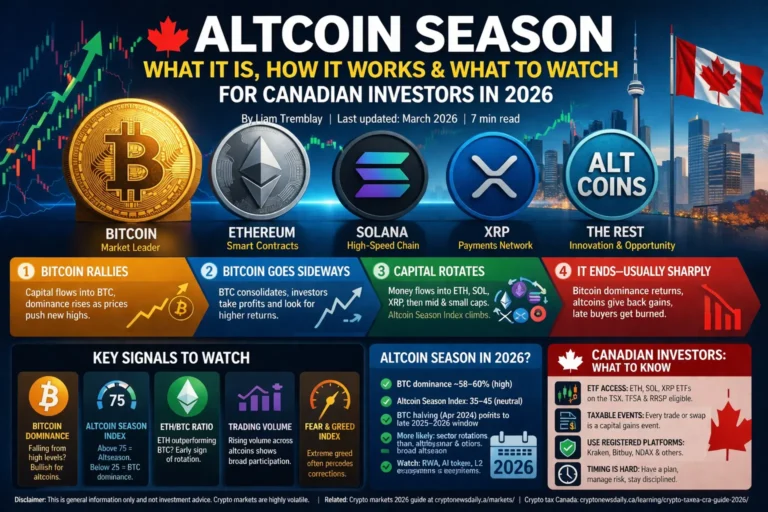
What Is Altcoin Season? A Canadian Investor’s Guide
Every so often in the crypto market, something shifts. Bitcoin has already run hard, and investors start moving capital into Ethereum, Solana,…
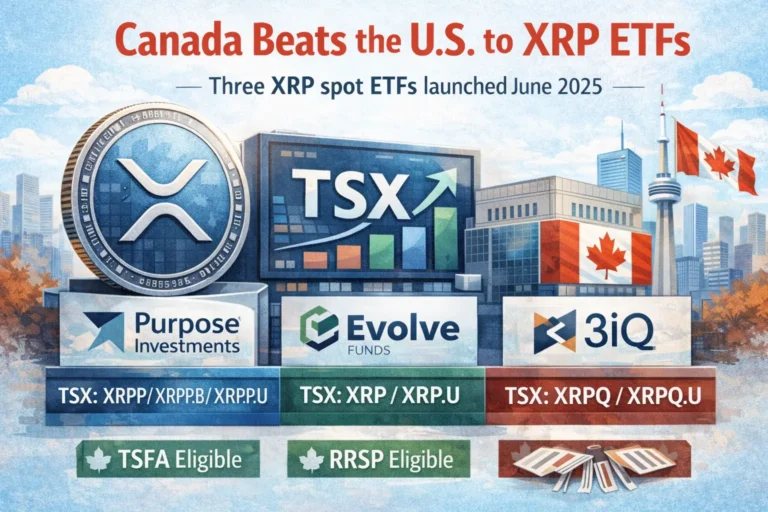
XRP ETF Canada: What You Need to Know About XRPP, XRP, and XRPQ
Canada beat the United States to the punch on XRP ETFs by a significant margin. In June 2025, three Canadian asset managers…
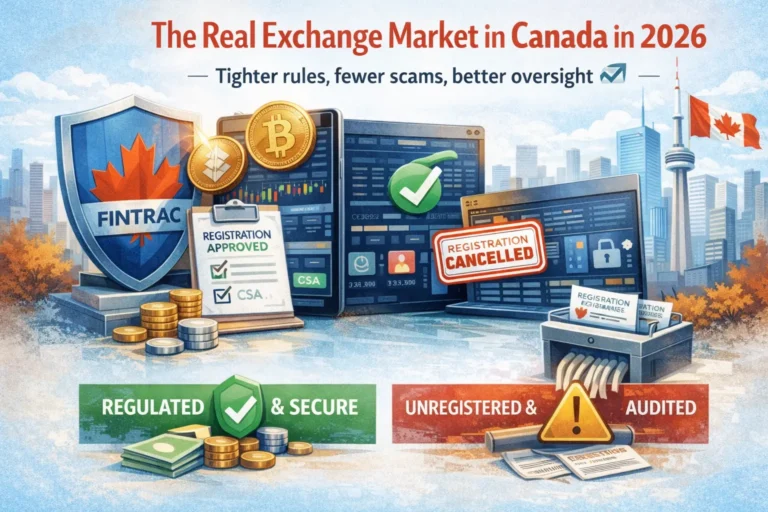
Best Crypto Exchanges Canada 2026: Your FINTRAC Registration Guide
Canada’s crypto exchange market looks very different in 2026 than it did three years ago. Regulators have tightened requirements, dozens of non-compliant…
How Big Is the Crypto Market in 2026?
As of early 2026, the total cryptocurrency market cap sits around $2.2 to $2.5 trillion USD. That’s roughly the size of Canada’s entire GDP, give or take. It’s a number that’s easy to gloss over, but it represents hundreds of millions of people around the world holding, trading, and building with digital assets.
For context: in 2017, the total market cap briefly touched $800 billion before crashing hard. In 2021, it hit nearly $3 trillion at its peak. Today’s market is larger, more liquid, and substantially more institutional than anything that came before it.
Where the Money Actually Sits
Bitcoin still dominates. It holds roughly 56 to 58% of the total market at any given time, which tells you a lot about where institutional confidence sits. Everything else, Ethereum, stablecoins, altcoins, DeFi tokens, divides up what’s left.
Asset
Approx. Market Cap
Dominance
What it represents
Bitcoin (BTC)
~$1.3T
~58%
Digital gold, institutional store of value
Ethereum (ETH)
~$240B
~10%
Smart contracts, DeFi, NFTs, Layer-2 anchor
Stablecoins (all)
~$235B
~10%
Trading, payments, DeFi liquidity
XRP
~$85B
~4%
Cross-border payments, banking rails
Solana (SOL)
~$55B
~2%
High-speed Layer-1, DeFi, memecoins
BNB
~$50B
~2%
Binance ecosystem token
All others
~$340B
~14%
Altcoins, DeFi tokens, meme coins, etc.
Price by coin:
| Name | Price | 24H (%) |
|---|---|---|
 Bitcoin(BTC) | C$98,008.68 | -1.16% |
 Ethereum(ETH) | C$2,997.06 | -3.24% |
 Tether(USDT) | C$1.38 | -0.01% |
 BNB(BNB) | C$832.17 | -1.02% |
 XRP(XRP) | C$1.84 | -3.37% |
 USDC(USDC) | C$1.38 | 0.01% |
 Solana(SOL) | C$113.21 | -2.77% |
 TRON(TRX) | C$0.440606 | 0.11% |
 Figure Heloc(FIGR_HELOC) | C$1.43 | -0.05% |
 Dogecoin(DOGE) | C$0.126282 | -3.56% |
Stablecoins deserve a special mention. They’re not an investment, they’re infrastructure. Their $235 billion collective market cap represents parked capital waiting to be deployed, liquidity enabling DeFi protocols to function, and the plumbing behind most crypto trading volume globally.
Bitcoin in 2026: Still the Market Anchor
Bitcoin remains what it’s always been: the reference asset. When institutions talk about crypto allocation, they’re almost always talking about Bitcoin first. Its fixed supply of 21 million coins, its track record, and its growing availability through regulated ETFs make it the clearest entry point for traditional capital.
After a volatile second half of 2025, Bitcoin staged a recovery heading into 2026. It’s been trading in a range roughly between $85,000 and $100,000 CAD, with analysts watching institutional ETF flows closely as the key variable. When ETF demand is strong, prices tend to hold. When ETF outflows pick up, you see the kind of selling pressure we saw in late 2025.
Bitcoin Dominance: What It Tells You
Bitcoin dominance, its share of total crypto market cap, is one of the most watched signals in the industry. Right now it’s hovering around 58%, which is historically high. That’s meaningful: it says that most crypto capital is sitting in Bitcoin rather than rotating into smaller assets.
When dominance starts dropping below 50%, it usually means investors are moving profits into Ethereum and altcoins chasing higher returns. Traders call this ‘altcoin season.’ It doesn’t always follow, and timing it is notoriously difficult, but it’s a pattern worth knowing.
Canadian Bitcoin ETFs
Canada’s Bitcoin ETF market is mature by global standards. Products like the Purpose Bitcoin ETF (BTCC), the Fidelity Advantage Bitcoin ETF, and the CI Galaxy Bitcoin ETF trade on the TSX and can be held in TFSAs and RRSPs. That’s a big deal for Canadian investors: it means Bitcoin exposure with no private keys, no exchange accounts, and full tax-sheltered access.
Combined assets under management in Canadian crypto ETFs have grown consistently, reflecting steady demand from both retail and institutional buyers who want regulated, custody-free access to the asset class.
Ethereum’s Market Position
Ethereum occupies a different space than Bitcoin. It’s not positioned as digital gold. Its value is tied to utility: how much activity runs through the network, how many developers are building on it, how much capital is locked into DeFi protocols on top of it.
In early 2026, Ethereum’s on-chain fundamentals are solid. Total value locked in DeFi protocols built on Ethereum rose 16% in the first two months of the year. Developer activity remains the highest of any Layer-1 blockchain. Institutional interest is growing through Canadian ETFs like ETHX and ETHH.
ETH’s price performance has been messier. After a rough second half of 2025, it’s been trading in the $2,700 to $3,200 CAD range in early 2026. Its relationship to Bitcoin (the ETH/BTC ratio) hit multi-year lows, which frustrated ETH holders watching BTC run ahead.
That said, the Fusaka upgrade expected later in 2026 could change the economics. It introduces PeerDAS, which should dramatically lower Layer-2 transaction fees and potentially drive a lot more on-chain activity back through the Ethereum base layer.
Altcoins: What They Are and How They Behave
Every cryptocurrency that isn’t Bitcoin is technically an altcoin. That definition covers an enormous range: from Ethereum, a $240 billion network with a decade of development history, to brand new meme tokens that might not exist in a month.
In practice, most serious market participants think about altcoins in tiers. There’s the large-cap group (ETH, SOL, XRP, BNB) that trades with reasonable liquidity and has established use cases. Then there’s the mid-cap tier, projects with working products but more risk. And then everything else, the long tail of speculation.
Solana’s Rise as a Genuine Competitor
Solana has earned its place in the conversation. After the chaos of FTX’s collapse in 2022, most people wrote it off. It came back. By 2025, Solana was processing more daily transactions than any other Layer-1 network, had a thriving memecoin ecosystem, and saw its first Canadian spot ETFs launch on the TSX.
It’s faster and cheaper than Ethereum for most everyday use cases. The tradeoff is a more centralised validator set and a shorter track record. For Canadians interested in altcoin exposure, Solana is increasingly part of the conversation alongside Ethereum.
XRP and the Regulatory Clarity Story
XRP had a long legal battle with the SEC in the United States. That case concluded with meaningful clarity: XRP traded on secondary markets wasn’t classified as a security, which opened the door for ETF products. Canada moved quickly. XRP spot ETFs launched on the TSX in mid-2025, becoming the first in North America.
XRP’s use case is focused: fast, cheap cross-border payments for financial institutions. It’s not trying to be a smart contract platform or digital gold. Whether that narrow focus is a strength or a limitation depends on who you ask.
What Drives Altcoin Seasons
‘Altcoin season’ is when altcoins broadly outperform Bitcoin for an extended period. It typically follows a sustained Bitcoin rally, as investors rotate profits into higher-risk assets chasing larger percentage gains. We’ve seen a few clear altcoin seasons historically, in 2017, in early 2021, in mid-2023.
Whether one is coming in 2026 is the question everyone’s debating. Bitcoin dominance at 58% is high. That’s the fuel sitting ready. But it won’t rotate until something triggers it, whether that’s a strong macro environment, a breakthrough protocol upgrade, or simply Bitcoin going sideways long enough that traders get bored and look elsewhere.
DeFi: Where Crypto Finance Actually Happens
Decentralised finance, DeFi, is the part of crypto that most directly challenges traditional banking. It’s a collection of protocols built mostly on Ethereum (and increasingly on other chains) that allow people to lend, borrow, trade, and earn yield without going through a bank, broker, or exchange.
It’s not a niche anymore. DeFi protocols collectively held over $80 billion in total value locked as of early 2026. Aave lets users borrow crypto against crypto collateral. Uniswap processes billions in daily trading volume without a central order book. Lido manages over $20 billion in staked Ethereum.
Real-World Asset Tokenisation
The most interesting DeFi development of the past 18 months isn’t yield farming or liquidity mining. It’s tokenisation of real-world assets: government bonds, private credit, real estate, being brought on-chain as DeFi collateral. BlackRock, Fidelity, and several major banks have active tokenisation programmes.
For the crypto market, this matters because it ties DeFi’s growth to traditional finance’s acceptance rather than pure speculation. When a US Treasury bond becomes usable DeFi collateral, the risk profile of the protocol holding it changes completely.
DeFi and Canada
Canadian regulators haven’t produced specific DeFi guidance yet, but the CRA’s position on crypto income applies. If you earn yield from a DeFi lending protocol, those rewards are likely taxable as income at the fair market value when received. Swapping tokens on a DEX is a taxable disposal. The rules from TradFi apply, even when there’s no intermediary.
You can’t hold DeFi positions directly in a TFSA or RRSP. But you can access DeFi exposure indirectly through certain ETF structures as that product category develops.
Stablecoins: The Market’s Plumbing
Stablecoins get less attention than Bitcoin or Ethereum, but they’re what makes the whole system function. A stablecoin is a crypto asset pegged to a fiat currency, usually the US dollar. USDT (Tether), USDC (Circle), and PYUSD (PayPal) are the biggest by volume.
Their combined market cap sits around $235 billion as of early 2026. That capital isn’t speculating; it’s sitting ready to trade, providing liquidity to exchanges and DeFi protocols, and increasingly being used for payments and cross-border transfers.
Canada’s Stablecoin Act
Canada is taking a more active regulatory role in stablecoins than most countries. The Stablecoin Act, which allocated $10 million to the Bank of Canada for oversight starting in 2026, signals that the government sees stablecoins as a legitimate part of the financial system, not something to be banned or ignored.
Value-Referenced Crypto Assets (VRCAs) is the regulatory term the CSA uses. Under these rules, Canadian-accessible stablecoins must be properly backed and audited. It’s a protective framework, but it also gives institutional players the regulatory clarity they need to incorporate stablecoins into their treasury operations.
⚠️ Not all stablecoins are equal. Some are backed 1:1 by cash and treasuries (USDC). Others use complex algorithms or partially backed reserves. The 2022 UST collapse, where a $40 billion algorithmic stablecoin went to zero in 72 hours, is a reminder that ‘stable’ is not a guarantee.
How to Read Crypto Markets: The Metrics That Actually Matter
Price is the number everyone watches. But price alone doesn’t tell you much. Here are the metrics that give you context around a price move.
Metric
What it measures
Why it matters
Market Capitalisation
Total value of all circulating coins (price × supply). Think of it as the ‘size’ of a cryptocurrency.
Gives you context — a $1 coin with 1 billion supply is worth more than a $100 coin with 1 million.
24h Trading Volume
How much of a coin changed hands in the last 24 hours.
High volume = active interest. Low volume = illiquid, harder to sell quickly.
Bitcoin Dominance
Bitcoin’s share of the total crypto market cap.
Above 55%: Bitcoin-led market. Below 45%: altcoin rotation underway.
Fear & Greed Index
A 0–100 sentiment score built from volatility, momentum, volume, and social data.
Below 25 = extreme fear (historically near bottoms). Above 75 = extreme greed (risk of reversal).
Total Value Locked (TVL)
Total assets deposited into DeFi protocols.
Rising TVL = more capital flowing into decentralised finance. Useful for tracking DeFi health.
Funding Rate
The fee paid between long and short traders in perpetual futures markets.
Positive rate = longs paying shorts (bullish sentiment). Negative = shorts paying longs (bearish).
Open Interest
Total value of outstanding futures contracts.
Dropping OI during a price fall = deleveraging. High OI + rising price = conviction.
You don’t need to watch all of these constantly. But knowing what they are means you’ll understand what people are actually talking about when a headline says ‘open interest collapsed’ or ‘fear and greed hit extreme fear.’
The Fear & Greed Index in Practice
It sounds simple, almost gimmicky. But the crypto Fear & Greed Index has a decent track record as a contrarian signal. When it hits extreme fear, it’s often close to a local bottom. When it hits extreme greed, a correction usually isn’t far off. Neither of these is a reliable trading signal on its own, but as one input among several, it earns its place.
Crypto Markets in Canada: The Local Context
Most crypto market commentary is written for a US audience. For Canadians, the picture has some important differences.
You’re Priced in CAD
When Bitcoin is at $83,000 USD, it’s closer to $115,000 CAD. That matters. Every price you track on CoinGecko or CoinMarketCap is in USD by default. Canadian exchanges like NDAX, Newton, and Netcoins show CAD prices, which removes the confusion. Always be clear which currency you’re looking at.
TFSA and RRSP Access Through ETFs
Canada’s crypto ETF infrastructure is one of the most developed in the world. You can get exposure to Bitcoin, Ethereum, Solana, and XRP through TSX-listed ETFs that qualify for TFSAs and RRSPs. That’s not available to US investors in the same way. It’s genuinely worth using if your goal is long-term exposure without the complexity of self-custody.
CRA and Tax Obligations
Every trade you make is a taxable event in Canada. Selling crypto for CAD, swapping one coin for another, using crypto to buy something: all of these trigger capital gains or losses that you need to report on Schedule 3 of your T1 return.
Staking rewards and DeFi income are taxed as income at receipt. For the 2026 tax year, capital gains above $250,000 have a higher inclusion rate of 66.67%. Keep records of every transaction, including the date, amount in CAD, and what you did. Software like Koinly or CoinLedger can automate most of this.
📌 This is general information, not tax advice. Talk to a Canadian tax professional if you’re unsure how your specific crypto activity should be reported.
Regulation Is Tightening
Canada’s crypto market is more regulated than most. Exchanges must be registered with FINTRAC and comply with CSA requirements. Some platforms available globally have pulled out of the Canadian market rather than meet these requirements. The ones remaining are properly registered and more trustworthy for it.
Starting in 2026, reporting requirements are stricter. All crypto asset service providers must report fiat-to-crypto and crypto-to-crypto transactions. It’s not surveillance, it’s tax compliance infrastructure, but it does mean the era of reporting nothing is over.
Key Market Themes to Watch in 2026
A few things are likely to shape how crypto markets move for the rest of this year.
Institutional ETF Flows
ETF flows are now the dominant price driver for Bitcoin and, increasingly, Ethereum. When institutions are buying, you’ll see positive weekly ETF flow data alongside rising prices and tightening spreads. When they’re selling, the opposite. Watching weekly ETF flow data from sources like Bloomberg or CoinDesk has become as important as any on-chain metric.
Macro: Interest Rates and Risk Appetite
Crypto has become genuinely correlated with risk assets. When equities fall sharply, crypto usually follows. When the Federal Reserve signals rate cuts, crypto tends to benefit as investors reach for higher-yielding, higher-risk assets. It’s not a perfect relationship, but ignoring macro entirely is a mistake.
In Canada, the Bank of Canada’s rate decisions also matter for sentiment, particularly since most Canadian crypto investors hold their assets in CAD and feel rate changes directly in their mortgage payments and investment accounts.
Protocol Upgrades and On-Chain Activity
Ethereum’s Fusaka upgrade, Solana’s continued performance improvements, and the growing pipeline of Layer-2 networks are all worth tracking. Strong on-chain activity, high TVL, active developer counts, generally precedes price appreciation, though not always on a timeline traders find convenient.
Quantum Computing Concerns
It sounds like science fiction, but it’s a real conversation in 2026. Google’s quantum computing research suggested that Bitcoin and Ethereum’s current cryptography could theoretically be vulnerable to sufficiently powerful quantum computers. Both networks have acknowledged this and are working on post-quantum solutions. It’s a long-term risk, not an immediate threat, but it’s worth understanding.
Frequently Asked Questions
What is the total crypto market cap right now?
It changes constantly, but as of early 2026, total market cap is in the $2.2 to $2.5 trillion USD range. We’ve embedded a live widget at the top of this page. Bitcoin accounts for roughly 56 to 58% of that total. Check CoinGecko or CoinMarketCap for real-time figures.
What is Bitcoin dominance and why does it matter?
Bitcoin dominance is simply Bitcoin’s share of the total crypto market cap. When it’s above 55%, most crypto capital is sitting in Bitcoin rather than flowing into altcoins. When it drops significantly, that usually signals a rotation into ETH and other assets. It’s one of the cleaner macro signals in crypto, not perfect, but useful.
What is altcoin season?
Altcoin season is a period when most major altcoins outperform Bitcoin. It tends to happen after a sustained BTC rally, as investors rotate into higher-risk assets. It doesn’t always follow a Bitcoin run, and picking the start of one in advance is harder than it looks in retrospect.
Is DeFi still relevant in 2026?
Yes, genuinely. The speculative frenzy of 2021 is gone, but the underlying protocols are bigger and more active than ever. TVL on Ethereum-based DeFi rose 16% in early 2026. The growth area is real-world asset tokenisation rather than yield farming, which represents a more durable form of adoption.
Can Canadians legally trade crypto markets?
Yes, completely legally. You can buy, sell, and trade crypto on any FINTRAC-registered Canadian exchange. You can access global markets through international platforms as well, though you’ll want to stick with platforms that meet Canadian compliance standards. All profits need to be reported to the CRA.
What’s the best way to track crypto markets in Canada?
CoinGecko and CoinMarketCap both let you set your currency to CAD, which makes price tracking much cleaner. For Canadian-specific context, including ETF flows, exchange news, and regulatory updates, you’re in the right place at cryptonewsdaily.ca.
Putting It All Together
Crypto markets in 2026 aren’t the wild west they were in 2017. There are regulated ETFs, institutional custody solutions, proper tax frameworks, and a global infrastructure that didn’t exist a few years ago. That maturity changes how you should think about these markets.
It doesn’t mean the volatility is gone. It won’t be for a long time. But it does mean you can participate in a more informed, structured way, using proper exchanges, tax-compliant structures like TFSAs and RRSPs, and real market data rather than social media noise.
Stay up with what’s moving. Canada’s crypto markets are maturing fast, and the information gap between those who track it seriously and those who don’t is real.
📰 Keep up with daily crypto market coverage at cryptonewsdaily.ca. Browse all our full cryptocurrency coverage.
About the Author
Liam Tremblay covers cryptocurrency markets, Canadian regulation, and digital assets at Crypto News Daily Canada. Contact: contact@cryptonewsdaily.ca
⚠️ Disclaimer: This content is for informational purposes only and does not constitute financial, investment, or tax advice. Crypto markets are highly volatile. Always do your own research and consult qualified professionals before making financial decisions.