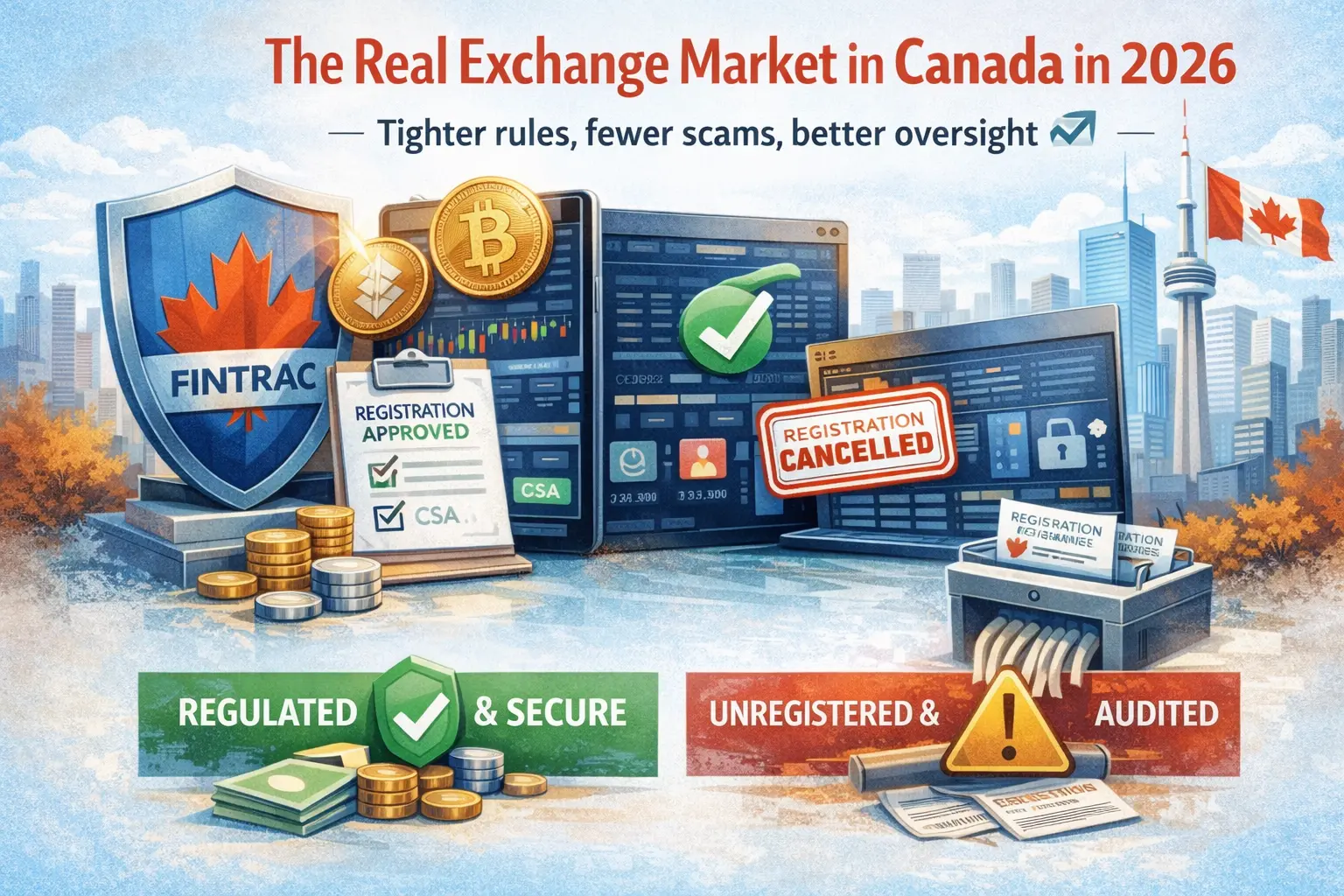
Canada’s crypto exchange market looks very different in 2026 than it did three years ago. Regulators have tightened requirements, dozens of non-compliant platforms have had their registrations pulled, and the exchanges still operating are properly registered, audited, and accountable. That’s actually good news if you know what you’re looking for.
This guide covers why FINTRAC registration matters, what else to check before you deposit money, and which platforms are genuinely worth using for Canadian investors in 2026.
Why FINTRAC Registration Is Your First Filter
FINTRAC — the Financial Transactions and Reports Analysis Centre of Canada — requires any business dealing in virtual currency in Canada to register as a Money Services Business (MSB). It’s the federal baseline for operating legally. Exchanges must verify customer identities, keep records, report large transactions, and maintain anti-money laundering protocols.
In 2026, FINTRAC has escalated enforcement significantly. The regulator cancelled 47 crypto firm registrations in the first months of the year alone, including exchanges, wallet services, and ATM operators. Cryptomus was fined $126 million for failing to report suspicious transactions. KuCoin faced a $14 million penalty for operating without proper registration.
The message is clear: platforms that cut corners are being removed. The ones still standing have earned their compliance status.
Beyond FINTRAC, the Canadian Securities Administrators (CSA) requires exchanges to register as either Restricted Dealers or Investment Dealers. The Digital Asset Custody Framework launched by CIRO in 2026 also mandates that registered platforms keep client assets legally separate from company funds — meaning if an exchange goes under, your crypto stays yours.
Stick with exchanges that are registered with both FINTRAC and the CSA. That combination gives you the strongest legal protection available.
What Else to Check Before You Choose an Exchange
Registration is the floor, not the ceiling. Here’s what else separates good exchanges from adequate ones:
Proof of Reserves. Does the exchange publish regular, third-party audited proof that they actually hold the assets they claim? This became critical after FTX collapsed in 2022. Platforms with ongoing PoR audits are significantly more trustworthy.
Cold storage. The majority of customer funds should be held offline. Hot wallets are convenient but vulnerable. A platform that keeps most assets in cold storage and publishes its custody arrangements is taking security seriously.
CAD deposit and withdrawal options. You want Interac e-Transfer support at minimum. Platforms with EFT and wire options as well are better for larger moves.
Trading fees. Maker/taker fee structures are now standard. Compare carefully — some exchanges advertise “no fee” trading but build costs into the spread. Always calculate your actual all-in cost on a sample trade.
Coin coverage. If you only want Bitcoin and Ethereum, almost any platform works. If you want Solana, XRP, or a broader range of altcoins, check availability before signing up.
Exchanges Worth Using in Canada in 2026
Kraken One of the longest-standing exchanges globally, operating in Canada since 2011. FINTRAC, CSA, and OSC registered. Offers 400+ cryptocurrencies, strong security (no major breaches in its history), Interac and wire support, and a Pro platform for active traders. One of the better all-round options for Canadians who want depth alongside compliance.
Wealthsimple Crypto Wealthsimple’s crypto offering sits inside the same app as stocks and ETFs, which is genuinely convenient for investors who want to manage everything in one place. 100+ cryptocurrencies, simple interface, fully regulated under both FINTRAC and IIROC. Fees are higher than dedicated crypto exchanges (0.5–2%), but the integration with registered investment accounts adds real value for certain users.
Bitbuy Toronto-based and one of Canada’s oldest registered crypto platforms. CSA-approved, FINTRAC registered, SOC 2 certified. Offers an Express Trade option for beginners and a Pro platform for more advanced users. 60+ cryptocurrencies, OTC trading for larger volumes. Solid for Canadians who want a local, institutional-grade platform.
NDAX (National Digital Asset Exchange) Based in Calgary. FINTRAC-registered and CSA-compliant. Known for competitive fees and a straightforward trading experience, with a good range of altcoins. A strong choice for cost-conscious traders who don’t need all the features of a larger platform.
Coinbase NASDAQ-listed and FINTRAC-registered, Coinbase entered the Canadian market in 2023 and has built solid compliance credentials. The interface is one of the most beginner-friendly available. 250+ cryptocurrencies, CAD deposits via debit and Interac. Fees are on the higher end for casual buyers, but the Advanced Trade platform is competitive for active traders.
Newton A Canadian exchange that prices itself as zero-fee, though the cost is baked into trading spreads. Simple app, instant CAD deposits. Good for straightforward buying of major assets without dealing with fee structures. Worth comparing actual purchase prices against other platforms before assuming it’s cheapest.
What Changed in 2026
The regulatory shift that matters most in 2026 is the Crypto-Asset Reporting Framework (CARF). Starting this year, registered Canadian exchanges are required to report transactions and account data to the CRA. Any transaction over $10,000 CAD is automatically flagged. The era of crypto operating under a different set of rules from traditional finance is over.
This is worth understanding before you choose a platform. Every FINTRAC/CSA-registered exchange is now part of this reporting framework. That’s appropriate — it brings crypto into the same compliance structure as banks and brokerages. But it means your trading history is no longer private from the CRA.
The Short Version
Use a FINTRAC and CSA-registered exchange. Check for proof of reserves, cold storage, and real CAD funding options. Compare fees on an actual trade, not a headline rate. For most Canadians, Kraken, Wealthsimple, Bitbuy, or NDAX covers the full range of needs depending on your priorities.
Don’t use exchanges that have lost their Canadian registration. The regulatory crackdown in 2026 is ongoing, and using a non-compliant platform puts both your funds and your tax position at risk.
📌 Disclaimer: This is general information only and not financial advice. Always verify an exchange’s current registration status before depositing funds.
🔗 Related: Crypto markets guide