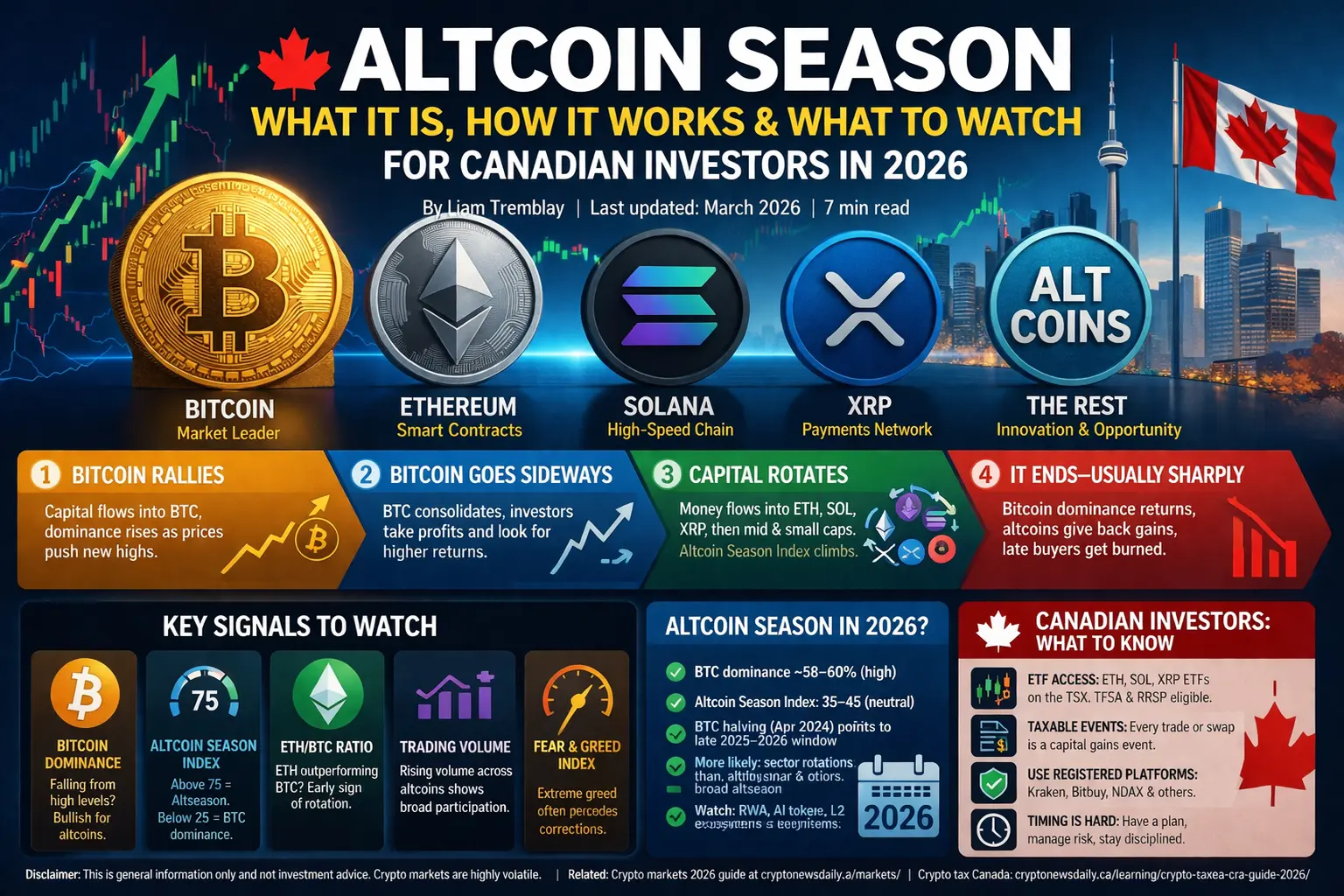
Every so often in the crypto market, something shifts. Bitcoin has already run hard, and investors start moving capital into Ethereum, Solana, XRP, and further out into smaller projects. Prices start jumping across the board. Social media fills up with people talking about returns that feel impossible in traditional markets. That’s altcoin season — and knowing how it works puts you in a much better position than watching it happen in confusion.
This guide covers what altcoin season actually is, what historically triggers it, how to read the signals, and what it means for Canadian investors in 2026 specifically.
The Basic Definition
An altcoin is any cryptocurrency that isn’t Bitcoin. The term covers a huge range — from Ethereum, a $240 billion network with a decade of history, to new tokens that appear and disappear within weeks.
Altcoin season, or altseason, is a period when a broad basket of altcoins outperforms Bitcoin on a relative basis. The most commonly cited definition comes from Blockchain Center’s Altcoin Season Index: when at least 75% of the top 50 cryptocurrencies (excluding stablecoins) have outperformed Bitcoin over the previous 90 days, the index reads above 75 and the market is officially in altcoin season.
A single altcoin going up isn’t altseason. XRP doubling while everything else stagnates isn’t altseason. It’s about broad, market-wide capital rotation away from Bitcoin into the rest of the market.
What Historically Triggers It
Altcoin seasons don’t happen randomly. There’s a rough pattern that repeats across market cycles, though it’s never identical.
Step one: Bitcoin rallies. Institutional money, retail interest, and macro tailwinds push Bitcoin to new highs or sustained strength. Bitcoin dominance — its share of total crypto market cap — rises as capital flows into the most trusted, most liquid asset in the space.
Step two: Bitcoin goes sideways. After the rally, Bitcoin consolidates. Investors who bought early are sitting on gains and looking for higher-percentage returns elsewhere. The perceived risk of holding Bitcoin feels lower than the opportunity cost of missing a potential altcoin run.
Step three: Capital rotates. Money flows first into large-cap altcoins — typically Ethereum, then Solana and XRP. As those move, capital reaches further into mid-caps and eventually smaller, more speculative tokens. The Altcoin Season Index climbs. Gains become explosive for a period. Sentiment turns euphoric.
Step four: It ends. Usually sharply. Bitcoin reasserts dominance, altcoins give back large portions of their gains, and late buyers learn a hard lesson about timing.
The historical altseasons that most people reference: 2017–2018, when ICO mania drove hundreds of new tokens to extraordinary valuations before a brutal collapse; and early-to-mid 2021, when DeFi and NFTs brought a new cycle of explosive altcoin returns.
How to Read the Signals
A few indicators are worth tracking if you’re watching for altcoin season conditions:
Bitcoin Dominance. The most important single signal. When Bitcoin’s share of total crypto market cap starts falling from elevated levels — above 55% — it typically means capital is rotating outward. The current reading matters less than the direction and rate of change.
Altcoin Season Index. Blockchain Center publishes this daily. Readings below 25 suggest Bitcoin is dominating. Readings above 75 signal altcoin outperformance. As of early 2026, the index was sitting in the 35–45 range — neither confirmed altseason nor clear Bitcoin dominance, reflecting a mixed market.
ETH/BTC ratio. When Ethereum starts outperforming Bitcoin on a sustained basis, it’s usually an early sign that capital is beginning to move down the risk curve. ETH is the first stop on the rotation.
Trading volume. Rising volume across altcoins, not just Bitcoin, is a concrete signal of broader participation.
Fear & Greed Index. Extreme greed readings often precede corrections. If the broader market Fear & Greed Index is deep in greed territory while altcoins are running hard, it’s worth taking that seriously as a risk signal.
Is There an Altcoin Season in 2026?
This is the question dominating crypto Twitter in early 2026, and the honest answer is: not yet confirmed, and more complicated than past cycles.
Bitcoin dominance has been holding around 58–60%, historically high. The Altcoin Season Index has been well below the threshold that would confirm broad altcoin outperformance. The April 2024 Bitcoin halving typically precedes a major bull cycle within 12–18 months — which by that pattern would point toward late 2025 or 2026 as a potential window.
There are legitimate structural headwinds this time. The number of tracked tokens has exploded from roughly 5.8 million to nearly 30 million in the past year alone. That dilution means capital gets spread thinner — making a broad altseason like 2021 less likely than a more selective, sector-driven one. Institutional capital, which has poured into Bitcoin ETFs, tends to stay concentrated in the largest assets rather than flowing into mid and small caps.
Some analysts argue altseason is already happening, just in different assets than investors expected. Arthur Hayes put it bluntly: there is always an altcoin season happening somewhere — if you missed it, you didn’t own what went up.
The more practical framework for 2026: rather than waiting for a broad altseason signal, watch for sector-specific rotations. Real-world asset tokenisation, AI tokens, Layer-2 ecosystems. Sectors with actual institutional adoption are attracting capital regardless of what the broad altcoin index is doing.
What This Means for Canadian Investors
A few Canada-specific points worth keeping in mind as you follow altcoin season dynamics:
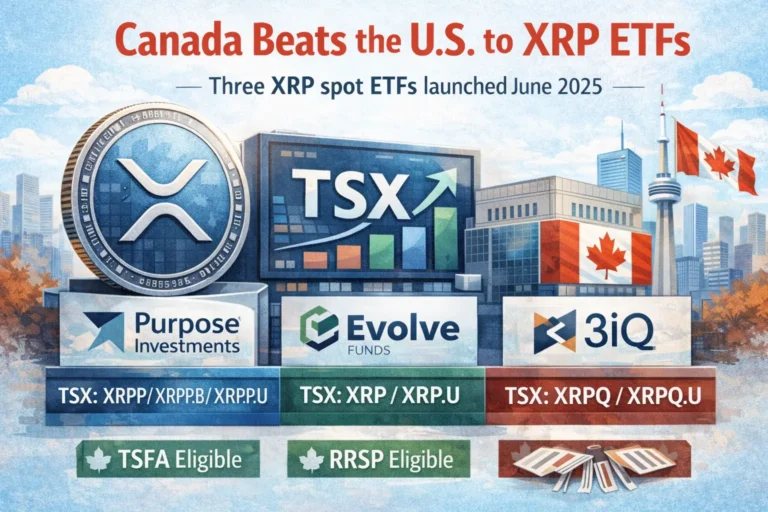
ETF exposure gives you some altcoin access without the chaos. Canadian investors can now hold Ethereum, Solana, and XRP through TSX-listed ETFs inside TFSAs and RRSPs. If you want altcoin exposure through the ETF route, those are the options.
Every trade is taxable. Swapping Bitcoin for Ethereum, or any altcoin for another altcoin, triggers a capital gains event in Canada. The CRA treats every swap as a disposal and an acquisition. If you’re actively rotating between assets during an altcoin season, you’re generating taxable events on each move. Keep records meticulously.
FINTRAC-registered exchanges matter more when trading altcoins. Altcoins often have thinner liquidity on smaller platforms. Stick to registered Canadian exchanges like Kraken, Bitbuy, or NDAX, or larger international platforms with Canadian compliance registrations.
Timing altseason is genuinely difficult. The analysts who called the start of the 2021 altseason accurately mostly did so in retrospect. Preparing a framework and positioning gradually is more reliable than trying to call the exact moment of rotation.
The Short Version
Altcoin season is a period of broad capital rotation from Bitcoin into alternative cryptocurrencies, typically following a Bitcoin rally and driven by investors seeking higher-percentage returns. The signals to watch are Bitcoin dominance direction, the Altcoin Season Index, and the ETH/BTC ratio.
Whether 2026 produces a classic broad altseason is debated. What’s more likely is sector-specific rotations rather than a rising-tide-lifts-all dynamic. For Canadian investors, that means staying informed, keeping tax implications in view, and sizing altcoin exposure within a portfolio you’d be comfortable holding through a sharp correction.
📌 Disclaimer: This is general information only and not investment advice. Crypto markets are highly volatile.
🔗 Related: Crypto markets 2026 guide