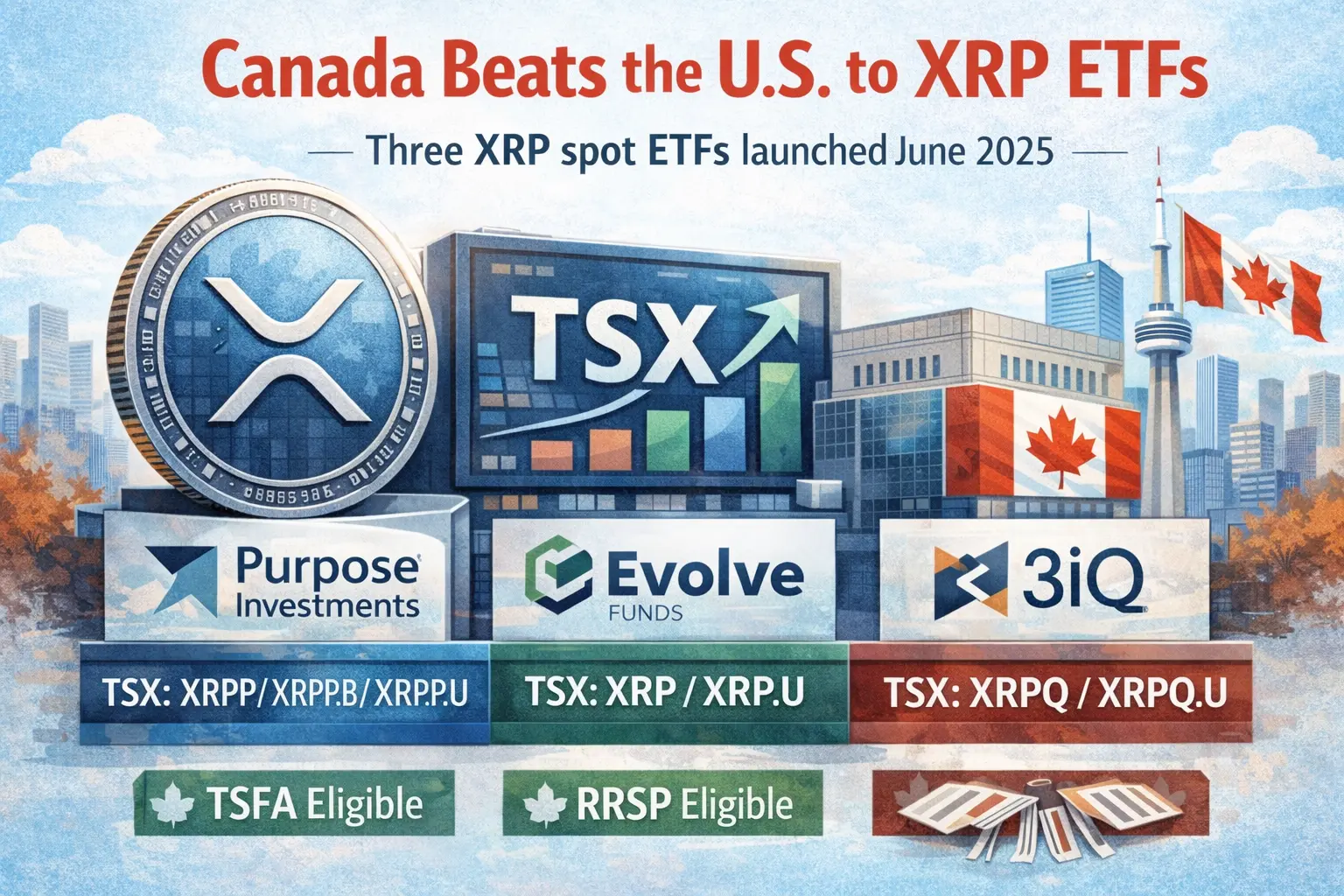
Canada beat the United States to the punch on XRP ETFs by a significant margin. In June 2025, three Canadian asset managers — Purpose Investments, Evolve Funds, and 3iQ — launched competing XRP spot ETFs on the Toronto Stock Exchange simultaneously. US issuers were still waiting for SEC approval at the time.
For Canadian investors, this means you can get regulated, TFSA and RRSP-eligible exposure to XRP through your existing brokerage account. No crypto exchange, no wallet, no private key management. This guide covers how these products work, what distinguishes them from each other, and what you should understand about XRP before putting money into it.
A Quick Recap: What Is XRP?
XRP is the native token of the XRP Ledger, an open-source blockchain built by Ripple in 2012. Its primary design goal is fast, low-cost cross-border payments — settling transactions in seconds for fractions of a cent, compared to days and significant fees for traditional international wire transfers.
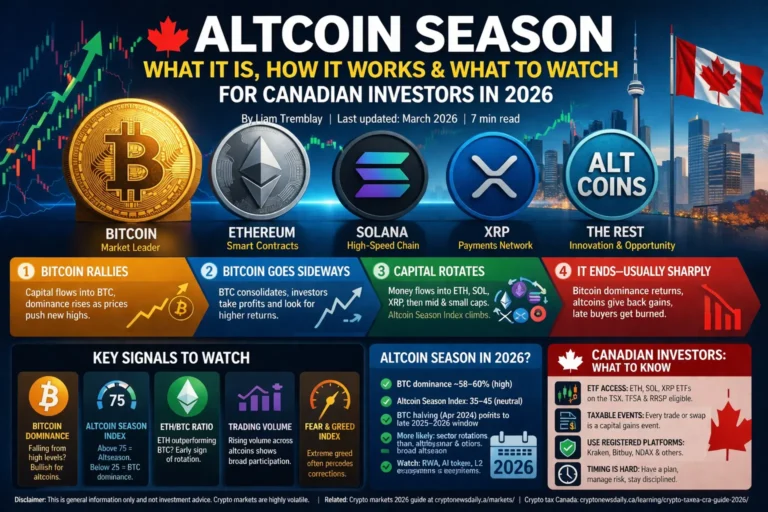
It’s the fourth-largest cryptocurrency by market cap globally, sitting around $85 billion USD in early 2026. XRP isn’t trying to be digital gold like Bitcoin, or a smart contract platform like Ethereum. Its focus is payments infrastructure — a narrower but potentially very practical use case as financial institutions explore blockchain for settlement.
Why XRP ETFs Finally Launched in Canada
For years, XRP’s ETF prospects were clouded by a legal battle between Ripple Labs and the US Securities and Exchange Commission over whether XRP constituted an unregistered security. That case reached a meaningful resolution: a US court ruled that XRP sold on public secondary markets wasn’t a security — clearing a significant regulatory hurdle.
Canada’s regulators moved quickly on that clarity. The OSC approved the products in June 2025, and all three launched on the same day. This made Canada the first jurisdiction in North America to offer spot XRP ETFs to retail investors.
The Three Canadian XRP ETFs
Purpose XRP ETF (TSX: XRPP / XRPP.B / XRPP.U) Launched June 18, 2025, by Purpose Investments — the same firm behind Canada’s first Bitcoin ETF in 2021. XRPP invests directly in XRP with institutional-grade custody through Gemini and Coinbase. Three versions are available: CAD-hedged (XRPP), CAD non-hedged (XRPP.B), and USD-denominated (XRPP.U). Management fee of 0.69% after the initial fee-holiday period ended in early 2026. TFSA and RRSP eligible.
Evolve XRP ETF (TSX: XRP / XRP.U) Evolve launched the same day as Purpose. It holds physical XRP with a 0.75% management fee, passively managed and tracking the CME CF XRP-Dollar Reference Rate. Two versions: unhedged CAD (XRP) and USD (XRP.U). TFSA and RRSP eligible. Evolve manages about $7 billion in assets overall, giving the fund solid institutional backing.
3iQ XRP ETF (TSX: XRPQ / XRPQ.U) 3iQ launched alongside the others, offering no management fee for the first six months to attract early investors. Ripple Labs itself invested in the 3iQ fund at launch, which is notable. All assets held in independent cold storage. Available in both CAD (XRPQ) and USD (XRPQ.U). TFSA and RRSP eligible.
Hedged vs Unhedged: Which Matters for You
All three managers offer currency-hedged and unhedged options. Here’s the practical difference:
XRP is priced in USD. When you hold an unhedged XRP ETF in your Canadian brokerage account, your returns in CAD are influenced by both XRP’s price movement and the USD/CAD exchange rate. A weakening Canadian dollar can boost your returns; a strengthening loonie can cut them.
A hedged version eliminates that currency variable. You get XRP price exposure without the foreign exchange noise. Hedging typically costs a small premium and can slightly reduce returns in environments where the Canadian dollar weakens, but it also protects you if the loonie strengthens.
For shorter holding periods or if you’re actively watching your portfolio, the hedged version is generally cleaner. For very long-term holders, currency effects tend to average out over time.
What XRP’s Use Case Means for Investors
XRP is a more concentrated bet than Bitcoin or Ethereum. Its value is tied to adoption by financial institutions using the XRP Ledger for cross-border settlement — which is a real and growing use case, but one that depends heavily on Ripple Labs and its institutional partnerships.
The regulatory clarity from the US court ruling helped significantly. Franklin Templeton’s XRP ETF receiving NYSE listing approval in late 2025 added further legitimacy to the asset. But XRP doesn’t have the broad developer ecosystem of Ethereum or the store-of-value narrative of Bitcoin. It’s a more specific, utility-focused asset.
That doesn’t make it a bad investment — it makes it a different kind of investment. If you believe cross-border payment infrastructure will increasingly run on blockchain rails, and that XRP has a meaningful role in that, the ETF structure gives you a clean way to express that view without direct custody complexity.
How to Buy a Canadian XRP ETF
Through any major Canadian brokerage — Questrade, Wealthsimple Trade, TD Direct Investing, RBC Direct Investing, and others all support TSX-listed ETFs. Search for XRPP, XRP, or XRPQ, select the version (hedged/unhedged, CAD/USD) that fits your situation, and place the order. Available inside TFSAs and RRSPs.
Things to Keep in Mind
All three products are physically-backed spot ETFs — they hold actual XRP, not derivatives. That’s important. You’re tracking the real asset price, not a synthetic version of it.
Management fees differ. 3iQ’s fee-holiday period has ended, putting all three products broadly in the 0.69–0.75% range. Check current MER rates before buying as these can change.
XRP is volatile. It has a long history of significant price swings in both directions. Sizing it as a small portion of a broader crypto allocation is the approach most financial advisors would recommend if they’re recommending it at all.
Bottom Line
Canada’s XRP ETFs give investors a regulated, low-friction way to gain exposure to XRP inside tax-advantaged accounts. Whether you choose XRPP, XRP, or XRPQ largely comes down to your preferred custodian, fee sensitivity, and whether you want currency hedging. All three are solid, properly registered products with institutional backing.
XRP itself is a focused bet on payment infrastructure. It’s worth understanding what you’re investing in before you do.
📌 Disclaimer: This is general information only and not financial or investment advice. Always do your own research.
🔗 Related: Full crypto markets guide | Bitcoin ETF Canada: