
The Ethereum AI downstream trade got a big shoutout this week, and it has Fundstrat’s Tom Lee sounding pretty confident. On July 21, Lee posted a chart showing ETH beating the Roundhill Memory ETF by 72 percentage points over the past month. That is a real number. But it does not automatically mean money is fleeing chip stocks for Ethereum, and I think the full story is more interesting than the headline.
Inside the Ethereum AI Downstream Trade
Here is the actual math behind the Ethereum AI downstream trade. Ether climbed 24% over the past month. The Roundhill Memory ETF, ticker DRAM, fell 38% over that same stretch. Stack those together and you get a 72 percentage point gap, or 7,200 basis points in trader lingo. Lee posted the chart on X and framed it as proof that AI linked money is rotating out of hardware and into Ethereum.
DRAM only launched in April 2026, so it is still a young fund. It is also the first ETF built entirely around memory chip makers. That includes firms producing HBM, DRAM, and NAND Flash chips, the components that keep AI models running. So it is a fair proxy for hardware side AI investment, even with a short track record.
Why Tom Lee Picked Memory Chips as the Comparison
Lee did not pick DRAM at random. Memory chips have been one of the loudest AI trades of 2026, and for good reason. IDC expects worldwide AI spending to hit $758 billion by 2029. Storage built specifically for AI workloads grew 20.5% in a single quarter last year, according to the same research.
So why did the fund drop 38% while that demand story stayed intact? Lee’s post did not say, and that is the part I keep coming back to. Fundstrat did not publish fund flow data showing money actually leaving semiconductor stocks for Ethereum. What we have is a performance chart, not proof of where the cash is going.
What the Ethereum AI Downstream Trade Leaves Out
A rotation story needs more than two lines on a graph moving in opposite directions. It needs actual flows, and those flows are not showing up in Lee’s post yet. Meanwhile, spot ETH funds also logged renewed ETF inflows this month. That gives the Ethereum AI downstream trade some real backing beyond a single chart, and it is the piece of evidence I would want more of before calling this a genuine shift.
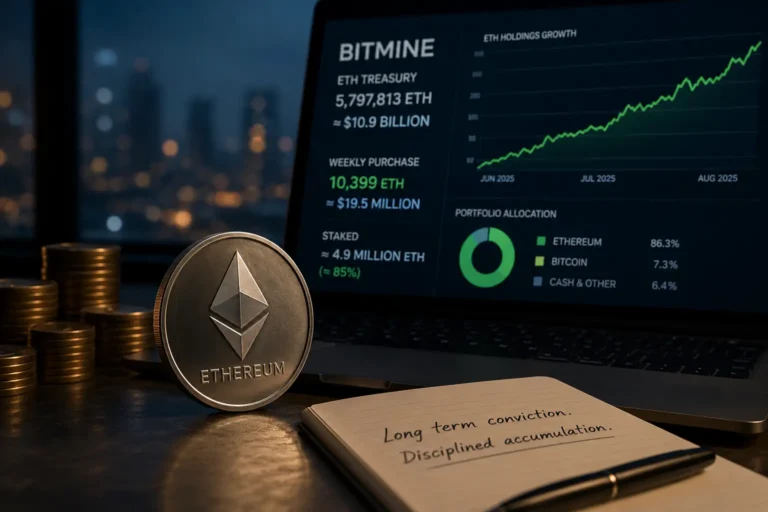
It is also worth remembering who is talking here. Lee chairs BitMine Immersion Technologies, one of the largest corporate holders of ETH anywhere. The firm holds more than 5.7 million coins on its balance sheet. A bullish framing for Ethereum is not a conflict by itself, but it is context that belongs in the room.
Memory Chip Demand Still Looks Strong
None of that lines up neatly with what is happening in the physical memory market. TrendForce’s own July forecast points to rising memory chip prices heading into the third quarter. Conventional DRAM contracts are expected to climb 13% to 18%, while NAND Flash rises 10% to 15%, largely on AI server demand.
That is a strange backdrop for a fund tracking those exact companies to fall 38% in a month. The more likely explanation is profit taking after a blistering earlier run, not a collapse in the underlying business. Investors trimming winners is not the same thing as investors abandoning a sector entirely.
What the Ethereum AI Downstream Trade Means for Canadian Investors
For anyone holding ETH through a Canadian exchange or ETF, this is a narrative worth watching rather than trading on today. Ethereum’s push into institutional privacy tools this month adds another layer to that story. It gives banks one more reason to take the network seriously beyond price charts and X threads.
One month of outperformance against a three month old ETF is not nothing, but it is not a verdict either. Whether the Ethereum AI downstream trade turns into a lasting theme depends on real ETF flow data. It also depends on whether Ethereum keeps pulling in fresh capital once semiconductor stocks stop correcting.
Keep half an eye on this one for now. If the next few weeks bring real fund flow numbers backing up the rotation story, that changes things. If they do not, this stays a clever chart and nothing more.