
Canadian crypto scam websites are disappearing by the thousands, and on paper that looks like a win. Between June 5, 2025, and June 5, 2026, securities regulators and CIRO knocked 11,728 fake platforms offline. Yet most people who already sent money to those sites are still waiting for it. In my view, the takedown count shows how big the problem is, not how close we are to fixing it.
Canadian Crypto Scam Websites by the Numbers
The headline figure comes from the Canadian Securities Administrators’ Year in Review, released in August. The 11,728 sites used 19,860 separate web addresses, so plenty of scams ran on several domains at once. Put another way, that’s roughly 32 fake platforms gone every single day.
Crypto also dominates the warnings. Over the same year, the CSA issued 763 investor alerts, and over 85% involved crypto assets. Regulators also pursued 13 crypto enforcement matters and permanently banned 47 firms and individuals from Canadian markets. That lines up with the record FINTRAC crypto penalties we covered last week. So the pressure is coming from more than one regulator.
On October 6, the CSA followed up with a fresh warning for Investor Education Month. Its advice was simple: question online tips and any pitch promising big gains with little risk. It also warned that AI now makes fake investment content far more convincing. That matches the Canadian crypto investor awareness data from August, where more people knew the risks but plenty still got caught.
Why Canadian Crypto Scam Websites Keep Coming Back
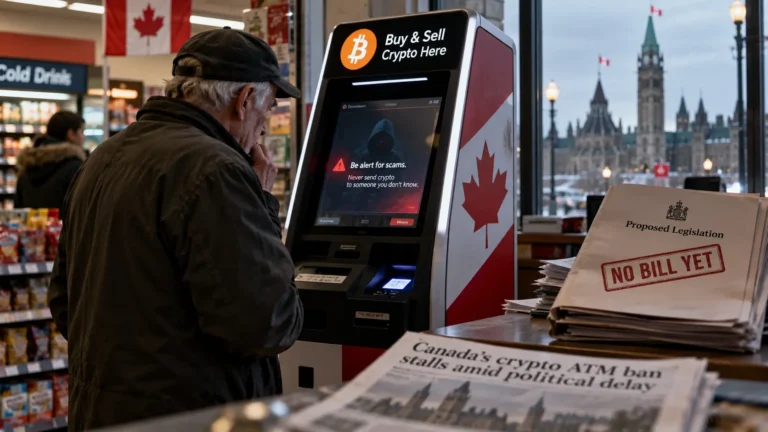
Here’s the uncomfortable part. Spinning up one of these sites costs a few dollars and maybe an hour. A takedown, by contrast, needs reports, checks and paperwork. So a site regulators remove on Monday can be back under a new name by the weekend. Ottawa’s crypto ATM ban tells a similar story, since it still has no bill six months after it was announced.
Cross-border money is the bigger wall. Once stolen crypto lands on an offshore exchange, Canadian police and courts struggle to touch it. That’s why the Supreme Court will hear an appeal over about $65,000 in bitcoin tied to an alleged fraud. In short, the judges will decide when Canadian courts can freeze crypto held by offshore companies.
Meanwhile, Ottawa is building a new enforcement arm. Tabled on April 27, Bill C-29 would create a Financial Crimes Agency with its own police powers. Ottawa has also set aside $352.7 million over five years to fund it. The bill passed second reading in June, and a House committee began studying it in October, but it still faces third reading and the Senate.
The Recovery Gap Nobody Wants to Talk About
Takedowns of Canadian crypto scam websites protect the next victim, not the last one. After a payment confirms on a blockchain, there’s no bank to call and no chargeback to request. As a result, most victims simply never see that money again.
Worse still, losing money once can make you a target twice. In August, the CSA warned that fraudsters were posing as Union Bancaire Privée, a real Swiss private bank. They contacted Canadians who had lost crypto and demanded upfront fees to recover it. The bank, for its part, said it had nothing to do with any of it.
That second wave hurts because it feeds on hope. Simply put, anyone who offers to recover your stolen crypto for a fee is almost certainly running the next scam.
What Could Actually Slow Canadian Crypto Scam Websites
First, the Supreme Court ruling could hand prosecutors a clear test for freezing crypto held offshore. A firm answer would make it much harder to park stolen funds on exchanges that once courted Canadian users. Even so, a decision is probably many months away.
Second, a working Financial Crimes Agency could actually trace and seize funds instead of just logging complaints. Critics have long said Canada lags its peers on financial crime enforcement. A dedicated agency would close part of that gap, but only if Parliament gets the bill over the line.
Until then, the cheapest defence against Canadian crypto scam websites is also the dullest. Before you send a cent, search the platform on the CSA’s free registration tool at aretheyregistered.ca. If it isn’t listed, walk away, no matter how polished the site looks or who seems to endorse it.
My Take: Takedowns Are the Floor, Not the Fix
I’m glad regulators are pulling 32 fake platforms offline a day. Still, celebrating that number misses the point. Every closed site is a symptom of a market that’s still easy to exploit. Canadian crypto scam websites will keep multiplying as long as the money behind them stays safe once it crosses a border.
So here’s where I land. Ottawa should treat Bill C-29 as urgent rather than routine. The Supreme Court case also deserves far more attention than it’s getting. Do you think Canada is moving fast enough to protect crypto investors, or are regulators still playing catch-up?