Nearly $46 million. That’s what hackers are still holding after breaking into Blockstream’s Liquid network and minting bitcoin that never should have existed. The Blockstream Bitcoin ransom demand that followed reads less like a disclosure and more like an old-fashioned shakedown. Blockstream said no.
What the Blockstream Bitcoin Ransom Demand Actually Involves
Someone found an inflation bug in Liquid, the sidechain Blockstream built to move bitcoin faster and more privately. They used it to mint more than 4,000 LBTC out of thin air, then converted a chunk of that fake supply into real bitcoin on-chain. So in total, roughly $320 million moved before anyone could stop it.
Why the “Bug Bounty” Framing Doesn’t Hold Up
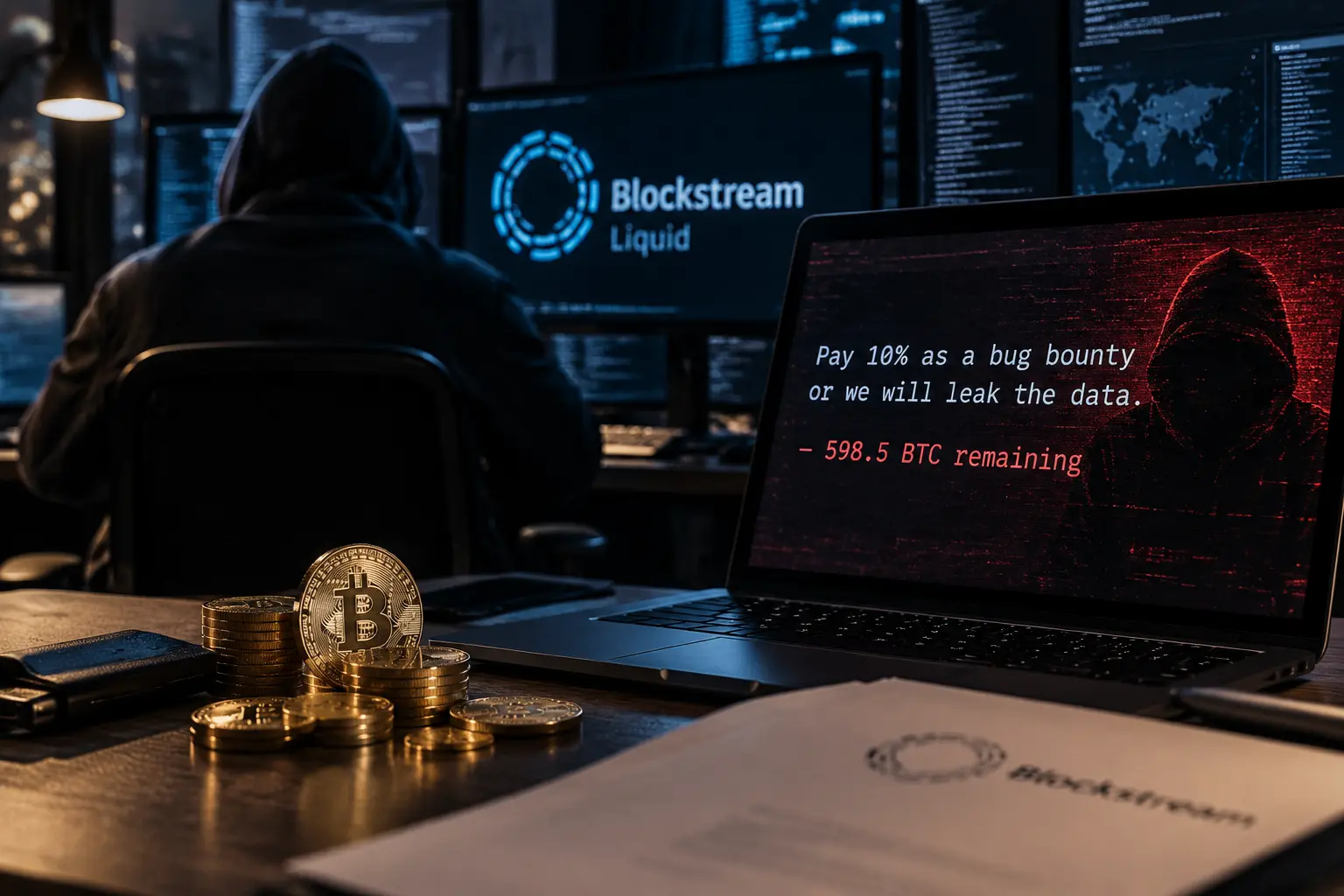
Most of that $320 million came back, except for 598.5 BTC, worth about $46 million at current prices. The attackers want 10 percent of it as a “bug bounty.” Otherwise, they’ll leak encrypted messages and claim it’ll cost users another 15 percent. That’s not disclosure, it’s the kind of pressure tactic security researchers have flagged as Bitcoin’s attack surface keeps growing.
The Blockstream Bitcoin Ransom Demand Fits a Bigger Trend
Still, Blockstream isn’t an isolated case. Illicit crypto addresses pulled in at least $154 billion in 2025 alone, and stolen funds are a growing slice of that pile. North Korean hackers alone are blamed for roughly $2 billion of it. That scale makes the Blockstream Bitcoin ransom demand look almost small by comparison.
Canada has already started building rules for exactly this kind of failure. CIRO, the country’s investment regulator, rolled out a tiered custody framework for crypto trading platforms back in February. It’s largely a response to the QuadrigaCX collapse, where investors are still missing $123 million. Blockstream isn’t a Canadian platform, but the same principle applies everywhere bitcoin sits in someone else’s wallet.
How Blockstream Is Responding
The company isn’t negotiating. Instead, it called the Blockstream Bitcoin ransom demand what it is: theft, not responsible disclosure, and said it won’t pay for stolen funds. Now it’s working with law enforcement, exchanges, and forensic investigators to trace the money and find whoever did this.
What the Blockstream Bitcoin Ransom Demand Means for Everyday Holders
If you don’t hold LBTC or use Liquid, the Blockstream Bitcoin ransom demand doesn’t touch your wallet directly. But it’s a reminder that bitcoin’s security depends on the code wrapped around it, not just the base chain. Sidechains, bridges, and custodial wrappers are where nearly all the recent damage keeps happening. That’s worth remembering before trusting any platform with real money.
So does the ransom get paid? Blockstream says no, and so far it’s holding that line. Whether the hackers actually leak anything or just fade away, this is one more case for locking down custody before the next inflation bug turns up somewhere else.