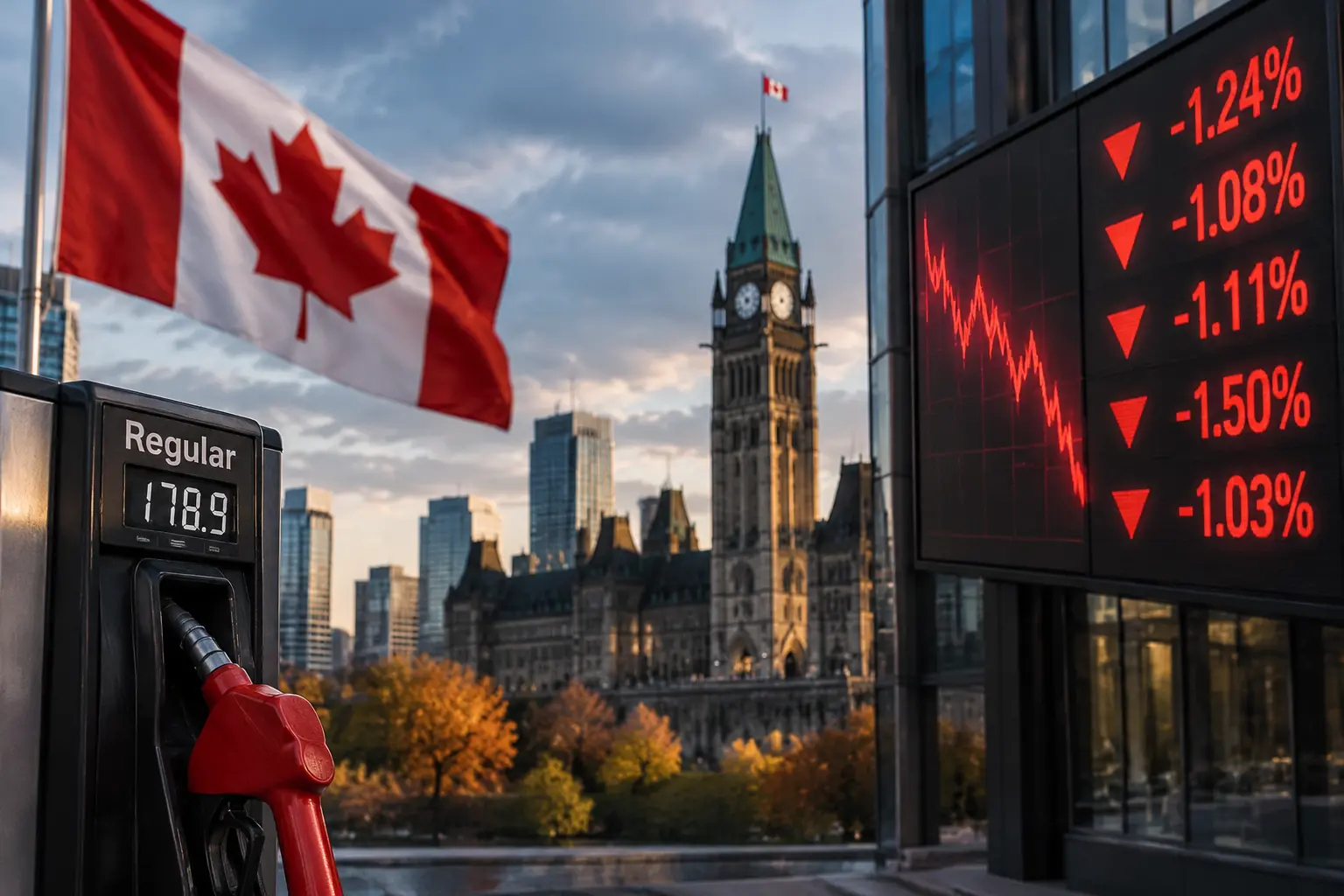
Canadian inflation above target is back after a three-month break, and the headline number looks worse than it is. Statistics Canada said Monday that consumer prices rose 3.1% in September from a year earlier. Gasoline did almost all the lifting, while the gauges the Bank of Canada actually trusts cooled off. My read is simple: this is an energy problem, not a broad inflation problem, and policymakers shouldn’t panic.
Why Canadian Inflation Above Target Is Back
September’s reading edged up from 3.0% in August, yet it still missed the 3.2% economists expected in a Reuters poll. Even so, it pushed headline inflation back above the 1% to 3% band after three straight months inside it. That band surrounds the Bank’s 2% inflation-control target, a deal with Ottawa that runs to the end of this year.
Energy prices climbed 19% from a year earlier, up from 15.4% in August. Gasoline alone jumped 27.8%, and fuel oil soared 57.8% as the Middle East conflict kept crude expensive. Crypto traders felt that pressure on Oct. 7, when tanker attacks in the Strait of Hormuz pushed Brent past $101.
On a monthly basis, prices rose just 0.1% after slipping 0.1% in August. Statistics Canada also noted that the seasonal switch to cheaper winter-blend gasoline held the fuel increase down. So without that switch, the headline could have looked even uglier.
Core Inflation Tells a Much Calmer Story
Here’s the part most headlines buried. All three of the Bank’s preferred measures of core inflation eased in September, according to the same release. CPI-trim slipped to 1.8% from 1.9%, while CPI-median dipped to 1.9% from 2.0%. Meanwhile, CPI-common cooled to 2.4% from 2.6%.
Strip out gasoline entirely and inflation ran at 2.2%, down from 2.4% a month earlier. Grocery prices rose only 1.7%, the smallest annual gain since May 2024. Shelter costs did pick up to 1.8%, with rent climbing 2.8%. Still, neither looks like a runaway trend.
Air fares are the odd outlier, up 19.4% from a year ago. Then again, airlines pass fuel costs straight to travellers, so that jump traces back to the same energy shock. In other words, Canadian inflation above target is narrow rather than broad, and that difference decides what the central bank does next.
What Canadian Inflation Above Target Means for the Bank of Canada
This was the last inflation report before the Bank of Canada rate decision on Oct. 28, which also brings fresh forecasts. Governor Tiff Macklem has already warned those projections will show higher inflation. However, he’s also said there’s little evidence so far of energy costs spreading to other goods and services.
Markets seem to agree with that reading, at least for now. Money markets expect the Bank to hold its policy rate at 2.25% next week, while still pricing in a quarter-point hike in December. Two-year Canadian bond yields also rose 7.7 basis points to 2.545% after the data. Clearly, traders aren’t ruling out tighter policy.
I think a December hike would be a mistake on these numbers. Higher rates won’t lower gasoline prices, and they’d squeeze households already paying more at the pump. Unless core measures start climbing, the Bank should look through Canadian inflation above target and wait.
Canadian Inflation Above Target and the Loonie
Currency traders reacted fast. After the release, the Canadian dollar firmed 0.29% to C$1.4096 per U.S. dollar, or about 70.94 US cents. Canadian inflation above target tends to lift hike odds, and higher hike odds usually support the loonie.
Crypto holders should care about that more than it seems. Since bitcoin trades mostly in U.S. dollars, a firmer loonie trims the Canadian value of coins you already own. On the flip side, it makes buying more slightly cheaper from a Canadian bank account.
Just don’t overthink the currency angle. As we’ve covered, bitcoin’s correlation with the U.S. dollar has been far weaker than most traders assume, explaining only about 17% of its daily moves. Flows and sentiment still do most of the driving.
Why Crypto Investors Should Watch Rates, Not Gas Prices
Rate expectations are the real transmission line here. When traders price in hikes, borrowed money gets pricier, and risk appetite usually fades first in crypto. We saw how fast that can unwind earlier this month, when roughly $487 million in long positions got wiped out in a day.
Right now, bitcoin sits near C$115,000, according to CoinGecko data. That’s a long way from panic territory. Still, a hawkish surprise from either the Bank of Canada or the Fed next week could change the mood quickly.
Practically, the advice hasn’t changed. Keep position sizes sensible, use a registered platform, and skip borrowed money during data-heavy weeks like this one. Canadian platforms can’t offer margin to retail clients anyway, which works in your favour right now.
My Take on Canadian Inflation Above Target
Sure, Canadian inflation above target makes for a scary headline, but it doesn’t describe what’s happening underneath. Core prices are cooling, groceries are calmer, and the only real fire is at the gas pump. That’s exactly the kind of shock a 1% to 3% band exists to absorb.
So keep an eye on Oct. 28, when both central banks speak on the same day. Will Macklem look through the fuel spike, or lean toward a December hike? Tell us how you’re positioning your crypto ahead of the decision, and whether a stronger loonie changes your buying plans.