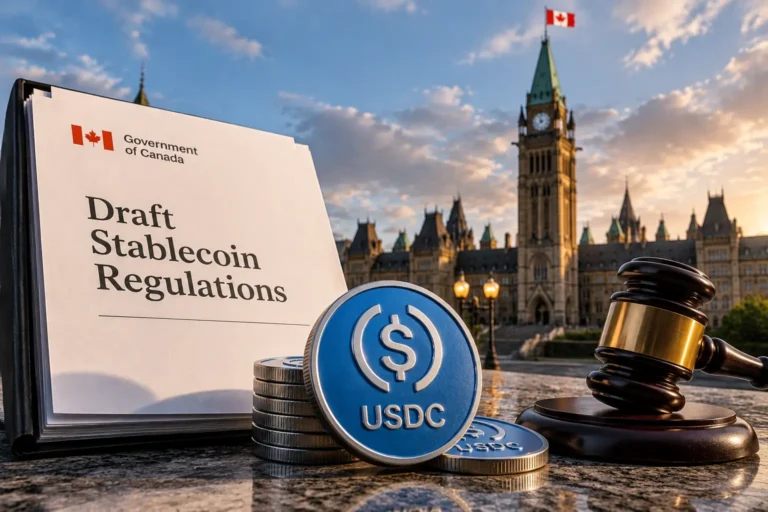

Crypto remittances from Canada just got a lot harder to dismiss as a niche story. Chainalysis says remittance-sized transfers from Canada to India, China and the Philippines hit US$2.36 billion in the year to June 2026, up 141%. That’s money going to families, not speculators chasing the next pump. Still, I think the headline hides an awkward detail: almost all of it travels in US dollars.
Crypto Remittances From Canada Hit US$2.36 Billion
Those numbers come from the North America chapter of the 2026 Geography of Crypto report, published Oct. 14. Over the period, people made 3.56 million transfers, with roughly 75,100 unique senders each month. On average, each transfer came to US$663, which looks a lot more like a monthly payment home than a trade.
Notably, the three corridors now make up 19.4% of Canada’s outbound cross-border stablecoin value, up from 10.9% a year earlier. Yet the Philippines, often the poster child for this trend, is only a small slice. Transfers there reached about US$61 million, up 28%, so India and China carry most of the weight.
For context, Chainalysis estimates Canadians sent about $8.3 billion abroad through all channels in 2023. In other words, crypto remittances from Canada are still a minority route. But it’s the fastest-growing one, and growth like that rarely goes unnoticed.
Why Canada Leads the G7 in Peer-to-Peer Crypto
Chainalysis ranks Canada as the G7’s strongest peer-to-peer crypto economy. It also places seventh in the world for both domestic and cross-border flows. Meanwhile, Canada’s overall crypto economy grew 2.3% to US$247.7 billion, while the U.S. economy shrank 2.2% over the same bear-market stretch.
Demographics explain a big chunk of that gap. Almost one in four people in the 2021 census, or 23.0% of the population, were or had been landed immigrants or permanent residents. Many of them still support relatives or pay bills back home.
Cost does the rest. According to World Bank figures cited in the report, sending money from Canada costs about 6.7% on average, and banks charge more than 7%. By contrast, a stablecoin transfer settles for a cent or less, although cashing out into rupees, yuan or pesos still costs something.
Stablecoins Drive Crypto Remittances From Canada
Stablecoins took 44% of Canadian dollar order book volume by June 2026, up from 30% a year earlier. Within that group, USDC does most of the work behind crypto remittances from Canada. Bitcoin still grabs the headlines, but for someone covering a sibling’s tuition in Delhi, price swings are a bug, not a feature.
Ownership keeps spreading, too. The Ontario Securities Commission found 25% of Canadians now hold some crypto, up from 10% in 2023. Competition for those users is heating up as well, since a U.S. brokerage closing its WonderFi takeover gave Canadians another registered on-ramp to crypto this year.
The Catch: Canadians Are Mostly Moving US Dollars
Here’s the part I’d flag. Chainalysis says very little trading flows into Canadian dollar stablecoins, so the most in-demand crypto in Canada is essentially a foreign asset. Morva Rohani of the Canadian Web3 Council warned that buying US dollar stablecoins builds demand for U.S. government debt instead of Canada’s.
Ottawa has noticed. Policymakers are watching the trend closely, Rohani said, and all six of the largest banks are now exploring a shared tokenized deposit system in Canadian dollars. Even so, homegrown options remain tiny next to USDC.
My view is that crypto remittances from Canada are great news for families and a quiet headache for monetary policy. Every payment routed through USDC skips the loonie entirely. Unless a Canadian dollar coin matches that speed and liquidity, the pattern won’t change.
How Rules Shape Crypto Remittances From Canada
Canada’s Stablecoin Act received Royal Assent in March 2026 as part of Bill C-15. Under it, the Bank of Canada will register stablecoin issuers and supervise their reserves and redemption. However, Finance Canada is still drafting the detailed regulations, so the framework isn’t fully running yet.
On the exchange side, every platform serving Canadians must register with FINTRAC as a money services business. Our guide to crypto regulations in Canada explains how that layer sits beside securities rules. FINTRAC has also revoked registrations from crypto firms that missed their obligations this year.
Separately, the Bank of Canada scaled back its work on a retail digital dollar in 2024. That leaves private stablecoins, and possibly bank tokens, to fill the payments gap.
What Crypto Remittances From Canada Mean Next
It’s tempting to treat crypto remittances from Canada as a permanent floor under local crypto activity. I’m not so sure. Chainalysis found domestic peer-to-peer volume has tracked the number of temporary visa holders since 2021, rising as permits grew and falling as Ottawa cut them.
So immigration policy may matter more to this market than bitcoin’s price ever will. Fewer study permits likely means fewer senders, whatever crypto does next. That’s a very different risk from the usual boom and bust cycle.
If you send money abroad, compare what your bank charges against a registered crypto platform, including the cost of cashing out on the other end. Have you tried stablecoins for sending money home? Tell us how it went, and whether a Canadian dollar coin would change your choice.