
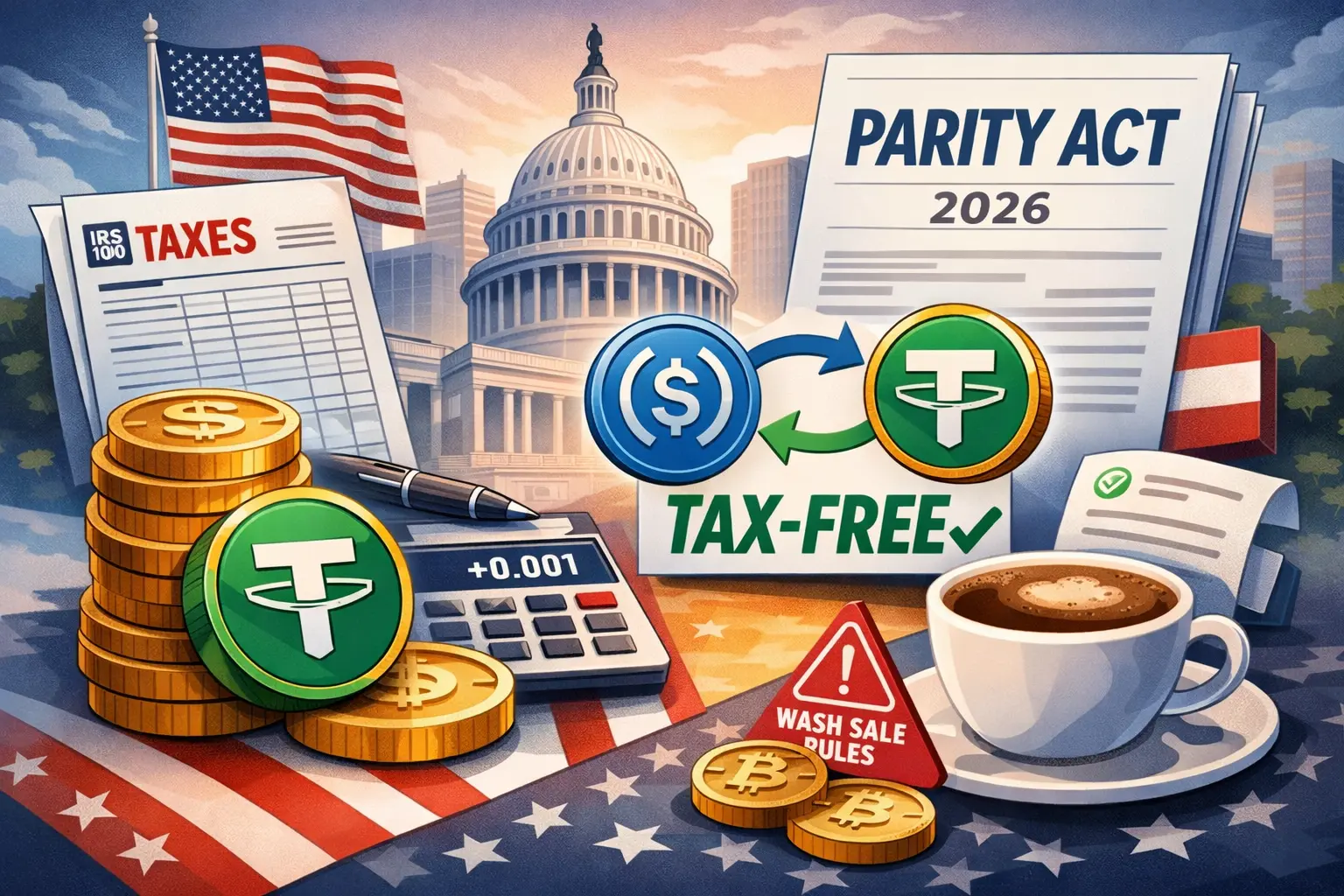
,Right now, buying a coffee with USDC is technically a taxable event in the United States. So is using USDT to pay for a subscription, settling a freelance invoice in stablecoins, or swapping one dollar-pegged coin for another. Every single one of those transactions requires the user to calculate a capital gain or loss and report it to the IRS, even when the “gain” is a fraction of a cent.
That might be about to change. A revised version of the Digital Asset PARITY Act was circulated in Congress on March 26 by Representatives Steven Horsford (D-Nev.) and Max Miller (R-Ohio), and its core proposal is simple: if you’re using a regulated, dollar-pegged stablecoin for a payment, you shouldn’t have to treat it like a stock sale. The bill aims to bring the tax treatment of compliant stablecoins in line with how people actually use them.
Why Stablecoins Get Taxed Like Investments Right Now
The IRS classifies all digital assets, including stablecoins, as property. That means every disposal triggers a capital gains calculation. If you bought USDC at $1.002 and spent it when it was worth $1.001, you technically have a $0.001 per coin loss that should be reported. If you swapped USDC for USDT at slightly different prices, same thing. The obligation exists regardless of whether any practical gain occurred.
For most people, this makes routine use of stablecoins an administrative nightmare. You’d need to track cost basis on every individual unit across every transaction, even when the price barely moves. It’s one of the main reasons that despite the stablecoin market now sitting at roughly $318 billion, everyday consumer adoption of stablecoins for payments has remained limited in the U.S. The compliance burden alone is enough to make most people stick to a credit card.
The Current Problem in Plain Terms Using USDC to buy anything is legally identical to selling a stock. Even if your stablecoin has moved by less than a penny, you owe a tax calculation on the transaction. Multiplied across hundreds of small purchases, this reporting obligation becomes completely unworkable for ordinary users.
What the PARITY Act Would Actually Change
The March 2026 draft of the PARITY Act introduces a new section of the tax code specifically for what it calls ‘regulated payment stablecoins.’ The key language reads: no gain or loss shall be recognized on the sale of a regulated payment stablecoin unless the taxpayer’s basis in that stablecoin is less than 99% of its redemption value.
In practice, what that means is this: if you’re holding USDC at approximately $1 and spending it at approximately $1, no taxable event occurs. The tiny price fluctuations that happen naturally as stablecoins drift slightly from their peg within normal market conditions would simply be ignored. Your basis is treated as $1, the sale is treated as $1, and there’s nothing to report.
For exchange transactions, the bill sets a deemed cost basis of $1 automatically. That removes the need to track what you originally paid for the stablecoin at all in most everyday scenarios.
What Qualifies as a ‘Regulated Payment Stablecoin’
Not every stablecoin would get this treatment. The bill ties the tax benefit directly to the regulatory framework established by the GENIUS Act, which was signed into law by President Trump on July 18, 2025. To qualify under the PARITY Act, a stablecoin would need to be issued by a permitted issuer under the GENIUS Act framework, be redeemable for a fixed number of U.S. dollars, and have been acquired by the taxpayer at a price within 1% of $1.00.
That last requirement is significant. It means stablecoins that have recently lost their peg, or coins that were purchased at a notable premium or discount, wouldn’t qualify. The tax benefit is designed for compliant, well-functioning, dollar-pegged payment tokens, not for distressed assets or speculative purchases. Dealers and traders in securities or commodities are also explicitly excluded.
How This Draft Differs from Earlier Versions
This isn’t the first time the PARITY Act has appeared. A discussion draft circulated back in December 2025 took a different approach. That version set a $200 de minimis threshold, meaning transactions under $200 using regulated stablecoins would be exempt from capital gains reporting. Above that threshold, normal tax rules would apply.
The March 2026 revision dropped the fixed dollar cap entirely. Rather than a per-transaction limit, the new structure focuses on the relationship between cost basis and redemption value. If your basis stays within 1% of $1, there’s no gain or loss to recognize on any sale, regardless of transaction size. That’s a broader and arguably simpler treatment than the old $200 threshold.
Whether that’s better or worse for ordinary users depends on how they use stablecoins. For high-volume payments well above $200, the new version is more favourable. For small consumer transactions, the practical difference is minimal.
| Key Change from December 2025 to March 2026 December version: $200 per-transaction de minimis exemption for regulated stablecoin payments. March version: No fixed dollar cap. No gain or loss recognised on any regulated stablecoin sale, as long as the taxpayer’s basis stays above 99% of redemption value. Both versions: Bitcoin and other non-stablecoin crypto assets are not included. |
The Wash Sale Provision: A Trade-Off for the Rest of Crypto
There’s a catch for holders of Bitcoin, Ethereum, and other non-stablecoin assets. Buried in the same bill is a provision that would extend wash sale rules to digital assets.
Wash sale rules currently apply to stocks and bonds but not to crypto. Under existing law, you can sell Bitcoin at a loss, immediately buy it back, and still claim the loss as a tax deduction. It’s a common strategy called tax-loss harvesting, and it’s been widely used by active crypto traders to reduce their annual tax bills. The PARITY Act would close that loophole, aligning crypto with the same restrictions that already apply to other investment assets.
For everyday investors who hold Bitcoin or Ethereum long-term, this probably doesn’t change much. But for traders who actively use tax-loss harvesting strategies, it’s a meaningful tightening. The bill also draws a distinction between passive staking and active trading, treating them differently for tax purposes, which reflects a growing recognition that lumping all crypto activity into one category makes little sense.
Where the Bill Stands and What Comes Next
It’s important to be clear about what the PARITY Act is and isn’t right now. it’s a discussion draft. It’s been circulated for review, not introduced as a formal bill with a vote scheduled. It still needs to move through committee, survive debate, and clear both chambers before anything in it becomes law.
The timing, though, isn’t accidental. Congress is expected to take up major tax legislation later in 2026, potentially through reconciliation, and crypto advocates have been pushing hard to get digital asset provisions attached to that vehicle. With the GENIUS Act already signed and a regulatory framework for stablecoins now in place, the PARITY Act’s sponsors are positioning this as the logical next step: once you’ve decided what a compliant stablecoin is, you should also decide how to tax it.
Industry reaction has been broadly positive. For years, the absence of a sensible tax framework has been cited as one of the biggest practical barriers to stablecoin adoption for payments. If using USDC to pay for something is no different from using a debit card in terms of tax complexity, the argument for wider adoption becomes a lot stronger. Whether that argument persuades enough of Congress remains to be seen.
What This Could Mean for Stablecoin Users in the U.S. If the PARITY Act passes in its current form, everyday payments made with qualifying stablecoins like USDC would no longer trigger capital gains reporting. Swapping USDT for USDC would use a deemed $1 basis. Tax-loss harvesting on Bitcoin and other volatile crypto would be restricted under wash sale rules. The bill doesn’t affect how gains on volatile assets like Bitcoin are taxed.
What Canadian Crypto Holders Should Know
This is U.S. legislation, so it doesn’t directly affect Canadian tax rules. The CRA treats stablecoins the same way it treats any other cryptocurrency, as a commodity. Which means every disposal is potentially taxable regardless of how stable the price is. A Canadian using USDC to pay for something still triggers a capital gains calculation under current CRA guidance. There’s no equivalent of the PARITY Act being proposed in Canada right now.
That said, U.S. tax policy tends to influence global conversations about how digital assets should be treated. If Washington formally separates the tax treatment of payment stablecoins from speculative crypto assets, it creates a framework that other jurisdictions may look to as a model. It’s worth watching.
For now, if you’re in Canada and using stablecoins, the rules haven’t changed. Keep tracking your transactions, record your cost basis, and report disposals on Schedule 3 of your T1 return. For a full breakdown of how the CRA taxes cryptocurrency, read our guide: Crypto Taxes Canada 2026.
The Quick Summary
- The PARITY Act (March 2026 draft) would make most regulated stablecoin transactions tax-free in the U.S. by recognising no gain or loss when basis stays within 1% of $1.
- Only GENIUS Act-compliant stablecoins qualify. Assets that have lost their peg or were bought at a significant premium are excluded.
- The previous $200 de minimis threshold was dropped in favour of a basis-to-redemption-value test. The new approach is broader.
- Bitcoin and other volatile assets are not covered and would actually face tighter rules through new wash sale restrictions.
- It’s still a discussion draft. Nothing is law yet. The bill’s fate depends on broader tax legislation expected later in 2026.
- Canadian rules are unchanged. CRA still treats stablecoin disposals as taxable events. Track everything.
This article is for informational purposes only and does not constitute tax or legal advice. Canadian readers should note that U.S. tax legislation does not affect CRA rules. Always consult a qualified tax professional for advice specific to your situation.