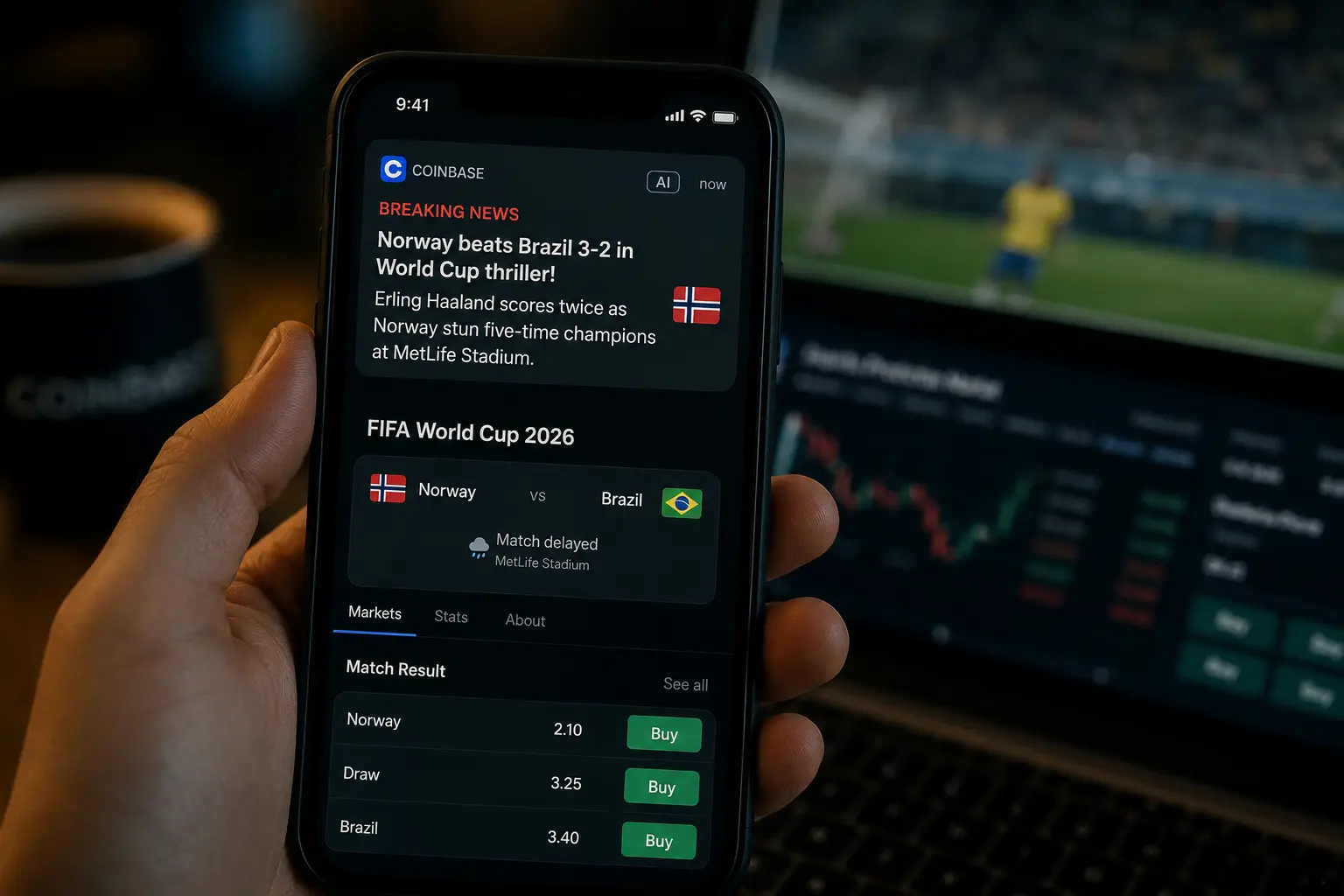
On July 5, 2026, a coinbase AI prediction market notification told users that Norway had beaten Brazil 3-2 in a World Cup knockout match. It claimed Erling Haaland scored twice at MetLife Stadium. There was just one problem. The match hadn’t even started yet.
At the time the alert went out, the game was sitting under a weather delay. In fact, Coinbase’s own prediction market page correctly showed the match as delayed. So the app was simultaneously telling users the game was over and showing it hadn’t begun. That contradiction set off a firestorm of criticism across social media and raised real questions about how AI-generated content interacts with live financial products.
What the Coinbase AI Prediction Market Error Got Wrong
Here’s what actually happened. A user named jay_drainjr posted screenshots on X showing the alert, which was styled as “breaking news” and carried an AI badge. It ran under a headline about Haaland stunning five-time champions Brazil. Beneath the fabricated alert sat genuine, live prediction markets on the same fixture.
CEO Brian Armstrong responded within hours, writing that he was looking into it with his team. Coinbase later confirmed it had made updates to prevent similar AI-generated inaccuracies. However, no detailed postmortem has been published as of this writing. Key questions remain unanswered: how many users saw the notification, whether anyone traded based on it, and which system generated the false result.
For context, the actual match did end with Norway winning, but the final score was 2-1. Haaland did score twice. So the AI got the winner right and the scorer right, but invented a specific score line and published it hours early. That’s a textbook example of a large language model hallucination, and it happened inside a regulated financial app.
Why This Matters More Than a Simple Notification Bug
In most consumer apps, a wrong sports score is embarrassing. Fix it, apologize, move on. But Coinbase isn’t just a news app. It’s a registered financial platform that offers event contracts tied to match outcomes, tournament results, and player performance.
When information and trading sit side by side, a false alert can shape user decisions. Prediction markets are contracts whose value shifts as participants react to new data. If someone sees a “breaking news” alert claiming an event has already occurred, they might place or exit a trade based on that information. Even if no trades were directly influenced, the product design has exposed a serious vulnerability.
This incident also clashes directly with how Armstrong has positioned the product. Back in January, he described prediction markets as a reliable way to surface truth, arguing that financial stakes produce better information than traditional media. Those words now sit beside an AI system that fabricated a result and broadcast it as news.
Coinbase rolled out its crypto FIFA World Cup 2026 prediction markets to U.S. users earlier this year through a partnership with Kalshi. Sports markets now sit alongside spot crypto trading, wallets, and consumer finance tools inside the same app. That makes any content failure travel faster and feel more authoritative than it would on a standalone platform.
CFTC Scrutiny Adds Pressure to the Coinbase AI Prediction Market
The timing couldn’t be worse. Regulators are already paying close attention to prediction markets. On June 10, 2026, the CFTC published a proposed rule covering event contracts on prediction markets and public interest determinations. That proposal lays out a framework for market integrity, manipulation prevention, and clear settlement terms.
Most of those requirements focus on the contracts themselves. But the Coinbase incident points to something above the contract layer. Even if a market’s settlement criteria are objective and well-defined, misleading content around the market can still distort user behaviour before settlement occurs.
Additionally, a Congressional Research Service report has outlined how prediction markets raise policy issues for Congress, including questions about regulatory arbitrage between federal derivatives rules and state gambling laws. New York recently sued Coinbase and Gemini over their prediction market offerings, and the regulatory perimeter remains contested in Washington.
A consumer-facing AI error of this kind hands critics a concrete exhibit. It also arrives at a moment when combined monthly volumes across major prediction market platforms reached an all-time high of $44.8 billion in June, driven heavily by World Cup interest.
World Cup Volumes Show the Scale of Risk
Sports prediction markets have exploded during the 2026 World Cup. According to multiple reports, Polymarket’s tournament market alone has topped $3.9 billion in volume. Coinbase has been actively competing for a share of that activity through its “everything exchange” strategy.
The exchange has also added stock options, pre-IPO markets, and an AI adviser as it tries to fold more financial activity into one app. Nearly 40% of Coinbase’s core daily code is now generated by AI assistants, according to Armstrong. That aggressive adoption of automation makes the World Cup alert more than an isolated glitch. It’s a signal about how quickly AI-generated outputs can reach millions of users without adequate verification checkpoints.
This incident also follows an earlier notification bug in March, when Coinbase pushed unwanted trading alerts to a wide group of users. At that time, Armstrong dismissed calls for heavier moderation, calling such measures paternalistic.
What Coinbase AI Prediction Market Controls Should Look Like
So what should exchanges actually do? At minimum, a trading app that uses automated alerts around event markets needs to show the source of any claim, when it was verified, the status of the underlying event, and whether the alert was generated or approved by a human.
A simple “AI” badge isn’t enough if it doesn’t tell users whether the event itself has been resolved. A practical standard would separate at least four states: rumour, scheduled event, live event, and officially resolved result. Users shouldn’t need to infer those states from a push notification’s wording.
Speed is valuable in prediction markets, but only if proof travels with it. If an alert pipeline runs faster than its verification pipeline, the product can push users toward a claim before any reliable source has confirmed it as fact.
Exchanges operating coinbase AI prediction market products, or anything similar, will need to log data sources for every event alert. They’ll need to timestamp when a result becomes eligible to be described as final. Commentary must stay separate from official settlement language. And audit trails for any push notification tied to a tradable market should be mandatory.
These controls might slow down the alerts that make consumer apps feel timely. That’s the tradeoff. If an exchange picks speed over accuracy, it risks turning its alert layer into an unpriced part of the market structure.
The broader lesson from this incident is already clear. Prediction markets can only function as truth-seeking tools if users can distinguish among a forecast, a report, and a verified outcome. As exchanges add AI summaries and real-time alerts, the next competitive advantage won’t come from listing the most markets first. It’ll come from showing the fastest proof without asking users to trust a black box.
If you’re trading on event outcomes or just following the intersection of AI and crypto, this story is worth watching closely. How Coinbase responds to this incident will likely set expectations for every exchange running prediction markets going forward.