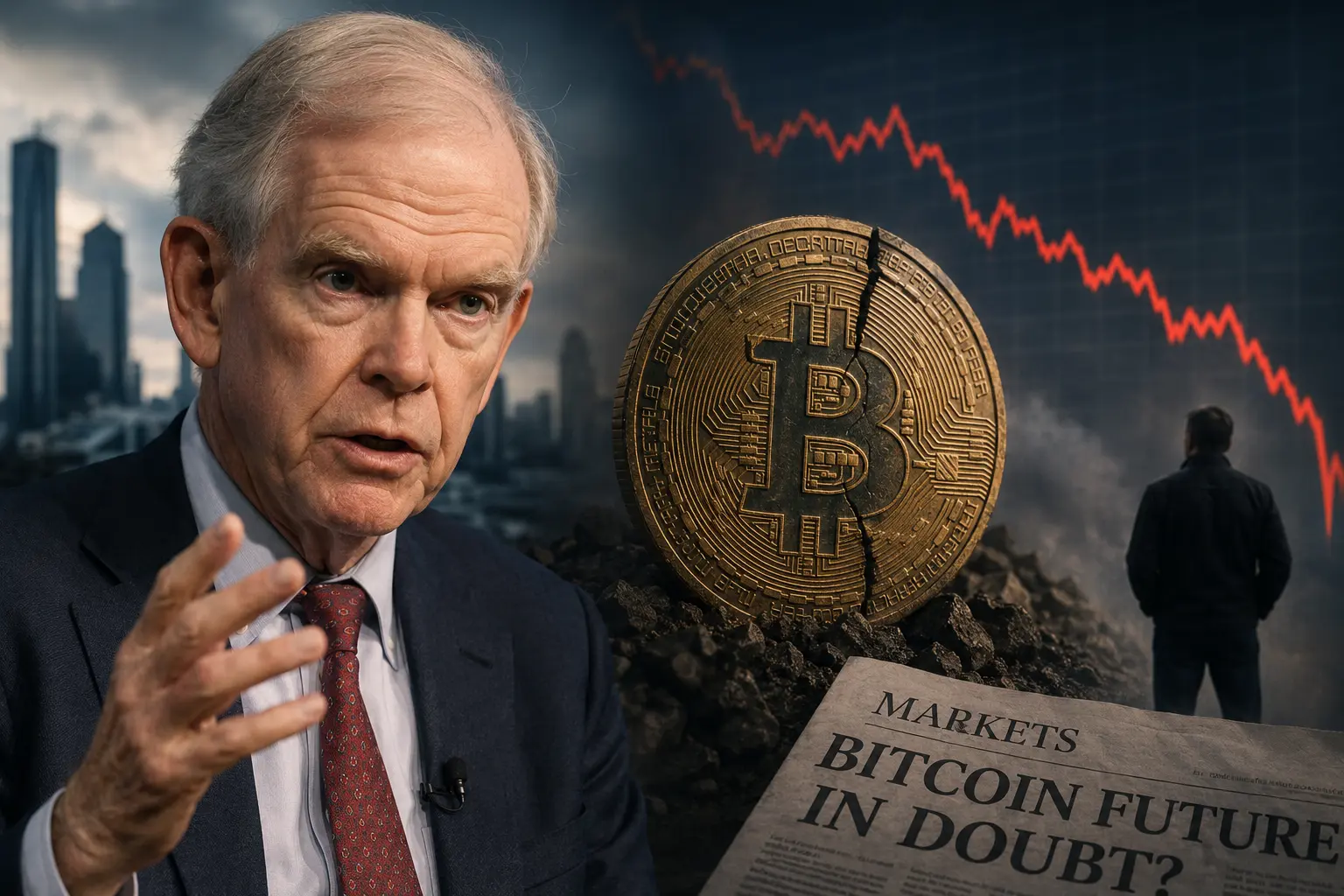
Jeremy Grantham has never been shy about telling the market what he thinks. The co-founder of Boston-based asset management firm GMO appeared on CNBC’s Squawk Box on June 26. His Jeremy Grantham Bitcoin prediction landed exactly as expected: blunt, sweeping, and backed by decades of bubble-spotting credibility. He called Bitcoin a “useless, speculative mechanism” and predicted it would fade not through a sudden crash but over years and decades.
“Over years and years, decades and decades, it will dwindle away, I suspect,” he said. “Not with a bang, but a whimper.”
What the Jeremy Grantham Bitcoin Prediction Actually Says
Grantham’s case rests on three specific criticisms. First, he argues Bitcoin has no intrinsic value. It pays no dividend, generates no cash flow, and produces nothing. Second, he says it fails as a store of value because it can lose half its price during a strong economy with no obvious trigger. Third, he insists it doesn’t work as a practical currency. “People don’t use it to buy dinner or pay at the supermarket,” he said plainly.
His framing of the decline is deliberate. Grantham isn’t predicting a catastrophic single-day crash. Instead, he sees a slow erosion of interest over time, as better alternatives emerge and investor attention migrates elsewhere. Think MySpace, not Lehman Brothers. The asset doesn’t explode; it just gets ignored.
He also took a shot at Bitcoin’s proof-of-work design, arguing that the energy miners consume produces no economic benefit. “Proof of unnecessary work shouldn’t be worth a bucket of warm spit,” he said.
Grantham’s Track Record Matters Here
This isn’t background noise from just another skeptic. Grantham correctly identified warning signs ahead of the dot-com crash in 2000 and the US housing collapse in 2007. His firm, GMO, manages roughly $85 billion and has built its reputation on disciplined bubble identification and mean-reversion investing. When he says a market is overvalued, traditional finance tends to listen.
That said, timing has always been his weakness. His 2021 “epic bubble” warning on US equities arrived early. Stocks climbed before their 2022 correction. Bitcoin bulls will note a similar pattern: Grantham has held his negative view since at least 2017, during which time BTC made several round-trips from five figures to six figures and back. Being right eventually and being right on schedule are very different things.
His broader warnings in this same CNBC appearance also add context. Grantham simultaneously argued that US stocks sit at the most expensive levels in American history. He warned an AI bubble could wipe out 70% of equity values. For Grantham, crypto is one piece of an overheated market headed for a painful reset across multiple asset classes.
The institutional side of the Bitcoin story paints a sharply different picture, though. Major custody infrastructure has been quietly maturing throughout 2026. Our recent piece on how a regulated bitcoin custody provider just hit the Fortune 500 covers exactly the structural development Grantham’s framework doesn’t account for.
Jeremy Grantham Bitcoin Prediction vs. the Counter-Case
Bitcoin advocates push back on each of Grantham’s three criticisms, and those pushbacks aren’t trivial.
On intrinsic value: gold also pays no dividend and generates no cash flow. Grantham concedes gold is a valid store of value. Bitcoin proponents argue its fixed supply of 21 million coins, combined with growing institutional custody, makes it functionally comparable to gold as a scarce, portable asset. Grantham actually prefers gold here. He pointed out that gold rose to a new all-time high above $5,500 per ounce earlier this year, while Bitcoin fell roughly 52% from its October 2025 peak of $126,080. His point: in a strong economy, gold held up and Bitcoin didn’t.
On stability: Grantham’s critique is that Bitcoin halved for no particular reason. That’s a fair characterisation of the recent drawdown. But Bitcoin has also recovered from every crash in its history, each time building from a higher base than the prior cycle low. Whether that pattern continues is the central question, and no one knows the answer.
On practical use: this is where his argument is weakest in 2026. Bitcoin is increasingly used not at the supermarket but as a treasury asset, a settlement layer, and a national reserve. El Salvador’s ongoing national Bitcoin program is a concrete counterexample to the idea that the asset has no state-level role. We covered that story in depth in our piece on how El Salvador’s Bitcoin law just turned five, and the country is still adding to its position.
What Bitcoin’s Price Tells Us About the Jeremy Grantham Bitcoin Prediction
As reported by Decrypt, Grantham made his case as Bitcoin was trading around $60,500, down roughly 52% from its October 2025 all-time high of $126,080. He used that drawdown as direct evidence for his store-of-value critique. Gold, by comparison, had risen to a new all-time high above $5,500 per ounce earlier in the year, and still showed a net positive trend over the same period.
The timing gives Grantham a stronger-than-usual platform. When Bitcoin is near all-time highs, dismissing it sounds contrarian. When it’s down 52% from its peak during a period of economic expansion, the critique lands harder. Crypto markets have absorbed bearish views from Jamie Dimon, Warren Buffett, and Peter Schiff without those predictions proving correct on schedule. But none of those skeptics have Grantham’s specific track record of calling major asset bubbles accurately.
US spot Bitcoin ETF flows add short-term weight to his case too. Galaxy Research data shows ETFs posted a record 30-day net outflow of $6.35 billion through mid-June, reflecting a meaningful pullback in institutional appetite.
What the Bitcoin Critics Keep Getting Wrong
The honest version of where this lands is straightforward. Grantham is raising legitimate questions in a market that has historically dismissed every version of them too quickly. His arguments about volatility, yield, and daily utility point to real weaknesses in Bitcoin’s case as a traditional store of value. His framing of a slow fade rather than a sudden collapse is also more interesting than the standard bear case, because it’s harder to disprove quickly.
But the Jeremy Grantham Bitcoin prediction also collides with structural realities he doesn’t fully address. Spot ETFs now give institutional investors regulated, audited access to BTC through standard brokerage accounts. Sovereign nations are holding it on their balance sheets. BlackRock and Fidelity have active custody products. The technical side of crypto continues developing rapidly. Our coverage of AI-powered security tools reshaping blockchain infrastructure captures how the space is evolving faster than most traditional finance analysts track.
As noted on CNBC, Grantham did concede one point: blockchain rails could play a meaningful role in future financial infrastructure. His fire is aimed squarely at Bitcoin and other crypto assets, not the underlying technology. That distinction matters when weighing his prediction against the actual pace of adoption.
Bitcoin has already survived seventeen years and multiple rounds of the “dwindle away” argument. It’s trading above $60,000, which isn’t the profile of an asset quietly dying. Whether the next seventeen years look the same is a genuinely open question. What isn’t open is whether Grantham’s views deserve serious attention. His record is too strong and his reasoning too specific for that.
The debate isn’t settled. It’s just getting more expensive to be wrong on either side.