
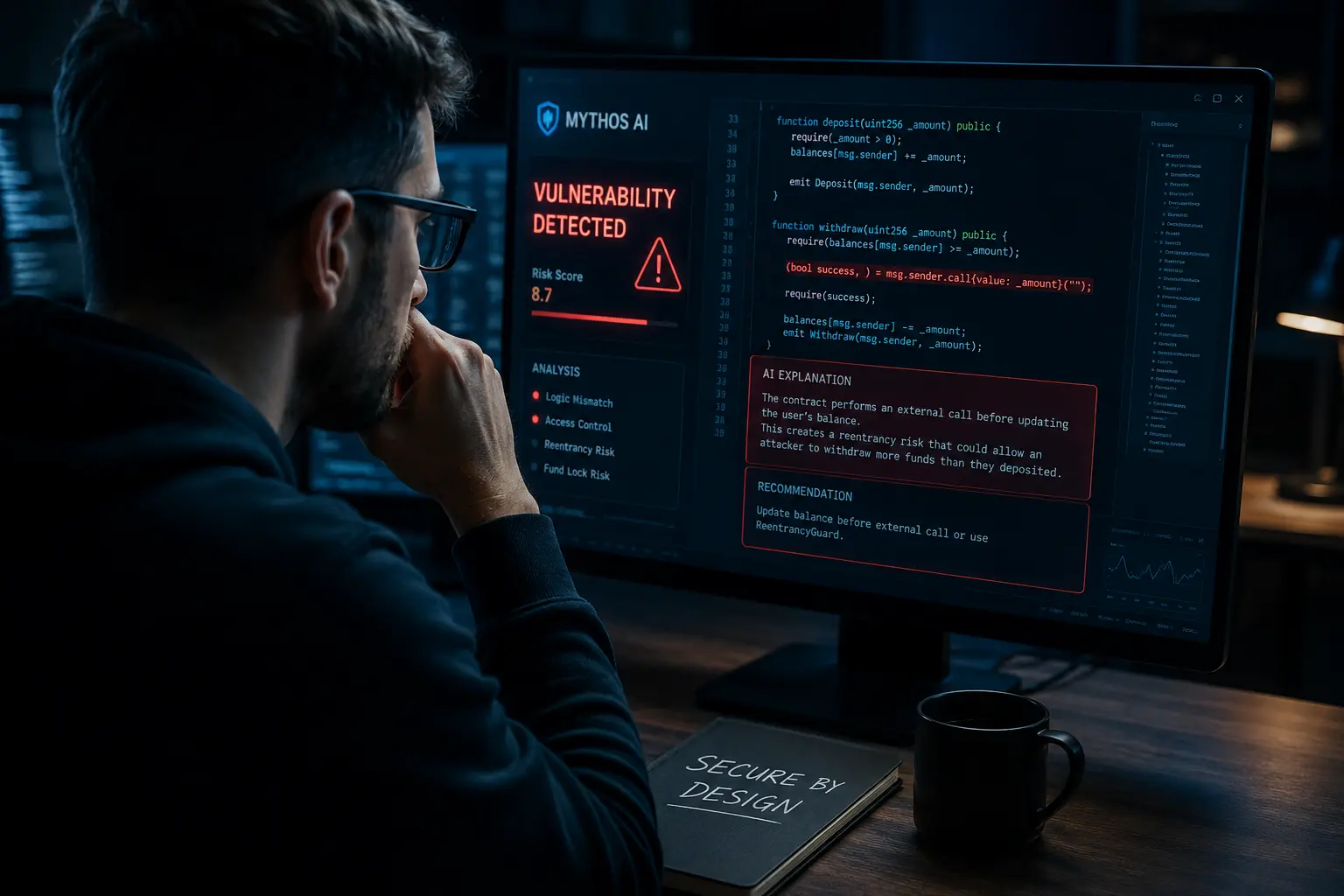
A new wave of AI crypto security tools is forcing blockchain projects to rethink what responsible due diligence looks like. The launch of Mythos, an AI system built to find code vulnerabilities autonomously, has sparked a serious debate about whether traditional audit practices can keep up.
What Mythos Actually Does
Mythos isn’t a smarter version of existing scanning tools. Rather than checking code against a known list of bugs, it can infer what a smart contract was meant to do and compare that against what it actually does. Researchers say that capability could meaningfully expand the industry’s ability to catch problems before deployment.
David Schwed is COO of blockchain security firm SVRN and founder of the cybersecurity master’s program at Yeshiva University. He described the shift plainly. “These models now operate the way a human attacker does,” he said. “They iterate, they take the next step based on what they’re seeing in real time. The older tooling was just complicated deterministic flows.”
AI Crypto Security Tools and the Cost of Auditing
Here’s where the practical impact gets interesting. Schwed pointed to a shift that may matter more than raw vulnerability detection. The real change, he argued, is continuous security monitoring at a fraction of what traditional point-in-time reviews cost.
Standard smart contract audits are expensive and slow. AI crypto security tools promise something different: constant checks, not just a pre-launch review. For smaller DeFi projects that can’t stretch to top-tier audit firms, that cost shift could be significant.
Anthropic prices its Mythos-era models at a premium over previous versions. Still, continuous AI-driven auditing may work out cheaper than the alternative. A successful exploit tends to cost a lot more.
AI Crypto Security Tools and the Human Judgment Gap
Not everyone is convinced AI solves the core problem. John Urbelis, a researcher cited in the CoinDesk reporting, made a point worth taking seriously. “The bugs that drain treasuries often turn on intent and adversarial incentives,” he said. “Those still need an experienced human in the room.”
Schwed made a similar caution. Simply prompting a model to audit a contract and trusting the output isn’t a security programme. If the person reviewing the results can’t evaluate what comes back, they haven’t bought real security. They’ve bought a false sense of it.
That gap between AI output and human interpretation matters a lot. It’s especially relevant for the kinds of exploits that have caused crypto’s biggest losses.
AI Crypto Security Tools Won’t Catch Everything
When researchers looked at crypto’s most costly incidents, a clear pattern emerged. Many of the largest hacks didn’t come from smart contract bugs at all. The compromise of Drift, for example, came from a months-long social engineering campaign targeting trusted contributors, not the protocol’s code.
Schwed pointed to Ronin and Bybit as similar cases. Compromised keys and manipulated signing processes played the central roles in both. Smart contracts in those incidents did exactly what they were told. The problem was who was giving the instructions.
Beyond social engineering, Mythos has also shifted attention toward infrastructure risk. Key management systems, oracle networks, and bridge designs have historically sat outside standard audit scope. As CBC News has reported in covering Canada’s blockchain sector, the industry is coming to understand that security risks extend well beyond the smart contract layer, into the infrastructure protocols depend on.
AI Crypto Security Tools and the Arms Race Problem
Here’s the uncomfortable reality underneath all of this. The same capabilities that make AI useful for defence also make it useful for attack. Elliptic CEO Simone Maini warned in May 2026 that AI is making it cheaper and easier for bad actors to run hacks and fraud at a scale compliance teams can’t match.
Ledger CTO Charles Guillemet made a similar argument in April. Tasks that once took skilled attackers months can now be done in seconds. Defenders need access to equivalent AI crypto security tools if they’re going to keep pace.
That pressure explains why Coinbase, Binance, and Uniswap have all reportedly sought early access to Mythos-class models. As the Financial Post has noted in covering digital asset security the protocols that survive this shift will likely be those with the best defensive tools, not those that passed last quarter’s audit.
What This Means for Developers Right Now
The reality is simple: the bar for security is rising, and it’s not coming down. If you’re building on-chain, assuming that a single audit before launch is enough protection is becoming a risky bet. AI crypto security tools have changed the calculus entirely.
Continuous monitoring isn’t a luxury feature anymore. It’s the baseline that serious projects will need to compete on. Teams that move in that direction now will have time to integrate these tools properly, understand their output, and build the human expertise around them. Those that wait will be scrambling to catch up while their competitors have already moved on.