
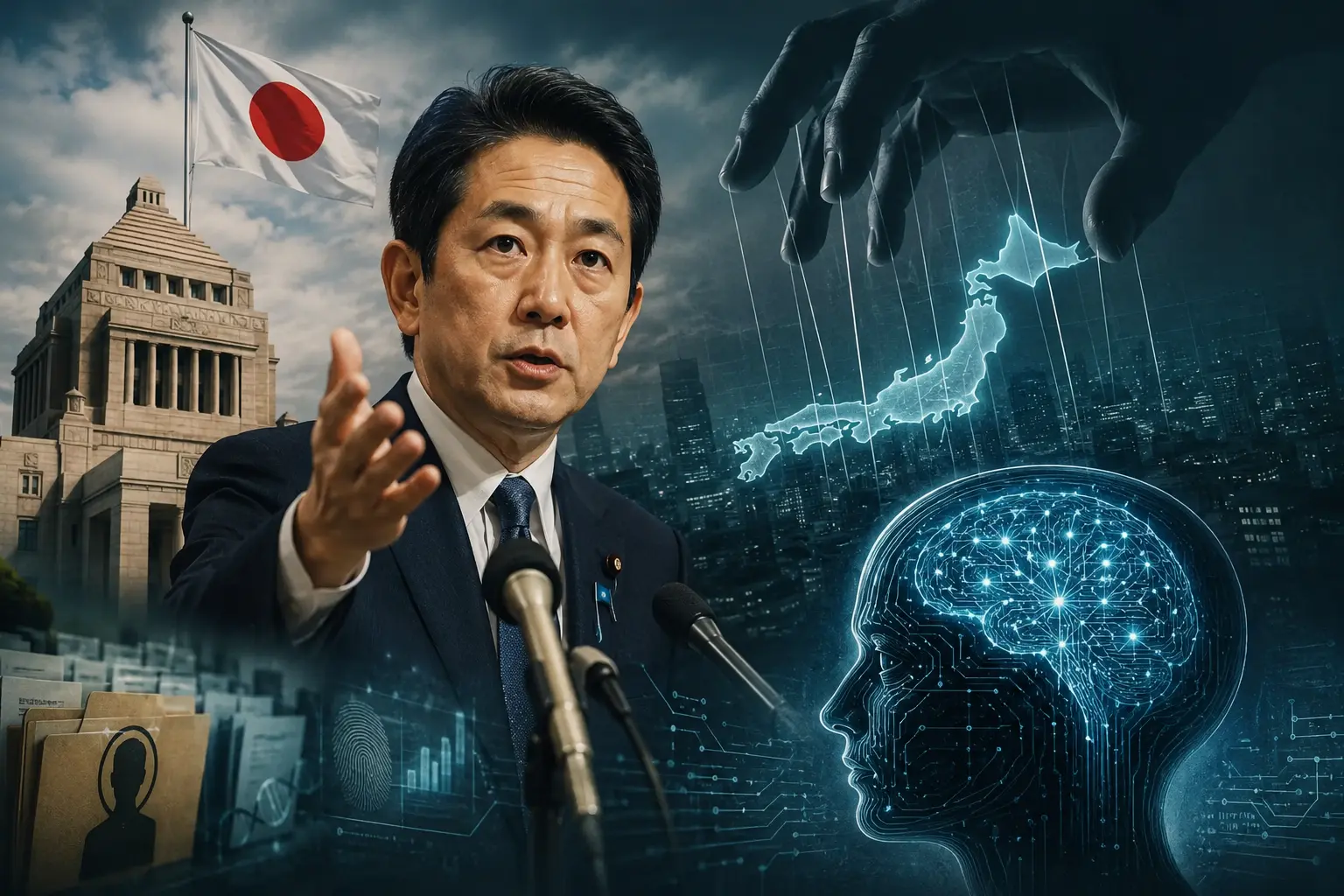
Japan’s Digital Minister has a stark warning: fall behind on AI, and Japan becomes an AI colony. That phrase landed hard in parliament last week. It’s cracking open one of the most significant tech policy fights the country has seen. At the centre of it is a bill with serious implications. It would let AI developers train models on sensitive personal data without consent. That includes medical records and criminal histories. The Japan AI colony debate isn’t just about privacy. It’s about who controls the future of technology. And whether smaller economies can compete at all.
Japan AI Colony Fear: What the Minister Actually Said
Japan’s Digital Minister Hisashi Matsumoto made the remarks at a press briefing on Friday. He was defending a bill working its way through the upper house. His argument was blunt. Without faster AI development, Japan will end up dependent on foreign systems. It will lose control over its own data and infrastructure. And ultimately, its economic future too.
“I hope many Japanese people understand that we need to press ahead with AI development, or we’ll end up becoming an AI colony,” Matsumoto told reporters.
It’s a provocative choice of words. And a deliberate one. Matsumoto is trying to reframe the debate entirely. Instead of talking about data rights, he wants the public focused on national competitiveness. Whether that framing lands with voters is another question.
The Bill That’s Splitting Parliament
The amendment already cleared Japan’s lower house last week. Now it’s in the upper chamber, where opposition lawmakers are pushing back hard. Their concern is straightforward: opening up access to medical records and criminal histories for AI training purposes is an invitation to data breaches. They argue it would gut privacy protections that citizens have a right to expect.
Matsumoto has responded by saying the bill limits expanded data access strictly to statistical use cases tied to AI development, and that it won’t lead to personal information leaking. Critics aren’t convinced. The worry isn’t just about what the bill says — it’s about what happens when systems fail, or when the data ends up in the wrong hands. This tension between innovation and individual rights is one that countries around the world are wrestling with. Canada is no exception: its own AI minister recently said the goal is to build trust in artificial intelligence as a cornerstone of its forthcoming national AI strategy.
Japan AI Colony Risk Is Backed by Real Numbers
To understand why Matsumoto is so worried, start with the investment data. Between 2019 and 2023, the United States poured roughly $329 billion into domestic AI research. China, meanwhile, invested around $133 billion. Japan, by contrast, managed about $10 billion. That’s not a gap – it’s a chasm.
Unsurprisingly, that kind of disparity is what makes the Japan AI colony framing feel less like hyperbole and more like a genuine policy concern. After all, when the infrastructure powering your economy’s most important systems is built, owned, and maintained by foreign companies, the question of sovereignty becomes very real. Still, analysts debating AI independence often land on a similar point: as The Globe and Mail noted, no country can own the entire AI stack, but middle powers still need a credible strategy for the parts that matter most.
Why This Matters Beyond Japan
Japan isn’t alone in this bind. Governments across the developed world are trying to figure out how to compete with the US and China on AI without sacrificing the privacy frameworks their citizens depend on. It’s a genuine dilemma, and there’s no clean answer.
What makes the Japanese situation particularly pointed is the scale of the investment gap. A country that spent $10 billion on AI over four years isn’t just behind — it’s in a different race entirely. Catching up will require either massive new public investment, private sector mobilisation, or rule changes that make Japan a more attractive place to develop AI. Matsumoto’s bill is an attempt at the third option.
Whether that’s the right trade-off is a debate worth having. Much of modern tech infrastructure, from decentralised finance to blockchain technology, has been built precisely on the premise that data transparency and individual control matter. Loosening those protections — even in the name of competitiveness — sets a precedent that’s hard to walk back.
What Happens Next
For now, all eyes are on Japan’s upper house. If the bill passes, it’ll signal that economic urgency is winning out over privacy concerns — at least in the short term. If, on the other hand, it fails or gets significantly amended, it’ll be a meaningful rebuke of Matsumoto’s framing, and the Japan AI colony debate will continue without a resolution.
Either way, the conversation Japan is having right now is one that every developed economy will eventually face. Beyond Japan’s borders, the question of who controls data, who trains the models, and who benefits from AI isn’t going away. In fact, Japan just happens to be having it loudly, in public, and with real stakes.
As a result, this isn’t just a story about one country’s data bill. It’s a preview of the policy fights coming everywhere. Follow our tech coverage for ongoing updates on AI regulation, data privacy policy, and how governments around the world are responding to the revolutionising of finance and technology by artificial intelligence.
Disclaimer: This article is for informational purposes only and reflects publicly available reporting at the time of writing.